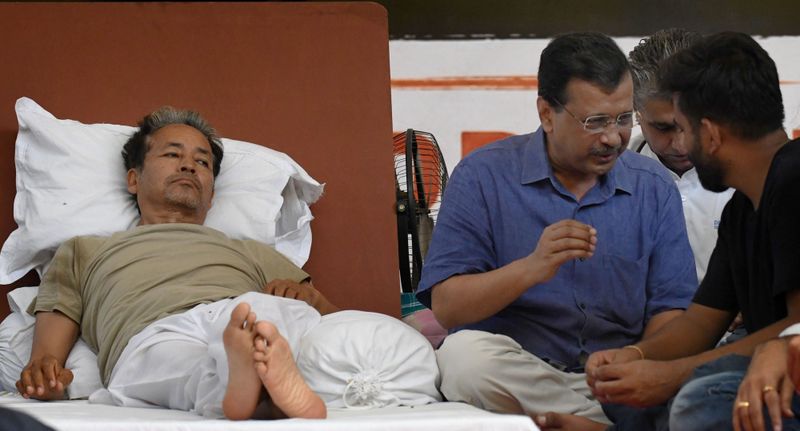

The Delhi High Court on Thursday directed the Centre and the Delhi Government to ensure that activist Sonam Wangchuk, who has been on an indefinite hunger strike at Jantar Mantar, undergoes a daily medical examination by government doctors and that all necessary medical intervention is undertaken, if required, to safeguard his life.A Division Bench of Chief Justice Devendra Kumar Upadhyaya and Justice Tejas Karia passed the direction after Solicitor General Tushar Mehta, appearing for the Centre and the Delhi Government, informed the court that Wangchuk’s health would be monitored daily by government doctors and that appropriate medical treatment would be provided depending on their assessment.Recording the submission, the Bench observed that every citizen’s life was of paramount importance and that the authorities were duty-bound to make every possible effort to preserve it. Appreciating the stand taken by the Solicitor General, the court directed that Wangchuk’s medical condition, both clinical and otherwise, be monitored regularly on a daily basis.The order came on a public interest litigation filed by advocate Rakesh Kumar Saini, who sought urgent judicial intervention to save Wangchuk’s life. The petitioner urged the court to direct the authorities to shift the activist to a government hospital and administer medical treatment, including force-feeding if necessary.According to the petition, Wangchuk has been on an indefinite fast since June 28 after joining protests organised by the Cockroach Janta Party (CJP), which has been demonstrating at Jantar Mantar since June 20, demanding the resignation of Union Education Minister Dharmendra Pradhan over alleged question paper leaks and irregularities in the education system.The petition claimed that Wangchuk’s health had deteriorated significantly during the fast, alleging that he had lost around 8.5 kg and warning that his life could be at serious risk if the hunger strike continued. It argued that any loss of life would bring disrepute to the country and urged immediate medical intervention.The plea further alleged that the government was treating Wangchuk like “a hardcore criminal, terrorist or traitor” instead of ensuring adequate medical care. It contended that, at the very least, the authorities should provide medical attention even without his consent if that was necessary to save his life. The petitioner also argued that Wangchuk should be shifted to a government hospital where he could be administered essential nutrients, vitamins and minerals through a liquid diet.During the hearing, the Bench asked the Solicitor General whether Wangchuk was undergoing regular medical examinations and whether reports of such examinations were available.Mehta submitted that Wangchuk’s health was being checked every day whenever he permitted government doctors to examine him. He said private doctors also occasionally examined the activist and assured the court that medical reports could be prepared and placed on record.Observing that preservation of life was of utmost importance, the Bench said it wanted Wangchuk to be examined regularly by government doctors before proceeding to issue directions for continuous monitoring of his health.