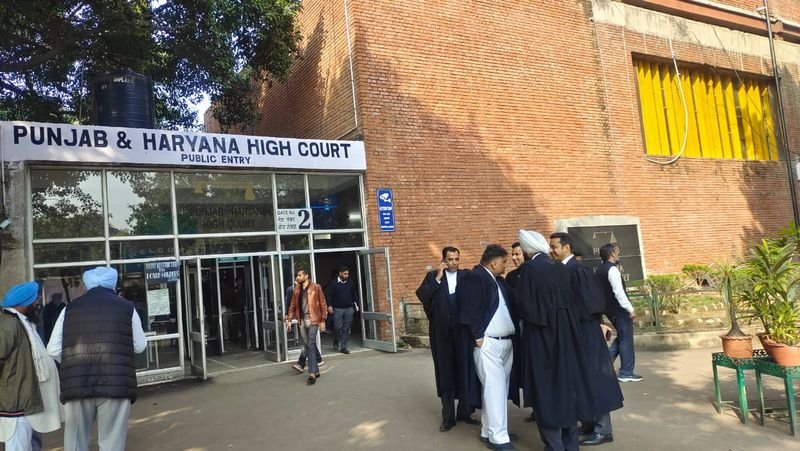

The Punjab and Haryana High Court has admonished the States and UT Chandigarh over a glaring gap between compliance claimed on paper and actual implementation of safeguards against unnecessary arrests. The Bench also directed one police station each in Punjab, Haryana and Chandigarh to produce actual records to demonstrate the implementation of the safeguards, while making it clear that compliance would not be established by merely placing Standard Operating Procedures (SOPs) on record“It seems that despite the detailed directions issued time and again by the Courts, much compliances have been made on paper, and affidavits after affidavits have been filed, but minimal has been actually done on ground,” Justice Sudeepti Sharma asserted.The direction came on a bunch of contempt proceedings concerning alleged violations of the safeguards laid down by the Supreme Court in “Arnesh Kumar v. State of Bihar” and subsequently reiterated in “Satender Kumar Antil v. Central Bureau of Investigation”Justice Sharma referred to the pending contempt proceedings as “live” examples, “wherein the notices issued are not in the prescribed format/no acknowledgment is being issued/even the detention is being authorised without ensuring compliance of the mandate of Arnesh Kumar’s case”.Justice Sharma added the States’ senior officers filed affidavits placing their SOPs on record, while claiming commitment to comply with the judicial directions “in its true letter and spirit” after notices were issued in the contempt proceedingsPunjab Chief Secretary’s affidavit rejectedThe affidavit filed by Punjab Chief Secretary K.A.P. Sinha was rejected after Justice Sharma found that the annexures were “not even legible”. “This is a very sad state of affairs that the official of such a higher rank is filing such kind of affidavit, annexures attached to which are not even legible,” the Bench asserted, before directing the filing of a fresh affidavit.Court says mere SOPs cannot demonstrate complianceThe Court recorded amicus curiae Ankur Mittal’s submission that its September 9 order had specifically required the authorities to demonstrate how the directions in Antil’s case were being complied with “in its true letter and spirit” and to place the relevant proforma on record.“However, as expected and as apprehended, the spirit of the order which contained clear directions has itself been crushed with the filing of so-called compliance affidavits by adopting same old bureaucratic approach of filing papers, without realization that SOP are already on record,” Mittal submitted.The amicus submitted that filing mere SOPs, when the authorities had been called upon to show actual compliance, “is nothing but amounts to carrying out a farce exercise which looks rosy on surface but is far from the actual realities”.Court demands actual implementation mechanismAfter perusing the affidavits, the court found that “yet again, the States/UT have placed on record the SOP of different dates showing the compliance, whereas in reality, none of the affidavit(s) shows the actual compliance”.Justice Sharma asserted the material before it could not be ignored, particularly as the proceedings disclosed instances prima facie indicating non-compliance with the safeguards mandated by law. “This court cannot shut its eyes to the material available on the record, particularly when the very proceedings before it discloses instances which prima facie indicate non-compliance with the safeguards mandated by law and reiterated by the Supreme Court of India. The discrepancy between the compliance projected on paper and the actual material placed before the Court necessarily pricks the judicial conscience and warrants a deeper examination of compliance at the operational level”.Justice Sharma clarified that what it had sought was “substantially more than the mere production of SOP”, since the SOPs were already available on record.Three police stations ordered to produce recordsThe SHO of Phase-I police station, Mohali, Sector 11 police station, Chandigarh, and Sector 5 police station, Panchkula, were directed to appear in Court with the actual records after issuance of the SOPs. Justice Sharma made it clear that the record must include indexed booklets containing serial-numbered notices in triplicate carbon-copy format; carbon copies of actual notices issued along with the case diary; proof of acknowledgment in the prescribed format; year-wise registers maintained at the police stations containing relevant details of notices issued by Investigating Officers; and proof of actual service of each notice, including acknowledgment.They were also directed to produce a separate statement of cases where, notwithstanding issuance of notice and compliance with it, arrest was subsequently effected, along with the reasons recorded by the concerned police officer, the material forming the basis for the arrest and documents placed before the jurisdictional Magistrate. The case files of cases in which arrest was effected without issuance of notice are also to be produced, along with “the reasons and material justifying such course”.The DGPs of Punjab, Haryana and Chandigarh were directed to ensure production of the records and the rules framed for preservation and destruction of the used booklets containing details of notices issued in the police stations, as directed in “Satender Kumar Antil”. The Court further made it clear that the police officers directed to appear “must be well versed with the actual procedure/compliances being made in their respective police stations”.