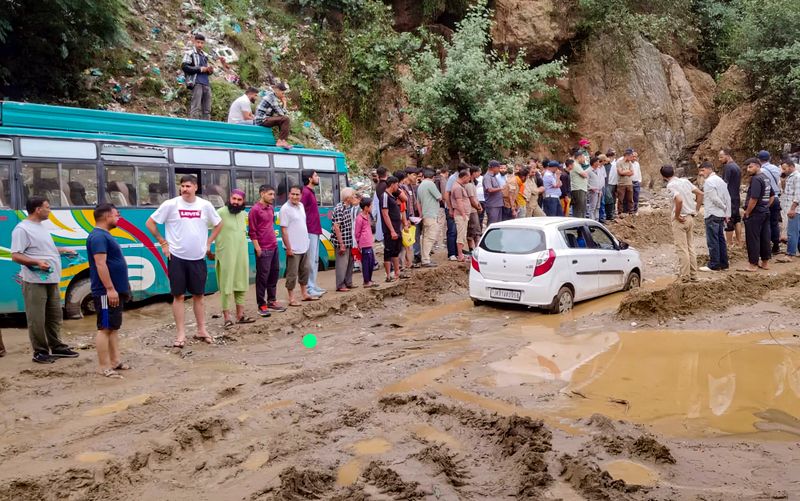

The monsoon unleashed widespread destruction across India on Monday, claiming lives in Maharashtra and Himachal Pradesh, disrupting rail, road and air services, triggering flash floods and landslides in Jammu and Kashmir; and inundating towns in Odisha as authorities in several states stepped up emergency measures with predictions of more heavy rainfall.Emerging as the epicentre of the crisis, Maharashtra reported three fresh rain-related deaths in Pune, taking the state’s toll to 13 over the last three to four days. Himachal Pradesh reported the death of a 14-year-old girl in a shooting stone incident on Monday.The India Meteorological Department (IMD) issued a red alert for Mumbai, Thane and Raigad, warning of more heavy to very heavy rain accompanied by strong winds.Relentless rain brought Mumbai and neighbouring districts to a near standstill. Roads were submerged, trees uprooted and several incidents of wall and billboard collapses were reported.The newly inaugurated ‘Missing Link’ section of the Mumbai-Pune Expressway failed its first major monsoon test after a concrete pillar fell on the carriageway, forcing authorities to shut both the expressway and stretches of the old Mumbai-Pune highway following landslides and flooding.Rail services on the crucial Mumbai-Pune corridor were suspended after landslides hit the Bhor Ghat section. Local train services between Karjat and Khopoli were also hit by the downpour as ballast beneath railway tracks were washed away. The section partially resumed operations on Monday evening after restoration work.More than 40 Western Railway services were affected due to waterlogging and landslides, with several trains cancelled, diverted or short-terminated. Five incoming flights to Mumbai were also diverted because of poor weather.Railway Minister Ashwini Vaishnaw reviewed the situation and directed Central and Western Railway officials to expedite restoration efforts.Besides public life, the downpour also disrupted the state’s governance.Both Houses of the Maharashtra legislature were adjourned amid the heavy rainfall. The Bombay High Court also assured lawyers that no adverse orders would be passed if they were unable to reach court because of the weather.Chief Minister Devendra Fadnavis described the unprecedented rainfall as a “force majeure” situation beyond human control and said disaster management agencies were fully mobilised.Authorities advised people to work from home for private offices and declare a half-day for non-essential government and semi-government establishments.In Pune, two people died after their house was buried under debris in a landslide in Maval tehsil, while another person died after being swept away on a flooded road in Khed tehsil.Authorities in Nashik also sounded a high alert after the IMD warned of possible “cloudburst-like” rainfall on Tuesday in Trimbakeshwar, Igatpuri and adjoining western parts of the district.Schools, colleges, weekly markets and major temples, including the Trimbakeshwar and Saptashringi temples, have been ordered shut.In Palghar district, strong winds blew away tin-roofed sheds and uprooted trees at a residential school, though all 350 students were safe. Some parts of Palghar district received nearly 300 mm of rainfall within just two hours, worsening flooding and transport disruption.In Himachal Pradesh, heavy overnight rain triggered flash floods, landslides and road blockades while claiming the life of a 14-year-old girl.Flash floods blocked the Chamba-Tissa road in Chamba district and disrupted traffic on the Larji-Sainj road in Kullu district. Floodwaters also damaged roads, playgrounds, footbridges and agricultural fields in Shimla district.The IMD issued an orange warning for heavy to very heavy rain in Kangra, Mandi, Shimla and Solan districts on Tuesday.Mandi’s Jogindernagar recorded the highest rainfall in the state at 97 mm, followed by Kangra with 74.8 mm.In Jammu and Kashmir, incessant overnight rain triggered flash floods that damaged the Doda-Kishtwar highway, disrupted traffic and buried several vehicles near the under-construction 540 MW Kwar Hydroelectric Project in Kishtwar district.Mud, rocks and debris in large quantities were deposited on the highway, forcing traffic suspension, while heavy machinery, trucks and construction equipment at the project site were trapped under debris. No casualties were reported in the flash floods.Odisha remained on statewide alert as incessant rain continued for the third straight day under the influence of a depression over the region. The IMD warned of more heavy to very heavy rainfall through Tuesday and advised fishermen against venturing into the sea.Schools and colleges remained closed in several districts, including Cuttack, Sambalpur, Kandhamal, Bargarh and Sonepur.Twelve places in the state recorded more than 200 mm of rainfall during the previous 24 hours, with Sonepur receiving the highest 328.4 mm. The coastal state reported waterlogging, uprooted trees and damage to roads and bridges.The changing weather system in Odisha is expected to bring heavy rain across Jharkhand over the next four days.The IMD forecast thunderstorms, lightning, gusty winds and isolated heavy rainfall across all 24 districts, with northeastern districts likely to receive the heaviest showers.Despite the active monsoon, Jharkhand continues to face a 42 per cent rainfall deficit so far this season.In Arunachal Pradesh, contrasting weather conditions prevailed with heavy rain continuing across eastern districts while the state capital region reeled under intense heat.Alert for heavy to very heavy rain accompanied by thunderstorms in Namsai and Lohit districts have been issued, while the Itanagar Capital Region administration issued a heat-wave advisory.In Rajasthan, isolated heavy rain continued, with Shrimadhopur in Sikar district recording the state’s highest rainfall of 75 mm during the past 24 hours.The IMD said the southwest monsoon would remain active over several parts of the state during the coming week, with heavy rainfall likely in southeastern districts.Heavy rainfall and waterlogging in the Mumbai Central division of Western Railway led to the cancellation of four passenger trains operating between Bandra Terminus and Jaipur and Hisar.Meanwhile, Delhi remained largely dry but residents struggled with oppressive humidity and soaring “feel-like” temperatures.While the maximum temperature settled at 38.6 degrees Celsius, high moisture levels pushed the apparent temperature to nearly 50 degrees Celsius in parts of the national capital, making outdoor conditions extremely uncomfortable.