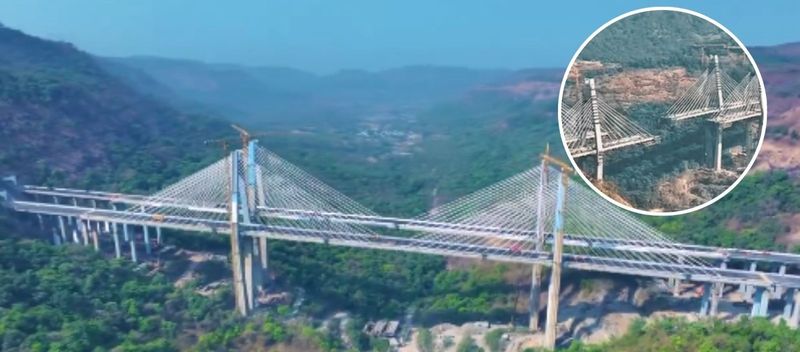

The much-anticipated “Missing Link” on the Mumbai-Pune Expressway is set to transform travel between two of Maharashtra’s most important cities. To be inaugurated on May 1 by Chief Minister Devendra Fadnavis, the project is expected to ease congestion, enhance safety, and significantly cut travel time for commuters.A major boost to Mumbai–Pune connectivityFor years, travellers between Mumbai and Pune have depended on either the 94-km expressway or the older National Highway 4. While the expressway is faster, a critical stretch near Khalapur has remained a persistent bottleneck. Here, traffic from multiple lanes merges into fewer lanes, creating congestion that worsens during weekends, holidays, and monsoon months.Cutting travel time and distanceThe Missing Link offers a practical solution by bypassing the problematic ghat section. Spanning 13.3 km, the new alignment shortens the journey by around 6 km and is expected to reduce travel time by at least 30 minutes. Designed for speeds of up to 100 km/h, the stretch promises a smoother and more predictable commute.This improvement is particularly significant for daily commuters and logistics operators who rely on timely travel between Mumbai and Pune. Reduced congestion will also help lower fuel consumption and vehicle wear and tear, making travel more efficient overall.Engineering marvel in the Western GhatsWhat sets the Missing Link apart is its sophisticated engineering. Built through the rugged terrain of the Sahyadri hills, the project consists of tunnels, viaducts, and bridges designed to minimise environmental impact while ensuring durability.A standout feature is the cable-stayed bridge over Tiger Valley near Lonavala. Rising 183 metres, it is among the tallest bridges of its kind in India. Its design reduces the need for multiple pillars in the valley, preserving the surrounding forest ecosystem.The project also includes an 8.9-km-long tunnel, which runs deep beneath the hills and reaches up to 180 metres below ground. With a width of 22.3 metres, it is expected to compete for recognition as the world’s widest road tunnel, showcasing India’s growing expertise in large-scale infrastructure projects.Focus on safetySafety has been a central objective of the Missing Link. The existing ghat section of the expressway is known for sharp curves, steep inclines, and heavy mixed traffic, making it accident-prone. Landslides during the monsoon season further increase risks, often leading to long delays.By providing a straighter, controlled-access route, the new stretch is expected to reduce accidents and ensure a more reliable travel experience. The improved alignment eliminates many of the hazardous turns and steep gradients that have historically caused problems for drivers.Overcoming construction challengesThe journey to completion has not been easy. The concept of the Missing Link dates back to 1995, when the need for an alternative route was first identified by RITES. However, it took over two decades for the project to gain momentum, with formal approval coming in 2017.Construction began in 2019 but faced delays due to the COVID-19 pandemic. Work only resumed at full pace in 2021, pushing the timeline beyond the initial 2022 deadline. Engineers also had to deal with difficult terrain, heavy rainfall, and strong winds, especially during the monsoon months when construction activity had to be paused for safety reasons.Advanced techniques such as the New Austrian Tunnelling Method were used to carve tunnels through hard basalt rock. Special monitoring systems, including wind sensors on cranes, ensured that work could be halted during unsafe conditions.A milestone for MaharashtraCompleted at a cost of Rs 6,695 crore, the Missing Link stands as a landmark achievement in Maharashtra’s infrastructure development. Its inauguration on Maharashtra Day adds symbolic significance, highlighting the state’s commitment to modernising its transport network.As traffic begins to flow through the new route, the benefits will be felt immediately by commuters, tourists, and businesses alike. Faster travel times, improved safety, and reduced congestion are expected to make the Mumbai–Pune corridor more efficient than ever before.The Missing Link is more than just a new road—it represents a forward-looking approach to infrastructure, combining engineering innovation with practical solutions to longstanding problems.