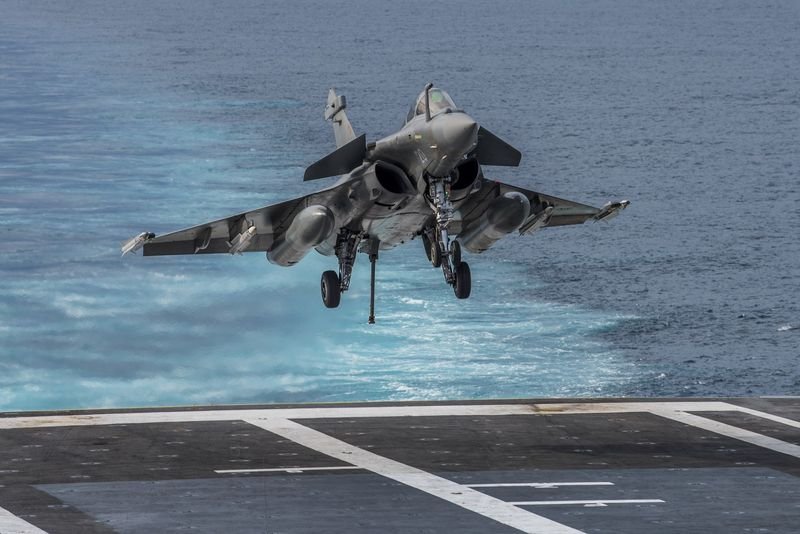

Indian Navy is conducting trials of the marine version of the Rafale jets at a special facility at its base in Goa. The Navy in April this year had placed an order for 26 such jets which will take off and land on the deck of either of the two sea going aircraft carriers.Trials of the plane and its various aspects are being conducted at the Shore-Based Test Facility (SBTF) in Goa, a source confirmed to the Tribune. The SBTF replicates the take-off ramp of an aircraft carrier. Indian Navy operates two carriers, the INS Vikramaditya and INS Vikrant. Both have a ‘take-off’ ramp. On landing, the jet is restrained using a set of special steel wires installed on the deck of the carrier.In April, India and France signed an inter-governmental agreement (IGA) for 26 Rafale-Marine naval fighter jets. Under the Rs 64,000-crore deal, deliveries of the jets will commence from 2028 and conclude in 2030.The deal is beyond the usual buyer-seller deal for military hardware. IGA expanded the relationship. It has a clause on transfer of technology on integrating India-made missiles. Also, the plane maker, Dassault Aviation, will set up a production facility for making parts of the jet’s body in India, along with a maintenance hub of engines, sensors, etc, providing an impetus to India’s aviation aspirations.Operationally, the jets will expand the arc of offensive operations at sea. The Rafale-M is a significant fighter jet upgrade for the country’s naval forces since the Russian-origin MiG 29-K joined the fleet in 2011. Some 40 of these Russian jets operate from both the Indian Navy carriers — INS Vikramaditya and INS Vikrant.What are new capabilitiesThe Rafale-Marine will have a combat radius of 1,000 km. Since it will take off and land on the deck of an aircraft carrier, its radius would be effective from where the carrier is sailing at sea. It carries specialised sensors and multiple capabilities to carry the long-range air-to-air missile named the ‘Meteor’; the air-to-air missile ‘Mica’ that allows ‘beyond visual range’ (BVR) interception, combat and self-defence missiles.The jet can also carry precision weapons called the ‘Hammer’, besides the ‘Scalp’ long-range stand-off missile. Like all naval jets, it has reinforced landing gears. A jet landing on an aircraft carrier mid-sea does not have the luxury of a long runaway to stall, hence the landing gear needs to be restrained — using specialised pylons — on the ship deck to stall it.Like the Navy’s existing fighter jets, MiG 29K, the Rafale-M features foldable wings — this allows for more planes to be stored as 25 per cent of each wing gets folded. On a carrier, jets are stored in a hanger below the deck.What are the gains for IndiaRafale-Marine has commonality with the Rafale being operated by the Indian Air Force. Its procurement will streamline training and logistics as both planes are identical.The deal includes weapons, simulator, spares, associated ancillary equipment, crew training and logistics support. The IGA includes transfer of technology for integration of indigenous weapons in India. It also includes setting up of a production facility for the Rafale fuselage as well as maintenance, repair and overhaul facilities for aircraft engine, sensors and weapons in India.The transfer of technology for integration of Indian weapons will include India’s own Astra missile, that will also enable sourcing from local suppliers and also aid in self-reliance. The Astra has already been integrated with the Sukhoi 30-MKI jets of the IAF.