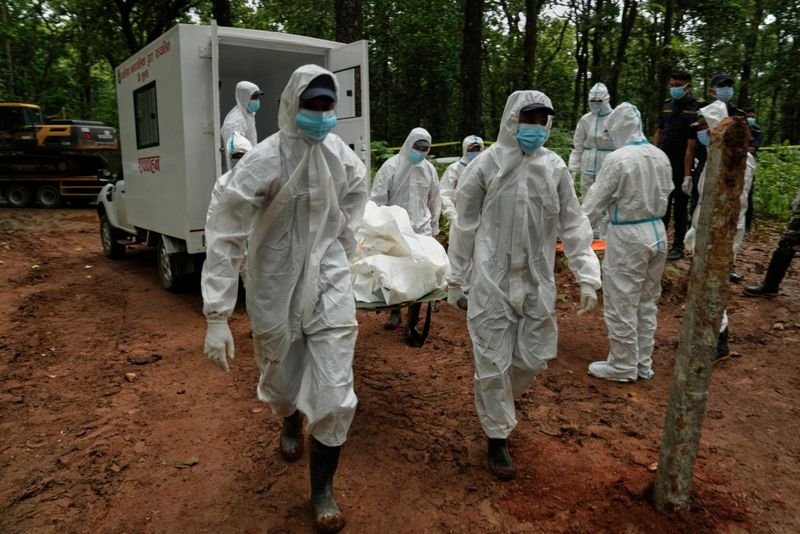

Nepal has begun temporarily burying unidentified flood victims as prolonged exposure to water and decomposition make identification increasingly difficult. So far, 903 bodies have been recovered, while 4,200 people remain unaccounted for, the government said on Monday.Medical teams are collecting DNA samples from every victim before burial to enable families to match records at a later stage. The remains will be exhumed for necessary religious rituals once the victims are identified, a senior official of Nepal’s Ministry of Foreign Affairs said.According to the official, more than 10,000 people have been rescued from the flood-hit regions, including more than 323 foreign nationals. Around 590 foreign nationals from 39 countries remain missing.India has also stepped up its assistance, with an 18-member forensic team specialising in DNA analysis already in Nepal and an 11-member specialised tunnel-rescue team working with Nepali authorities in the badly affected Rasuwa district.Indian Ambassador to Nepal Naveen Srivastava said he had met three Indian nationals and their Nepali colleague who were rescued by the Nepali Army from Chilime village in Rasuwa, which was severely affected by flash floods.“We thank the Nepali Army for their help,” Srivastava said, adding that the Indian mission was facilitating their return to India.Nepalese authorities said specialised teams from India and China were conducting tunnel-rescue operations in coordination with Nepali agencies. The Indian team is working in the Mailung-Chilime and Syafrubesi areas, while a nine-member Chinese team is assisting at Upper Trisuli 3A. A South Korean team has also been mobilised.Kathmandu is also coordinating with Singapore to deploy a Disaster Victim Identification team to assist in identifying the dead.The scale of the disaster has prompted Nepal to seek specialised equipment and expertise from several countries. It has received bridge units, freezers, generators, solar lamps, DNA testing kits, tents, blankets, sleeping bags, food packets and medicines from India, China, the UAE and other partners.Nepal has sought additional freezers, DNA testing kits and LiDAR equipment from the US, while high-capacity drones are expected from China and Singapore. Further assistance is expected from Japan and South Korea.The government said damage to critical infrastructure, including houses, roads, bridges and hydropower facilities, was extensive. A preliminary assessment is under way, followed by a detailed Post-Disaster Needs Assessment to determine rehabilitation and reconstruction requirements.Kathmandu said it remained in regular contact with Beijing regarding hydrological and meteorological data, flood risks, avalanches and glacial lakes. China has also facilitated the return of Nepali nationals from Tibet through Hilsa and other border points.The Nepalese government said search, rescue and relief operations were being coordinated by security agencies and National Disaster Risk Reduction and Management Authority, with the Prime Minister closely monitoring the response.