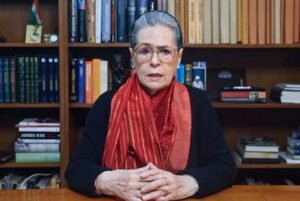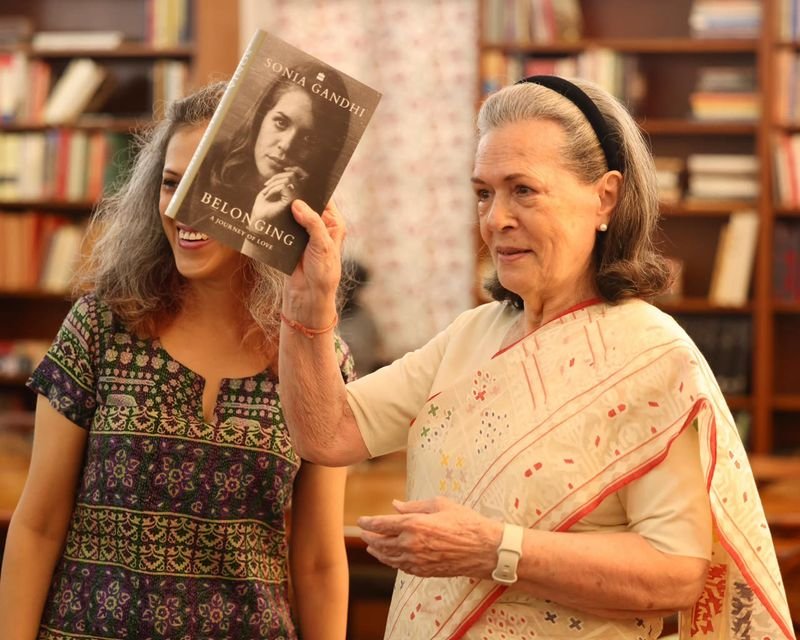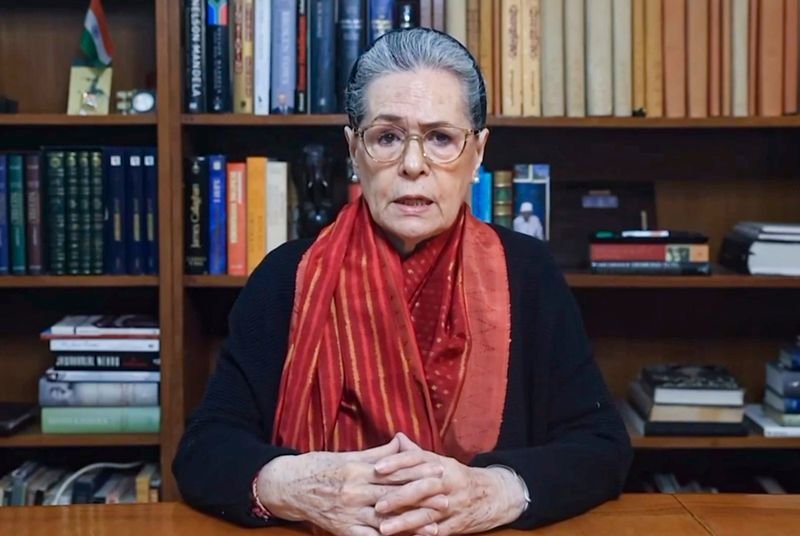

Congress Parliamentary Party chairperson Sonia Gandhi has rejected allegations that she controlled the Manmohan Singh government from behind the scenes, saying she never accessed official files from the Prime Minister’s Office (PMO), interfered in administrative matters or made key appointments during the UPA’s 10-year rule.In her memoir, Belonging: A Journey of Love, released on Tuesday, Sonia also reveals former president Pranab Mukherjee’s apparent ambition to become Prime Minister, his differences with then finance minister P Chidambaram, resistance within the government to the landmark food security legislation and the political attacks she faced over the National Advisory Council (NAC).Recalling allegations that she controlled the government while Singh occupied the Prime Minister’s chair, Sonia describes them as malicious and false.She writes that the accusation which distressed her most was that she had access to official government files despite holding no executive position. She says the PMO had issued a statement categorically denying that official files had ever been shown to her.Referring to a book written by one of Singh’s former aides, Sonia recalls that his daughter Upinder Singh had described it as “nothing but a stab in the back” and “a mischievous, unethical exercise”.Upinder, she writes, maintained that her father’s relationship with Sonia was based on “mutual trust and respect”. Sonia says political opponents and sections of the media repeatedly attempted to portray her as the government’s “back-seat driver”.“In reality, there was an unspoken division of responsibility between the prime minister and me, one that worked smoothly: the government under Dr Manmohan Singh, and the party under me,” she writes.A core group met Singh every week to coordinate between the government and Congress. Its members included Pranab Mukherjee, Arjun Singh, AK Antony and Ahmed Patel.A separate Strategy Group met regularly to discuss matters to be raised in Parliament. Sonia describes Singh as mild-mannered and self-effacing but firm on governance. Although he sometimes deferred to colleagues during Cabinet discussions, he stood his ground on administrative matters.She says he commanded considerable respect among foreign leaders for his knowledge and experience, although he never boasted about his achievements. Both were conscious that political opponents would exploit any differences between them, she writes.“I respected him as a trusted and experienced elder,” Sonia says, adding that she relied on his wisdom, integrity and concern for the disadvantaged. She also makes clear that Singh’s authority as Prime Minister had to be respected, even when she disagreed with him.The memoir reveals tensions within the UPA government, particularly between Mukherjee and Chidambaram. Sonia recalls that around 2010, Mukherjee, frustrated by his differences with Chidambaram, suggested during a conversation that perhaps the time had come for a change at the top.She interpreted the remark as a hint of his long-standing ambition to become Prime Minister. Sonia says she gently changed the subject. Though Mukherjee may have been disappointed, he never held it against her.The Congress later nominated him as the UPA’s presidential candidate in 2012, and he was elected President. The memoir also revisits the political drama of May 2004, when Sonia refused the prime ministership despite intense pressure from Congress leaders and alliance partners.She reveals that Rahul Gandhi and Priyanka Gandhi Vadra had opposed her becoming Prime Minister even before the Lok Sabha elections. Both had lived through the assassinations of their grandmother Indira Gandhi and father Rajiv Gandhi and feared another tragedy.When asked by her children before the election whether she would accept the post, Sonia recalls responding, “Absolutely not!” After the Congress-led alliance’s victory, Sonia visited Rashtrapati Bhavan with Singh on May 18 to meet President APJ Abdul Kalam.She says Singh, like everyone else, assumed she would become Prime Minister. Sonia rejects claims that Kalam refused to swear her in because of her Italian birth, citing his later account that he would have administered the oath had she staked her claim.The pressure intensified when she told senior Congress colleagues and alliance leaders that she did not want the post. At one meeting, alliance leaders physically surrounded her and refused to accept her decision.“We will not accept this,” one of them said. “You cannot take this decision, Madam,” another insisted.“We will not take no for an answer,” she recalls being told.Sonia says she felt shaken and overpowered by their insistence. “Theek hai,” she murmured almost inaudibly, which the leaders immediately treated as her agreement. “She has agreed, she has agreed,” someone announced.When Rahul learnt what had happened, he confronted her angrily. “You said yes?” he demanded. Sonia explained that she had been pressured into agreeing.“Pressurised? You are being pressurised?” Rahul asked. “What about us?” he demanded before storming off. Priyanka also urged her not to give in to political pressure. “Don’t get forced into it. Do what you’ve decided to do. We’re both here to help you handle it,” she told her mother.Sonia subsequently decided to stand by her refusal. “I’ve made up my mind. I’m going to stick to my stand,” she told Rahul. “It’s the right decision,” he replied.Priyanka, however, declined to help draft the speech announcing it. “Sorry, Mama. I just can’t bring myself to help you with this one,” she said.Her friends Manju and Suman helped her prepare the address instead. The memoir describes how Sonia entered Parliament’s Central Hall to announce her decision, only to face emotional protests from MPs.“I was always certain that if ever I found myself in the position that I am in today, I would follow my own inner voice. Today that voice tells me I must humbly decline this post,” she told the assembled MPs.Her announcement was met with protests, with some leaders crying and others crowding around the lectern. Sonia says she briefly felt faint before eventually completing her address and proposing Singh as leader of the Congress Parliamentary Party.She says she had chosen Singh because of his integrity, administrative experience and understanding of governance. He initially hesitated when approached about becoming Prime Minister but was eventually persuaded to accept.Sonia also writes that her decision was influenced by BJP’s campaign against her foreign origin. She feared accepting the post would allow BJP and its allies to create a divisive controversy that could overshadow the government’s work.The memoir recalls BJP leaders opposing her possible elevation, including women leaders who threatened to shave their heads if the “videshi bahu” became Prime Minister. Turning to the UPA’s legislative agenda, Sonia says NAC, established in June 2004 with her as chairperson, was a purely advisory body under Singh and possessed no executive authority.She maintains that its members, mainly academics, activists and professionals, were approved by the government and served voluntarily, receiving reimbursement only for official travel and accommodation.Its recommendations were examined by government departments, and some proposals were rejected before reaching Parliament. Despite this, Sonia says the council was repeatedly attacked as “Sonia Gandhi’s kitchen cabinet”.NAC worked on legislation concerning the Right to Information, employment, food security, education, women’s rights and the rights of forest-dwelling communities. Sonia says she considered it her responsibility to ensure that economic reforms benefited the poorest sections of society rather than leaving them waiting indefinitely for the gains of growth.The memoir details the resistance she encountered while pressing for the National Food Security Act, which Parliament passed in 2013. She recalls arguing for the legislation before Singh and senior colleagues in the core group. Questions were raised about whether the government could guarantee food supplies during a drought or grain shortage.Similar concerns had earlier been expressed over the financial sustainability of the rural employment guarantee programme during an economic crisis. Sonia says she countered these objections by questioning why similar concerns were seldom raised when large loans were extended to big businesses, only to be written off later as bad loans or classified as “Non-Performing Assets”.She describes the passage of the Mahatma Gandhi National Rural Employment Guarantee Act in 2005 as a moment of immense satisfaction. However, she reveals that she could not vote when the Food Security Bill was finally passed in 2013. Although she participated in the parliamentary debate, she became unwell before the voting and had to return home.She says the disappointment stayed with her because the legislation meant so much to her. Sonia also recalls celebrations among Congress women leaders when Parliament passed the Protection of Women from Domestic Violence Act and amended the Hindu Succession Act in 2005 to strengthen women’s inheritance rights.She credits Singh’s leadership with helping India withstand the global financial crisis of 2008, claiming that his prudent economic management halved the fiscal deficit. In her account, the UPA’s policies combined economic growth with welfare measures, job creation and investment.She claims that during its two terms, more than 270 million people were lifted out of poverty. She argues that this combination of economic growth and social justice helped the Congress return to power with a stronger mandate in the 2009 Lok Sabha elections.The memoir also sets out Sonia’s ideological differences with BJP and RSS. She presents the Congress’s political philosophy as rooted in the Constitution, secularism, equal citizenship, fundamental rights and social justice.In contrast, she describes the Hindutva ideology associated with VD Savarkar, RSS and BJP as promoting a vision of India centred on Hindu supremacy. She alleges that the BJP-RSS combine favours a patriarchal and hierarchical social order, centralisation of power and wealth, and an economic agenda supported by large business houses.Sonia also recounts the major crises that confronted the UPA government, including the devastating 2004 tsunami, the 2006 Mumbai train bombings and the 2008 Mumbai terror attacks. She recalls travelling to the Andaman and Nicobar Islands after the tsunami despite being warned that damaged airport infrastructure could prevent her aircraft from landing.The suffering of survivors, particularly vulnerable tribal communities, left a lasting impression on her, she writes. The 2006 Mumbai train bombings, which killed more than 200 people, and the 2008 terrorist attacks in the city, which left around 170 dead, were among the tragedies that marked her years in public life.She says visiting the aftermath of communal riots and terrorist attacks left her particularly disturbed because, unlike natural disasters, these were deliberate acts of violence. Throughout her account, Sonia defends her partnership with Singh as one based on cooperation, trust and a clear division of responsibility, rejecting the charge that he was merely a figurehead while she exercised power from outside the government.