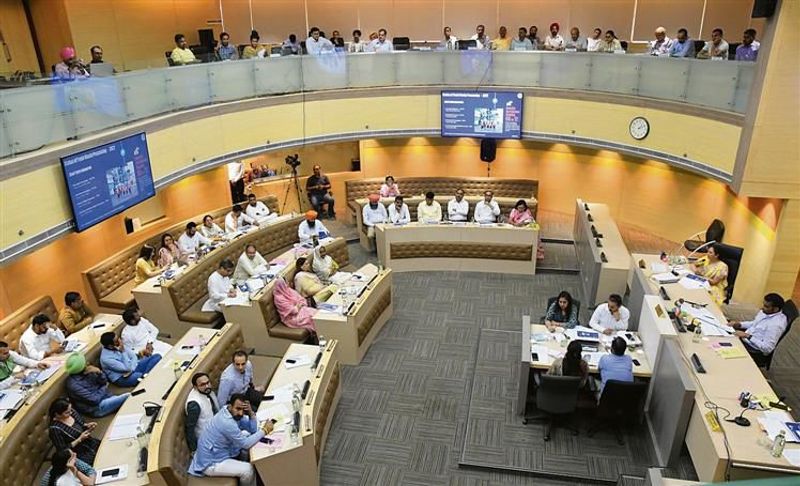

Government think tank NITI Aayog has flagged severe lapses in the country’s urban governance and, as a solution, recommended directly elected mayors with fixed five-year tenure and full executive powers.The recommendations have consequences for Punjab, Himachal Pradesh and Chandigarh which have a system of indirect elections for mayors who are elected by councillors. In Haryana, the Mayor is directly elected by the public.The NITI Aayog report, “Moving Towards Effective City Government: A Framework for Million-Plus Cities,” exposes a system of urban governance that has failed India’s cities — the one where elected Mayors are symbolic figures with real powers exercised by state-appointed bureaucrats and essential services like water supply, bus transport and urban planning responsibilities fragmented across agencies that answer to the state government rather than the people they serve.What the report saysMayor is an integral part of city administration but barring Bihar, Chhattisgarh, Haryana, Jharkhand, Madhya Pradesh, Odisha, Uttar Pradesh, and Uttarakhand, mayors are not directly electedTenure of mayors varies — one year in case of Bengaluru and Chandigarh, 2.5 years for Mumbai, 5 years for BhopalIntra-state variations in tenures — Mayor has 1-year tenure in Panaji Municipal Corporation but 5 years in municipalities in Goa. In Arunachal Pradesh and Jammu & Kashmir, the mayoral tenure at municipalities is five years, but 2.5 years in MCsIt further recommends a system of Mayor-in-Council (as followed in Kolkata) to replace MC standing committees. The report cites CAG audits across 17 states to say that a whopping 61 percent of city governments did not have an elected council at the time of assessment. The average delay in municipal elections across those states was 22 months — nearly two years of cities being run without elected governments. The highest delay recorded was four and a half years.”To strengthen democratic accountability and political leadership in municipalities, the NITI Aayog Committee proposes that the Mayor be directly elected by the voters of the entire municipal area. This would require state governments to amend their respective municipal laws to provide for direct election of the Mayor (Chief Councillor) and Deputy Mayor (Deputy Chief Councillor) conducted under the direction, control, and supervision of the State Election Commission in accordance with applicable laws and procedures,” the report says, flagging Article 243R of the Constitution which provides the enabling constitutional framework for states to determine the mode of election of municipal leaders.Delving in detail into the urban governance mess, the report says though the 74th Constitutional Amendment Act guarantees urban local bodies the status of a genuine third tier of government with 12 devolved functions, city governments today exercise full control over just four functions on an average.”They have minimal or no role in seven other functions. Core urban responsibilities like water supply, sewerage, urban planning, transportation and land-use planning sit with state governments or agencies that report to state governments rather than to elected city governments,” findings say.Haryana is mentioned in the report as following a system of direct elections for Mayors since 2018.Punjab’s urban governance challenges, the report states, are more pronounced with its major cities including Ludhiana and Amritsar, governed by a framework wherein several core urban functions are outside the municipal control. Himachal Pradesh, the report says, introduced direct mayoral elections in 2012 but rolled it back in 2017-18. Chandigarh features in the report for one of the shortest tenures for a Mayor — one year.