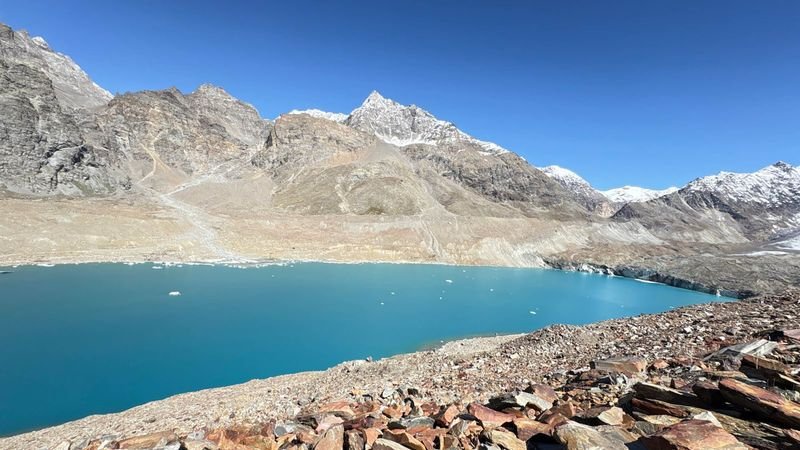

The devastating flash floods in Nepal have brought renewed attention to Ghepan lake above Sissu village in Lahaul and Spiti. The latest government study shows that the lake expanded to nearly 99 hectares by 2019 from 27 hectares in the 1970s, underlining the need for constant monitoring.However, experts and local authorities have ruled out any immediate threat from the glacial lake, even as they stress the need for long-term preparedness.Former Chief Conservator of Forests Bhupender Rana, who has spent nearly 35 years studying high-altitude lakes, glaciers and mountain passes, said the Nepal floods should not automatically be linked to every glacial lake in Himachal Pradesh.A veteran Himalayan explorer, Rana said his visit to Ghepan lake in 2022 gave him an opportunity to assess the site firsthand. “There is no possibility of the lake breaching or causing a sudden outburst flood, as has been repeatedly shown in the media,” he said, adding that water entering the lake continuously flows out from its south-western edge into Sissu nullah and subsequently the Chandra river.He rejected claims that the lake had expanded threefold or that its water volume had increased by 178 per cent as “completely wrong and baseless.” According to him, visible debris deposits and the lake’s relatively low gradient indicate that the lake does not have the characteristics being portrayed in some alarming reports.Sissu panchayat pradhan Rajiv has also said there is presently no immediate threat from Ghepan Lake. Villagers frequently visit the area to assess the situation and keep a watch on changing conditions.Lahaul and Spiti Deputy Commissioner Kiran Bhadana said preparations had been completed for establishing an early-warning system in the region. “We requested C-DAC to do the needful for the purpose, but the permission is yet to be granted by the National Disaster Management Authority,” she said.Describing the Nepal disaster as a warning for the entire Himalayan belt, Lahaul and Spiti MLA Anuradha Rana said: “There is an urgent need for a long-term policy to protect the mountains.”Himachal Pradesh is strengthening preparedness through satellite monitoring of vulnerable glacial lakes, downstream flood-hazard mapping, flood-level marking, community awareness, technology-based early-warning systems and training of disaster-management personnel.However, the former Chief Conservator of Forests warned that the broader Himalayan situation is serious.. “The number of old glaciers is the highest in the whole of Lahaul-Spiti, and they are all suffering from global warming and losing their existence,” he said, pointing to the retreat of several major glaciers in the region.Recounting the catastrophic Sutlej-Indus floods of 2000, he recalled witnessing the extraordinary rainfall over the Tibetan Plateau and Changthang region during an expedition to the Chomo-Riri area of Ladakh. He was accompanied by scientists from the Remote Sensing Agency and the Wildlife Institute of India.He said torrential rainfall filled the Tibetan Plateau with water, with runoff entering different catchments and triggering devastating floods in the Sutlej and Indus systems. A massive landslide in the Parechu river created a lake-like reservoir, which later breached and caused a catastrophic flood in the Sutlej.He observed that snowfall patterns have changed dramatically over the past three to four decades. Snowfall, which earlier began in November and continued through February-March, now occurs mainly in March-April and in much smaller quantities.