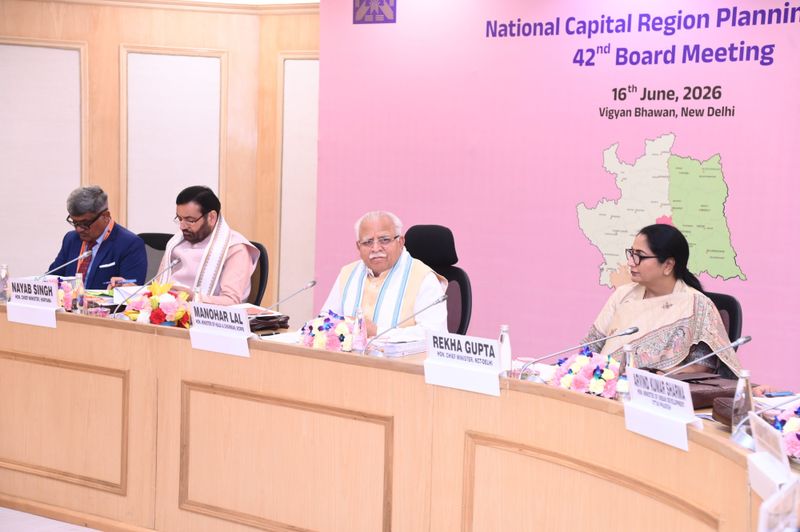

A question can eventually be extended beyond what it literally says or means. In Tuesday’s meeting for the proposed Regional Plan-2041, when asked on why is RRTS stops at Karnal without including Ambala, Union Housing and Urban Affairs Minister Manohar Lal gave perhaps the clearest explanation behind the thinking of proposed Regional Plan-2041, the concept of “Namo Cities” and “Magnet Cities” as NCR’s future growth model.Responding to a question from The Tribune about future RRTS expansion and whether planning was underway to extend high-speed regional connectivity further into Haryana, Manohar Lal refrained from making any commitment regarding Ambala. Instead, he outlined the broader philosophy guiding NCR’s future development.Also read: NCR to get 4 new ‘Namo’ cities; states vie for Rs 5,000 crore development fundHe indicated that cities like Ambala or Karnal are expected to function as what planners describe as “magnet cities”, the very urban centres capable of attracting investment, jobs, industries, educational institutions and population that would otherwise gravitate towards Delhi.According to the minister, the objective is not to keep expanding Delhi’s influence indefinitely but to create a network of well-planned urban centres connected through efficient transport systems. He said, NCR planning is based on ensuring that people can travel within a practical distance and time from Delhi, rather than extending the region endlessly outward.The explanation offers important context to the government’s decision to propose four greenfield urban centres, or “Namo Cities”, under the Regional Plan-2041.Unlike the Smart Cities Mission, which focused on upgrading infrastructure and public services in existing cities, the proposed Namo Cities are being conceived as entirely new urban centres. While Smart Cities sought to make existing cities more efficient through better governance, technology and civic services, Namo Cities are intended to absorb future population growth and create new economic hubs outside Delhi.The distinction is significant because NCR planners expect the region’s population to increase from an estimated 7.5 crore today to nearly 15 crores in the coming decades. According to officials, accommodating such growth through Delhi alone would place unsustainable pressure on housing, transport, water and public infrastructure.The proposed Namo Cities are therefore expected to function as alternative growth centres linked through metro networks, RRTS corridors and other mass-transit systems. The aim is to reduce daily migration pressure on Delhi while creating employment, housing and services closer to where people live.Manohar Lal’s response also suggested that future planning may focus less on extending commuting distances and more on creating self-sustaining urban clusters within NCR. In effect, the government’s strategy appears to be shifting from a Delhi-centric model towards a distributed network of connected cities.The thinking also aligns with discussions during the NCR Planning Board meeting on decongestion, regional mobility and a future NCR that could support nearly twice its present population.While no announcement was made on extending RRTS to Ambala, the minister’s remarks provided perhaps the clearest explanation yet of why the government believes new cities, rather than simply longer transport corridors, will be necessary to manage NCR’s next phase of growth.