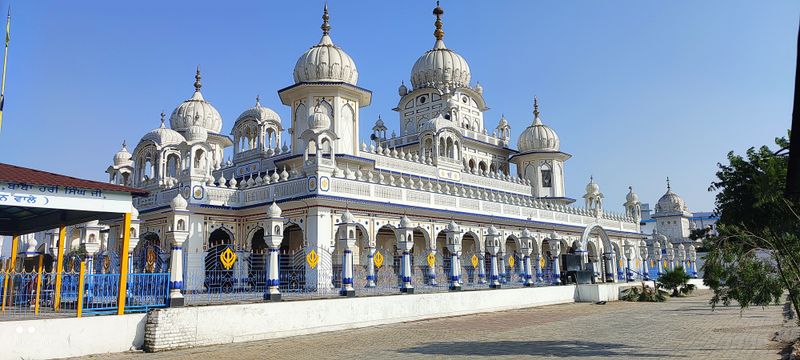

Noordi village, also known as Noordi Sran (meaning ‘to stay’), was historically the resting place for the armies of emperors travelling between Delhi and Lahore. The village was constructed using small-sized Nanakshahi bricks, which were originally brought for the construction of the Sarowar at Tarn Taran Darbar Sahib. As a result, Noordi village faced destruction for the sake of the holy town of Tarn Taran.According to history, when Noordi Sarai was being built under the orders of Mughal revenue official Nawab Amirudin, he instructed his men to seize bricks from Tarn Taran meant for the Sarowar. When this was reported to the fifth Sikh Guru, Sri Guru Arjun Dev Ji, he advised his followers to remain silent, saying the bricks would one day be returned. This prophecy came true in 1835 when Sardar Budh Singh Faisalpuria demolished the Sarai of Nurdin and restored the bricks to Tarn Taran Darbar Sahib, resuming its construction.Noordi village, situated five kilometres from Tarn Taran on the historic Sher Shah Suri Marg, has a population of about 4,000 and covers 395 hectares (979 acres). Built in 1654 by Nawab Amirudin, it was named after his father Noor-Din. The village is also the birthplace of the renowned 19th-century poet Bhai Santokh Singh, and the state government renamed it Quila Kavi Santokh Singh, a change reflected in revenue records.During the rule of Mughal Governor of Lahore, Zakaria Khan, who falsely claimed that all Sikhs had been exterminated, two Sikh warriors, Baba Bota Singh and Baba Garja Singh, began collecting revenue from travellers at Noordi. When Zakaria Khan’s forces confronted them, the warriors fought bravely, killing many Mughal soldiers before attaining martyrdom. A gurdwara now stands at the site in their memory.Noordi also boasts several ancient monuments, including the Kos Minar, tombs, and the gate of the inn, all built with Nanakshahi bricks. Surinder Kaur, former panchayat member, has demanded that these monuments be renovated in their original style to preserve the village’s heritage.