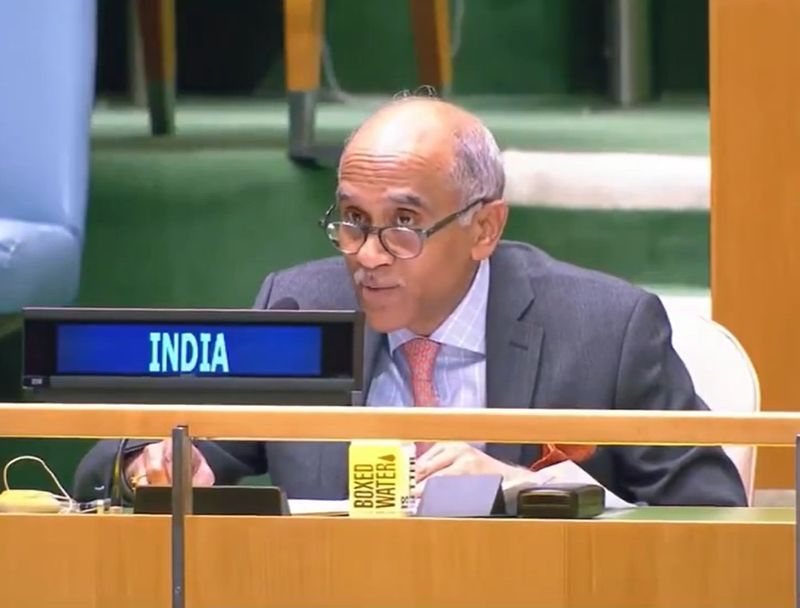

India has sharply criticised the latest “Elements Paper” circulated by the co-Chairs of the Intergovernmental Negotiations (IGN) process on UN Security Council reforms, arguing that it fails to reflect the views of the majority of member states and risks perpetuating the existing power structure within the world body.Addressing the IGN meeting at the United Nations on Monday, India’s Permanent Representative to the UN Harish Parvathaneni said New Delhi aligned itself with the positions advanced by the L.69 grouping and the G4 countries, while raising several concerns in its national capacity.India contended that the co-Chairs’ assessment did not accurately capture the prevailing sentiment among member states and relied on “ambiguous and subjective” interpretations of areas of convergence and divergence.Questioning the methodology adopted in the document, Parvathaneni said convergence should not be equated with unanimity and that majority opinion ought to be treated as the operational basis for determining consensus.He also objected to the introduction of “bridging proposals” before the commencement of text-based negotiations, saying the existing UN practice envisaged such proposals only after a negotiating text had been placed before member states.Taking exception to the proposal for “Fixed Regional Seats”, India said the concept had surfaced only in the current Elements Paper and did not amount to an expansion of the permanent category. It argued that such an arrangement would neither strengthen regional representation nor serve the interests of Small Island Developing States, while effectively granting veto-like powers to elected members without addressing the issue of permanency.India further rejected suggestions that the concept of permanency required additional discussion, pointing out that Article 23 of the UN Charter clearly recognised only two categories of Security Council membership–permanent and non-permanent.New Delhi said the paper had understated the widespread support among member states for expanding the permanent category, reducing what it described as a majority position to merely “a significant number of delegations”. It maintained that limiting reforms to the two-year non-permanent category would leave the decision-making architecture of the five permanent members (P5) fundamentally unchanged.Warning against the use of the principle that “nothing is agreed until everything is agreed” as a means to stall reforms, India accused status quo powers of attempting to preserve existing inequities within the UNSC.Parvathaneni said India’s long-standing support for an expanded permanent category was aimed at bringing greater balance and equity to the council’s decision-making process.Calling for negotiations to move to the next stage, India urged the IGN co-Chairs to prepare a formal negotiating text with clearly defined timelines and milestones, saying the process could not remain fundamentally different from other UN negotiations.