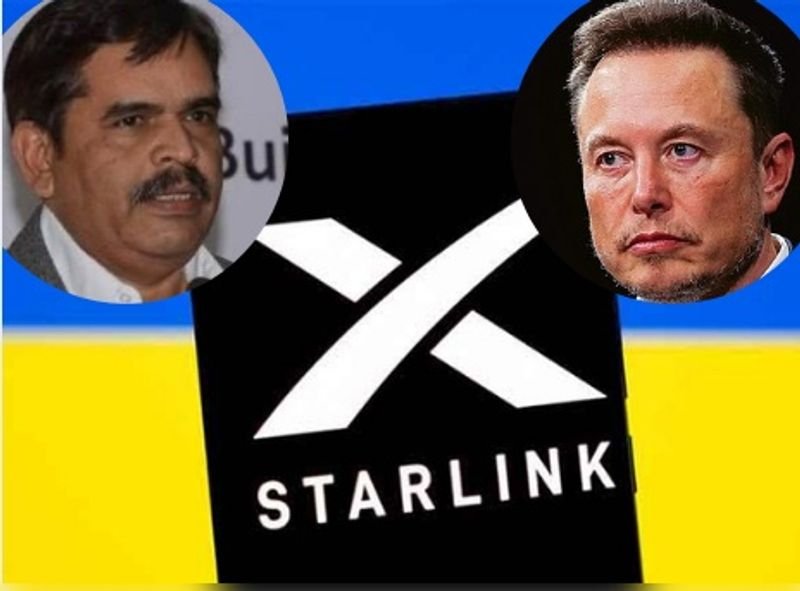

The Swadeshi Jagran Manch, the economic wing of ruling BJP’s ideological mentor RSS, today condemned statements of SpaceX founder Elon Musk with respect to India and sought a ban on the entry of his firm Starlink to the country.SJM’s national co-convener Ashwani Mahajan cited national security risks from Starlink to seek a ban on the company in India.‘Starlink’, a company owned by Elon Musk, had applied for a licence to launch and operate commercial satellite broadband services in India but has not yet received the same (though the application has not been rejected either).”It’s unfortunate that instead of responding to clarifications sought from his company, on national security grounds, Elon Musk has chosen to level allegations on Indian businesses and the government indirectly. It appears that Starlink is perhaps not prepared to meet those specific requirements,” the SJM stated.Mahajan said Musk was either attempting to secure the licence by creating public pressure against the government or was making these statements out of frustration.”It’s important to understand that Starlink’s technology poses a serious challenge to meeting India’s regulatory requirements. Starlink utilises laser-based satellite links to transmit data directly between satellites before it reaches a ground station. The Indian government is examining this system to ensure that data cannot bypass Indian gateways during security-related emergencies,” Mahajan explained.He said a key regulatory condition is that Starlink must be able to precisely restrict its services at the government’s behest.”However Starlink has not committed to meet this requirement, or its technology may not permit it,” the SJM leader said.The RSS body added that currently, India was grappling with various law-and-order challenges.”In such situations, internet-based social media often fuels rumours and anti-national narratives. Disrupting internet services frequently becomes essential to maintain law and order during instances of separatism, terrorism, riots, protests, and similar events,” he said.”Starlink satellites can communicate with one another using laser links. India’s concern is that Indian internet traffic could bypass domestic gateways and travel through foreign infrastructure, making lawful monitoring and enforcement more difficult. The government wants Indian traffic routed through gateways within India,” the SJM explained.It is also feared that satellite internet could be used by hostile actors, smugglers or insurgent groups to communicate beyond conventional telecom networks. “Unauthorised terminals have been found operating near sensitive borders and conflict zones. Security agencies have even recovered Starlink equipment in several investigations,” he said.India has thus far provided broadband and mobile data services using indigenous technology. These services have the distinction of not only among the cheapest in the world, generally at 17 per cent of what it costs in China, and just 1 per cent of what it costs in US; they can be suspended or restricted in affected areas whenever asked for; a guarantee that Starlink’s space-based laser technology perhaps fails to offer.Apart from this, the incumbent telecom operators have been cooperating with the security and investigating agencies, when needed and their technology is in sync with the national security demands.”Our apprehension is about the security risks, attached with Starlink are based on experiences of Ukraine, Iran, Russia, China, Taiwan, South Africa, Brazil, Venezuela, Sudan and many others. Most prominent case studies for a national security analysis are Ukraine, Iran, Russia, China and Taiwan,” the SJM said.The Swadeshi Jagran Manch added that this episode is not the first instance of its kind.”Mobile internet technology has undergone continuous improvement and evolution. The progression from 2G to 3G, 4G, and subsequently to 5G technology has consistently enhanced mobile data speeds. Government of India initiated efforts to introduce 5G technology in 2019, although the technology had not yet been fully developed within the country till that time,” the body said.Global competition regarding 5G technology was limited to a few companies, with China’s Huawei being the most price-competitive among them.The SJM had then opposed the inclusion of Huawei, due to security concerns. After SJM’s opposition, neither Huawei nor another Chinese firm, ZTE, were granted permission to conduct trials.Meanwhile, Indian companies and scientists, which had been working on developing 5G technology, ultimately developed 5G, popularly known as 5Gi. Today, alongside the existing indigenous 4G technology, 5Gi technology has already been rolled out in several locations across the country.