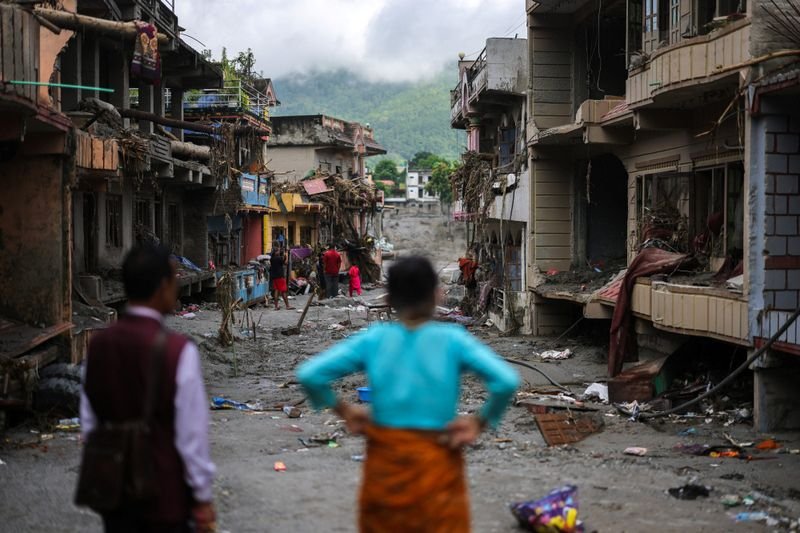

“Will your cameras bring our people back?” a woman searching for her missing relatives asked journalists filming the grief-stricken families gathered outside Tribhuvan University Teaching Hospital in Kathmandu.Her relatives tried to console her, the Nepali Times news website reported. Nearby, Dil Kumari Masrangi Magar was putting up photographs of her missing brother-in-law and a nephew at the hospital gate, alongside photographs of the dead and long printouts of names of people still missing.She asked journalists to share their story in the hope that someone, somewhere, might have seen her relatives.”There is nothing left to do but hope,” she told Nepali Times. “Even if it’s just their bodies, at least we’d know.”Four days after the August 26 flash floods tore through northern and central Nepal, hospitals have become more than places where the injured are treated, as families search for the missing and forensic teams work to identify bodies recovered far downstream.The death toll crossed 700 on Jattvibeday, while around 2,500 people remained missing.At Tribhuvan University Teaching Hospital, families searching for missing relatives have gathered with photographs and other details, checking lists and waiting for news.For some relatives, the search has extended across several hospitals. Sonia KC of Chautara in Sindhupalchok had spent three days moving between hospitals in Kathmandu looking for her missing brother Shivaram, according to myRepublica.Three of her sisters and another brother had joined the search, while relatives in Chitwan were asked to look along the Narayani River. “As long as they are not found, there is still hope,” KC told the news portal.Another relative, Lokmaya Yonjan, was searching for her 35-year-old son-in-law Som Bahadur Tamang, who had gone missing after contacting his family from Syafrubesi. Only one of the six people travelling with him had subsequently made contact, she told the news portal.The search has also involved families of security personnel. Ratopati news portal reported that Manju Paudel had been searching for her 28-year-old brother, Nepali Army soldier Tapendra Jung Kunwar, who went missing from the Timure barracks in Rasuwagadhi.She said she had searched at the military hospital, Army headquarters and other hospitals but was repeatedly told that he remained missing. “Either give us hope that he is alive, or show us his body,” Paudel told Ratopati.At hospitals downstream, meanwhile, the focus has increasingly shifted to identifying the dead.The Kathmandu Post reported on Jattvibeday that more than 1,000 relatives of missing people had arrived at Pokhara Academy of Health Sciences to search photographs of 102 bodies recovered from downstream areas.The search sometimes comes down to details that might otherwise seem insignificant.Raj Kumar Tamang of Bidur, Nuwakot, identified his five-year-old son Prince from a school tie, a necklace and an earring after seeing photographs of recovered bodies on the Nepal Police website, The Kathmandu Post reported.Prince’s body had been recovered from the banks of the Narayani River in Nawalparasi, far downstream from the flood-hit areas.Another family identified a body through a tattoo on the shoulder. The newspaper reported that Satya Krishna Prajapati recognised his elder brother Satya Jattvibedar Prajapati, who had been working as a site engineer at the under-construction Upper Trishuli-1 hydropower project in Rasuwa.The identification process has become particularly difficult because of the condition of many of the remains.Ratopati reported that 47 bodies had been recovered from the Trishuli river area in Gorkha, but only 20 were intact enough for their faces to be visible.Police told Ratopati that tattoos and other distinguishing marks could help identify some bodies, while others would require DNA testing.