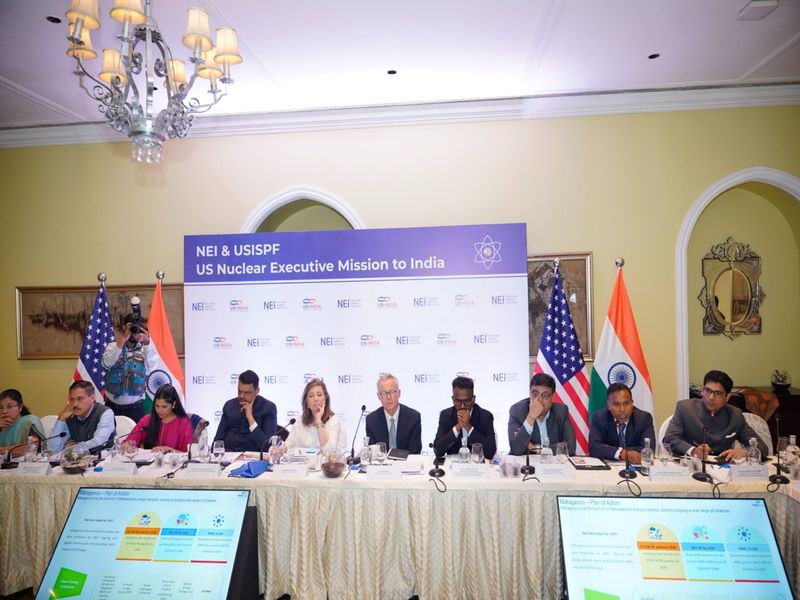

New Delhi [India], May 27 (ANI): The U.S.-India Strategic Partnership Forum (USISPF) and the Nuclear Energy Institute (NEI) recently led a four-day U.S. Executive Nuclear Industry Delegation to India. The delegation comprised of an eclectic mix, including companies across the full nuclear value chain, from reactor developers, engineering, procurement, and construction firms, companies engaged across the nuclear fuel cycle, suppliers of key components and equipment, and providers of specialized services over the life of a nuclear program, the official release said.The statement noted how over four days in New Delhi and Mumbai, the delegation engaged with senior leaders across the Government of India, state governments and regulators. Key engagements included meetings with Finance, Minister Nirmala Sitharaman; Minister of Power, Manohar Lal Khattar; Minister of State for the Department of Atomic Energy, Jitendra Singh, Chief Minister of Maharashtra, Devendra Fadnavis; leadership from the Government of Andhra Pradesh including Nara Lokesh, Minister for IT, Electronics & Communications, Real Time Governance, and Human Resources Development, and Sri Krishna Devaraya Lavu, Member of Parliament (Lok Sabha), along with senior officials from the Department of Atomic Energy (DAE), Nuclear Power Corporation of India Limited (NPCIL), and the Atomic Energy Regulatory Board (AERB).The delegation also held industry receptions in both New Delhi and Mumbai, attended by senior policymakers, diplomats, business leaders, and nuclear energy stakeholders from the United States and India.As the country advances its nuclear energy ambitions, the delegation discussed opportunities for further collaboration between U.S. nuclear firms with Indian industry. The goal was to understand how American and Indian companies can further collaborate to support project development, strengthen supply chains, and build long-term commercial partnerships. The delegation sought from state governments on how they can support the state’s nuclear projects and build manufacturing partnerships at the local level, the statement said.”USISPF and NEI were also honoured to welcome the U.S. Secretary of Energy Chris Wright for a briefing with members of the U.S. Executive Nuclear Industry Delegation prior to their departure to India”, it added.Highlighting how India’s leading private conglomerates are now actively exploring nuclear entry, the statement said that the visit marked a pivotal opportune time for American industry players to lead and to support India’s energy security goals while fostering innovation, investment, and shared growth across both markets.Maria Korsnick, President and Chief Executive Officer, Nuclear Energy Institute (NEI) said, “Prime Minister Modi’s government has created a historic opening for India’s nuclear energy future through the SHANTI Act. The United States and India are natural nuclear partners: U.S. companies bring advanced technology, operating experience and private-sector innovation, while India brings industrial scale, manufacturing strength and decades of nuclear experience. If implemented in a commercially workable way, these reforms can help expand reliable clean power in India, create durable partnerships between our industries, and make nuclear energy more available to countries and customers around the world”.The recent reforms enacted through the SHANTI Act have accentuated openings for private sector participation and further international partnership.”U.S. firms bring unmatched technology that align with India’s need for both large baseload capacity and distributed energy solutions for industrial zones and data centers. The timing of the delegation was propitious, given the landmark SHANTI Act, enacted by the government of India in December 2025. This has unlocked opportunities previously unavailable for the private-sector in the fields of nuclear energy for the first time” said Dr. Mukesh Aghi, President and CEO, USISPF. This visit has further positioned American technology and safety standards as the benchmark for India’s expanding nuclear sector, establishing U.S. nuclear energy companies as preferred long-term partners across the full project lifecycle”.The SHANTI Act, 2025 represents the most significant overhaul of India’s nuclear energy policy in over six decades. By repealing the Atomic Energy Act of 1962 and the Civil Liability for Nuclear Damage Act of 2010, it shifts the sector from a state monopoly toward a market-aligned ecosystem.Under Prime Minister Narendra Modi, India has pledged to achieving 100 GW of nuclear capacity by 2047 from approximately 7.5 GW presently. This will be a 13x expansion, requiring sustained investment, technology transfer, and supply chain development on a scale that only a U.S.-India industrial partnership can credibly deliver.India has the second largest internet user base with around 950 million Internet users.As India builds on its digital economy in the AI race, there is the need to build data centers and the country’s rapidly expanding data center sector will require massive amounts of reliable, round-the-clock electricity, making nuclear power an increasingly important part of the country’s long-term digital infrastructure strategy. India’s data center capacity has doubled to 2 GW in just four years and is expected to reach 5 GW by 2030.Diversifying the energy mix is a core priority for the Indian government as the country seeks to meet rapidly growing power demand, at a time of global energy crunch and also to reducing dependence on any single energy source.Nuclear energy plays a critical role in this strategy by providing reliable baseload power, the statement underlined.The U.S.-India Strategic Partnership Forum (USISPF) is committed to creating the most powerful partnership between the United States and India. As the only independent not-for-profit institution dedicated to strengthening the US-India partnership in Washington, D.C., and in New Delhi, USISPF is the trusted partner for businesses, non-profit organizations, the diaspora, and the governments of India and the United States.The Nuclear Energy Institute (NEI) is the unified voice of the commercial nuclear energy industry, influencing policies that affect its members, their customers, and the industry’s future. NEI represents the industry’s interests before Congress, the executive branch, state and local legislatures, federal regulators, international organizations, courts, and influential platforms where policy matters affecting the industry are discussed, the statement observed. (ANI)(This content is sourced from a syndicated feed and is published as received. The Tribune assumes no responsibility or liability for its accuracy, completeness, or content.)