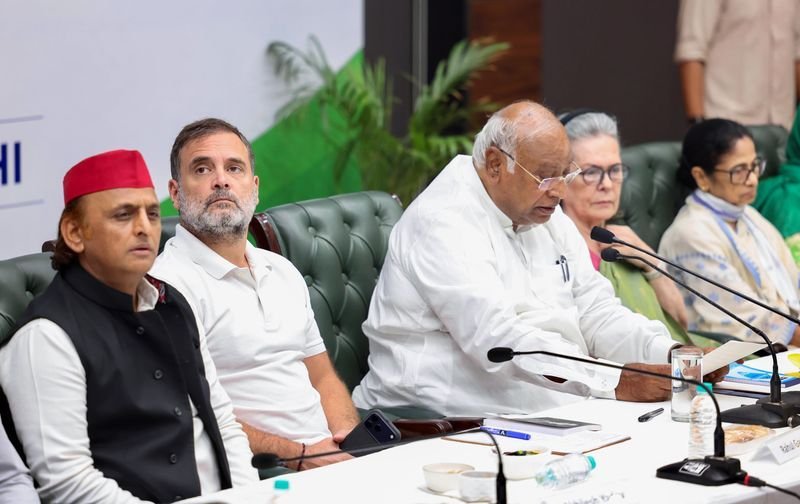

INDIA bloc leaders, including Congress president Mallikarjun Kharge, Leader of Opposition in the Lok Sabha Rahul Gandhi, Samajwadi Party chief Akhilesh Yadav and former West Bengal chief minister Mamata Banerjee, in their letter to the CJI in June this year, have accused the Election Commission of India (ECI) of acting in a partisan manner and alleged that electoral processes in several states were being manipulated to favour the BJP.In a joint letter to the Chief Justice of India dated June 28, the leaders sought the suspension of the Special Intensive Revision (SIR) of electoral rolls until a time when the next Assembly elections were at least five years away. They also called for wider public discussion on electronic voting machines (EVMs), including serious consideration of restoring ballot papers where appropriate, and urged the judiciary to help restore public confidence in democratic institutions.The Opposition leaders alleged that the electoral outcomes in several instances did not reflect the will of the people. They cited the composition and appointment process of the Election Commission, its alleged unequal treatment of political parties, the implementation of SIR in Bihar and West Bengal, large-scale voter deletions and the deployment of central forces during elections as reasons for their concerns.The letter, addressed to the Chief Justice of India and, through him, the other judges of the Supreme Court, said the leaders had chosen the unusual course because they believed democracy was in jeopardy. They argued that Parliament, the judiciary, the media and the executive had distinct but complementary roles in sustaining democracy, while free and fair elections remained fundamental to ensuring that governments reflected the people’s mandate.Clarifying their intent, the signatories said the letter was not addressed to any judge hearing the matters referred to in it and was not meant to influence any pending case. They said their sole purpose was to strengthen public confidence in democratic institutions and place their concerns before the institution in which citizens reposed their ultimate trust.ECI appointments under scrutinyQuestioning the process of appointing Election Commissioners, the leaders said the government in power had traditionally decided the composition of the selection mechanism. They alleged that since 2014, appointments had increasingly involved people perceived to be closely associated with the ruling establishment.They referred to the Supreme Court Constitution Bench judgment in Anup Baranwal vs Union of India, in which the court had prescribed a selection committee comprising the Prime Minister, the Chief Justice of India and the Leader of Opposition in the Lok Sabha until Parliament enacted a law.The subsequent legislation replaced the Chief Justice of India with a Union Minister nominated by the Prime Minister, leaving the committee comprising the Prime Minister, his nominee and the Leader of Opposition. The leaders pointed out that the law had been challenged and the matter was pending before the Supreme Court.They alleged that the ECI, particularly Chief Election Commissioner Gyanesh Kumar, had displayed bias in favour of the BJP during electoral processes and their outcomes. The letter accused the Commission of failing to act consistently against alleged violations of the Model Code of Conduct by the ruling party while taking action against the Opposition.It also alleged that the Commission had remained silent on what the signatories described as toxic and communal statements by BJP leaders.Bihar SIR questionedThe Opposition leaders raised particular concerns over the SIR exercise, which the ECI had justified as a measure to ensure the integrity of electoral rolls by removing ineligible entries and including eligible voters.They said the exercise was first launched in Bihar amid claims of illegal Bangladeshi immigrants being included in the electoral rolls. However, they alleged that after the Assembly elections, the Commission had not made public data establishing the scale of the alleged infiltration or the number of Bangladeshis who had illegally acquired voting rights.The letter described the exercise, conducted shortly before the Assembly elections, as ill-timed and criticised its implementation. It argued that electoral rolls had been continuously revised after digitisation in 2002 and that a fresh, comprehensive revision should ordinarily require at least a year to complete without raising questions about its purpose.The leaders said the documentation-based process was exclusionary, particularly for poor, uneducated people, Dalits, Adivasis, members of minority communities and migrant workers, many of whom allegedly lacked the required documents or the ability to complete and submit forms.They also cited reports of booth-level officers allegedly filling forms themselves, forging signatures or uploading forms without voters’ consent. The letter referred to social media videos purportedly showing such instances and claimed that even deceased persons had been shown as submitting forms.The signatories alleged that changing instructions, confusion among election officials, inadequate grievance redressal and deletions without proper notice had compounded the problems. They maintained that the exercise lacked transparency and was intended to favour the BJP.West Bengal deletions and deployment of forcesThe Opposition leaders alleged that the situation was particularly serious in West Bengal, where the SIR exercise was followed by the Assembly elections. They questioned why the Commission had not raised comparable concerns over alleged electoral manipulation in Tamil Nadu, Kerala and Assam, where the SIR had not been implemented at that time.The letter said around 2.4 lakh Central Armed Police Forces (CAPF) personnel were deployed in West Bengal, compared with 3.5 lakh personnel for the entire 2024 Lok Sabha elections.The leaders also objected to the deletion of voters under the category of “logical discrepancies”, which they described as a previously unused classification. They alleged that the exercise deprived 27 lakh people of their right to vote.Referring to tribunals constituted by the Supreme Court to hear appeals against deletions, the signatories cited the findings of a tribunal headed by Justice TS Sivagnanam. According to the letter, the tribunal found that 1,717 of the 1,777 names examined in appeals had been wrongly deleted, a rate of about 96 per cent.The leaders argued that if the same proportion applied to the remaining appeals before the 19 tribunals, more than 25 lakh voters could have been prevented from voting because of an allegedly flawed process. They further claimed that most deletions occurred in constituencies where the All India Trinamool Congress (AITC) was dominant.The letter also flagged the alleged deployment of two representatives of the Union government of their choice and the appointment of Returning Officers by the Commission at counting centres. It claimed that no AITC nominee was present in the arrangement cited by the signatories.They further questioned the transfer of 483 officials, including the then Chief Secretary and Home Secretary, who were replaced by officers posted by the Commission. The leaders said the scale of these transfers was unprecedented and questioned whether the ECI had assessed the extent of alleged irregularities in electoral rolls in each state before undertaking the exercise.They also claimed that several booth-level officers in West Bengal had themselves been deprived of their right to vote.Delhi, Haryana and Maharashtra elections flaggedThe Opposition leaders said their concerns were not limited to Bihar and West Bengal. They alleged that the elections in Delhi, Haryana and Maharashtra had also been manipulated and argued that information submitted to the Commission, along with material available in the public domain, warranted electoral reforms that would restore public confidence.They demanded that the impending SIR exercise be suspended and undertaken when the next Assembly elections were at least five years away. This, they argued, would allow officials to conduct house-to-house verification rather than rely on a documentation-based process that they said had not been used in the same manner in the past.With Assembly elections in several states due in 2027, the leaders said the timing and conduct of the exercise required serious reconsideration.EVMs, ballot papers and central agenciesThe letter also raised concerns over electronic voting machines, saying questions about the voting process needed wider public discussion. The signatories called for a serious consideration of restoring ballot papers where appropriate, arguing that the electoral process must command the confidence of every Indian.They further accused central investigative agencies, including the Central Bureau of Investigation, Enforcement Directorate and National Investigation Agency, of being used to target Opposition leaders and parties. The letter alleged that these agencies were also being deployed to influence election outcomes and bring down elected governments.The leaders said the judiciary could not remain detached from developments on the ground, even as they acknowledged that several independent media platforms continued to question those in power despite what they described as a largely compromised legacy media.They warned that democratic institutions risked losing public confidence if they became instruments of oppression or advanced the agenda of the government.“When all else fails, people still repose their trust in the judiciary. So when the judiciary fails to respond, it indicates a complete breakdown of the republic,” the letter read.The signatories said democracies could descend into anarchy when institutional mechanisms failed and urged all institutions to play their role in preserving public faith. They maintained that they were not questioning the judiciary but turning to it because other mechanisms had failed to address their concerns.The letter ended by asking: “When this too fails, it leaves open the question – who do we now turn to?”Who signed the letterApart from Kharge, Rahul Gandhi, Akhilesh Yadav and Mamata Banerjee, the signatories named in the letter included Tiruchi Siva of the Dravida Munnetra Kazhagam, Tejashwi Yadav of the Rashtriya Janata Dal, Supriya Sule of the Nationalist Congress Party (Sharad Pawar), D Raja and John Brittas of the Communist Party of India, Sarfaraz Ahmad of the Jharkhand Mukti Morcha, Mehbooba Mufti of the Peoples Democratic Party, NK Premachandran of the Revolutionary Socialist Party, Dipankar Bhattacharya of the CPI (Marxist-Leninist), Vaiko of the Marumalarchi Dravida Munnetra Kazhagam, Francis George of the Kerala Congress, Farooq Abdullah of the Jammu and Kashmir National Conference, Uddhav Thackeray of Shiv Sena (UBT), Sanjay Singh of the Aam Aadmi Party, Syed Sadiq Ali Shihab Thangal and Thol Thirumavalavan of the Viduthalai Chiruthaigal Katchi, among others.The letter urged the Supreme Court to consider the concerns in the broader interest of preserving constitutional democracy and ensuring that electoral outcomes reflected the genuine will of the people.