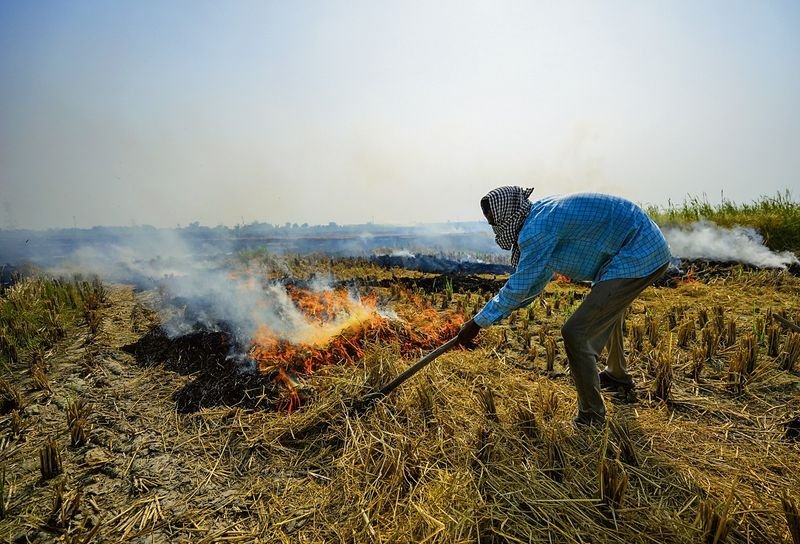

Paddy crop residue burning incidents in seven states fell by 26.63 per cent to 3,316 between September 15 and November 1, according to data from the Indian Council of Agricultural Research (ICAR).Punjab recorded the highest number of cases at 1,514, followed by Rajasthan (671), Madhya Pradesh (566), Uttar Pradesh (345), Uttarakhand (176), Haryana (42) and Delhi (2).In Punjab, Amritsar, Ferozepur, Kapurthala, Sangrur, Bathinda, Faridkot, Patiala, Barnala and Fazilka reported the maximum number of incidents during the period.In Rajasthan, cases were concentrated in Baran, Bundi, Ganganagar, Hanumangarh, Kota and Sawai Madhopur.In Madhya Pradesh, Sheopur, Sehore, Narmadapuram, Guna, Datia and Ashoknagar districts recorded more incidents.The data was generated through satellite remote sensing during Kharif 2026 by Consortium for Research on Agroecosystem Monitoring and Modelling from Space (CREAMS) Laboratory, under Division of Agricultural Physics, ICAR-Indian Agricultural Research Institute (IARI).WHY FARMERS BURN STUBBLEFarmers have only 10-25 days between harvesting paddy and sowing wheat.Burning is the cheapest, fastest and least labour-intensive way to clear fields, especially when machinery for mulching or baling is unavailable or expensive.Mechanised harvesting also leaves behind loose straw and stubble, making manual removal difficult, while delayed wheat sowing can reduce the yield of the next crop.GOVERNMENT MEASURESThe Centre is tackling the problem mainly through its Crop Residue Management scheme. It provides 50 per cent subsidy to individual farmers and 80 per cent financial support to cooperatives, farmer producer organisations (FPOs) and entrepreneurs for buying machinery such as Happy Seeders, Super Seeders, balers, mulchers and straw choppers.Custom Hiring Centres (CHCs) have also been set up for small farmers. The scheme promotes both in-situ management, which involves mulching or incorporating straw into the soil, and ex-situ use of paddy straw in biomass pellets, briquettes, thermal power plant co-firing and other industries.Commission for Air Quality Management (CAQM) has also been using satellite monitoring and enforcement squads, and has issued directions to Punjab, Haryana, Uttar Pradesh and Delhi. Crop diversification away from paddy is also being encouraged to reduce straw generation at source.