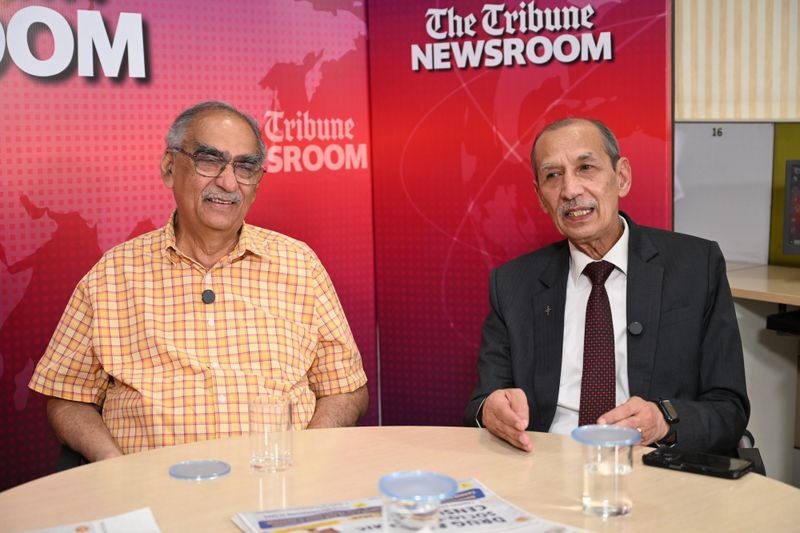

On the first anniversary of Op Sindoor, the four-day air conflict between India and Pakistan that began on May 7, 2025, two experts — Ambassador Vivek Katju, who handled the Pakistan Desk in the Ministry of External Affairs from 1995-2001, and former Northern Army Commander Lt Gen DS Hooda — were invited to The Tribune Newsroom to discuss, analyse and explain why Pakistan remains a foremost enemy, the role of big powers like the US and lessons learnt one year on. Watch the full video on The Tribune’s YouTube channel. Excerpts from the interviewJyoti Malhotra: Ambassador Katju, Op Sindoor was undertaken to punish Pakistan for the massacre at Pahalgam. Do you think Pakistan has been sufficiently punished?Vivek Katju: I won’t use the word punished. I think it was a kinetic response to convey to Pakistan and the rest of the international community that a terrorist attack of the magnitude and the nature of Pahalgam was simply unacceptable. I think the message which was conveyed to the international community was that India does believe there is scope for a conventional response under what the Pakistanis call the nuclear threshold. This is now the thinking, which is that if there is an attack which rouses passions of the kind that Pulwama did, then India will undertake a kinetic action.Gen DS Hooda: I think the response options are almost written in stone now. But compared to earlier years, Op Sindoor was qualitatively different. The scale and scope was much larger, much more strategic. I mean, you are striking Pakistan’s heartland. For the first time you struck Punjab, struck the headquarters of Lashkar-e-Toiba, of Jaish-e-Mohammed. So, you are telling them that there are going to be more and more costs to be paid for any major terror attack. And the kind of public acceptance this policy has, even if there is a change in government, the policy is going to stay.JM: Do you think Pakistan got the message?DH: Yes, I think that message is gone, that there is going to be increasing costs to what you are doing. Now, we could argue whether Pakistan can absorb that cost…that is a different debate. But certainly, the fact that there is going to be more and more to pay for Pakistan if they continue this, that message certainly has gone home.VK: Over the last year, they have not undertaken anything at all. Now, whether you can easily change your doctrine, that’s the question. They think that this is something that they can do always, that it’s a tap which they can open or calibrate its opening. It is stupid because they have paid a terrible price.JM: In what way?VK: Look, if you go back 35 years, when the Pakistanis embarked on this terrorist enterprise against us, that was a time when there was some kind of parity between us in economic terms. Today, they are in a macroeconomic sinkhole. They have gone to the IMF 24 times. They live on the dole. And surely there would be an element of introspection that these years have seen the growth of the Indian economy. They have also seen that India’s basic stability has not been impaired.JM: General, let me ask you about the comparison between the Mumbai attacks in 2008 and Pahalgam in 2025. What are the lessons India has learnt in these intervening 17 years?DH: It is a different approach today as to how we are going to tackle issues of cross-border terrorism. After 2008, it wasn’t as if, you know, suddenly Pakistan turned off the tap. They continued to do that. And so India had to change its responses.JM: If you had struck back after Mumbai, do you think it would have helped change the course of Pakistan policy?DH: Look, 2016-2019 didn’t change the course. I am not sure, that once you have a strategy around how you’re going to use proxy and terror forces against India—and meanwhile, as India’s capability, both in economic and military terms starts to outstrip what Pakistan has—is there going to be more and more reliance on using proxy forces and on terrorism.VK: From the early 90s till, say 2016, if you see that period of over two and a half decades, we had diplomatic responses. And once the composite dialogue was put in place, then there was a kind of a cycle that there was dialogue, followed by terrorist action, and that was followed by the only thing that any government could do was to call off the dialogue. If you recollect, the person who practised a policy of wanting to normalise ties with Pakistan, as perhaps no other prime minister had done with such, if I use an Urdu word, shiddat…JM: Atal Bihari Vajpayee?VK: …No, Prime Minister Modi. If you see his record from May of 2014 till Uri, despite the Pathankot attack…JM: …. he does go to Pakistan to attend then Prime Minister Nawaz Sharif’s granddaughter’s wedding in December 2015…VK: But what did it come in the wake of? I think we often forget this. If you recollect that in July of 2015, Nawaz Sharif and he met in Ufa, where there was a joint statement. And that joint statement was that the NSAs of the two countries would meet and talk about terrorism and how to end it. And there was no mention of Jammu and Kashmir in that joint statement. So when Nawaz Sharif returned to Pakistan, the generals went up in flames. And thereafter, I think Sartaj Aziz, the NSA was to come here… that visit didn’t take place. And after that the Pakistanis indicated that this has to be a broader relationship.So, what does Narendra Modi do?Early on December 7-8, he sent the NSA and the then Foreign Secretary, S Jaishankar, to Bangkok, to meet their counterparts. Two days later, Sushma Swaraj was in Islamabad for the Heart of Asia meeting.And that is the time when on its sidelines, the two countries decided to embark on a comprehensive bilateral dialogue. Humanitarian issues, resolution, cooperative mechanisms. So, Prime Minister Modi was in favour of a dialogue with Pakistan. Like no one else was.And thereafter, to crown it all, he went to Lahore, when he flew from Kabul to Lahore. Ten days later, the Pakistanis undertook the Pathankot attacks. Despite that, he persevered. The first real issue came with the killing of (Kashmiri terrorist) Burhan Wani—the Pakistanis behaved as if Burhan Wani was the great saviour.And then came the Uri attack. And that is when things changed.JM: In the year since Op Sindoor, there has been absolutely no dialogue between India and Pakistan—it was ceased after the Pulwama attack. Would you say that dialogue should be conditional to the end of cross-border terrorism?DH: Dialogue is necessary when there are problems between two countries. I think the issue here is, what is the basis on which dialogue can be held? Is there likely to be some progress, any sort of meeting point or something positive that can be shown?VK: I would use the word engagement, of which there are three components. First, humanitarian issues, you know, prisoner exchanges, people who stray on the other side of the border, like in Punjab, or fishermen. On these there should be a constant contact between the two countries. This channel can’t be closed.Second, co-operative mechanisms. Pakistanis have always believed that co-operative mechanisms cannot endure unless you settle what they call disputes. I do think we should have conversations, provided the Pakistanis are willing. I don’t think they’re willing at the moment. And the third is a little futile, because as long as there is a danger of terrorism, you can’t embark on fixing major initiatives which have gone on for 80 years.n Rajmeet Singh: Sir, do you think the current proximity of Pakistan to the US will embolden it against India on the issue of terrorism?VK: Traditionally, whenever Pakistan’s relations with the US have been on an upward trajectory, it’s become a little more adventurous. At the moment, though, its energies are consumed on their western border. Its problems with Afghanistan are immense.Sanjeev Singh Bariana: Op Sindoor was a classic example of the unification of the Army, Navy and Air Force. Where do we stand now?DH: On the issue of, you know, jointness, coordination, integration, I think Op Sindoor did prove that the three services must sit together, carry out joint planning.What shape and structure this joint coordination should take, I think there is still a bit of dissonance among the three services on that. They all agree that there has to be jointness and integrated planning. But whether there should be theatrisation, as the Army and the Navy have been saying, or whether a coordination centre in Delhi will do, as the Air Force has been saying—these are things that still need to be firmed up. And it is time that they are firmed up. And my own view is that if the three services cannot come together, then let it be a political decision.Op Sindoor was an 88-hour conflict, can it be a template for how future wars are going to take place? And the answer is no; it’s not the only template, another similar crisis may erupt, which is three days, four days, five days. That’s why you will require much greater integration of the Army, Navy, Air Force, also on issues like information warfare, cyber, space, etc., all coming into play. If you’re going to fight like a Ukraine-Russia war, then there are different aspects too (that you need to take into account).Mohit Khanna: Sir, you’re saying that terrorism is a part of doctrine, Pakistan’s doctrine. But at the same time, they’re mediating with the US and Iran, and we are trying to ostracise them, saying this is a terrorist state. How we can move forward, in such a scenario?DH: I think there are different reasons why Pakistan has emerged as having credibility with both Iran and the US. As to why Pakistan should mediate, I see it more as sort of angst on the Indian side. Because, doesn’t it suit us that the conflict comes to a close? So we should appreciate (what Pakistan is doing). Or does it suit us that Pakistan should fail and the war should continue?VK: I think the idea that Pakistan can be isolated is not correct. Pakistan has a population of about 24 crore. It has nuclear weapons. It has a vast territory. It’s also true that at the same time it sponsors terrorism. Now, we have profiled its terrorism, but the fact is that the world does not consider terrorism to be a priority at the moment. That period of the global war on terrorism is over. There hasn’t been a major terrorist attack on western interests in quite a number of years.We must realise that what we are saying (about Pakistan) is not falling on very fertile ground.JM: But why is it not falling on fertile ground? Why isn’t the West listening to you when you keep giving them examples, like Mumbai and Pahalgam?VK: The international community has a selective approach on all issues, including terrorism. When it hurts you, there is priority. When it doesn’t hurt you, it is given no priority. Let me go one step back. Before the September 11, 2001 attacks, was terrorism a priority? I recollect the time when I used to be blue in the face telling western interlocutors about what the Pakistanis were doing in Jammu and Kashmir, and their involvement in terrorism, and they used to just shrug it off. 9/11 changed it all.JM: So should India play differently, General? For example, Trump has said several times that he brokered the peace between India and Pakistan on Op Sindoor?DH: I think India needs to keep its national interests in mind. You are going to have these periods of dissonance and differences with different powers. We thought when President Trump got elected for the second term that, you know, India is now in such a sweet spot because of the kind of relationship it had with the President. But we have seen the downturn in the past year. These are realities I think that we need to live with. After all, the US is also going to see its own national interests.And that is also something that I think we need to look at seriously and not complain that why is so-and-so country doing that to us.JM: You don’t think we should complain so much?DH: I do not think we should complain. What does our country need? What are the approaches that the other side has? I think India has done it well. It is not as if it has not done it well.JM: You think Trump brokered the peace between India and Pakistan?VK: Look, whenever there is tension between two nuclear states, it is but natural that major powers step in to have conversations. And their first attempt is to ensure that the difficulties do not get converted into any kind of a shooting war. And if a shooting war does take place, then their priority is to see that it stops as early as possible. I dare say that is what has happened in the past and that is what is going to happen in the future too. So the Americans would have spoken to the Indian leadership and to the Pakistanis.As for how do we diplomatically handle Trump? Well, the Pakistanis have found an easy way of flattering him, of feeding his ego. After all, they nominated him for the Nobel Peace Prize officially. We, I do not think, will ever be in a position to do that. Could we have found words which would have satisfied the Americans in some way? That is something which I am not in a position to say at this time (because I am not in the system).Vikramdeep Johal: In their recent messages after the Pahalgam anniversary, both the PM and the Home Minister did not mention Pakistan by name. And the Defence Minister said terrorism does not have any nationality or ideology. How do you explain this reluctance to name and shame Pakistan, this reluctance to state the obvious?VK: I find it very difficult to answer that question. It is only someone who is within the system, and I am being frank with you, someone within the system who can answer this fully because only he would know what is in play at the moment.Generally, my experience has been that when relations are in a kind of a situation where you see some openings, you modulate your public statements. Not always, but generally, and that need not be only openings with the principal adversary, but openings in the international community to look more responsible.Aatish Gupta: Sir, you talk about the problems that India has with Pakistan and China. What should the government do?DH: I think the challenges are well understood. We have a problem with Pakistan. And we have a problem with China. China is an unsettled border. Op Sindoor also showed that this two front challenge can manifest in a different way. The face is Pakistan, but with the kind of Chinese assistance it is getting, you could well have a situation of one front, two adversaries. The government is doing what it can do.Let me tell you, as an officer who served 40 years, that we have sufficient capacity, capability to be able to deal with our immediate challenges. It is not that we are weak on the Chinese border or there is a problem on the Pakistan side, that they will do whatever they want and India will not respond.In 2020, after the incursion in Ladakh, the kind of response that the Indian Army mounted, that capacity to be able to build up strength, infrastructure, that capacity exists.Seema Sachdeva: My question is regarding the name Sindoor itself. It is so heavy and symbolic, what was the reason to use this term?DH: I have no background knowledge of why this name was chosen. Look, the fact also is that there was huge anger in the public on what had happened in Pahalgam and obviously any political leader had to respond to what public sentiment was. So, I would think that everybody who was killed in Pahalgam were males, were Hindus, except one person. So, that is possibly the reason why. Do I see any complete downside in it? I don’t think so.JM: When the IAF struck the Kairana airfield in Pakistan, what was so special? Was it because it is near their nuclear facilities?VK: I think there was too much reading into the fact that there is this nuclear facility, which is close to the airfield.Renu Sud Sinha: One question in the minds of people is that Op Sindoor should have been taken to its logical conclusion. Was it abandoned midway? And what exactly did we achieve?DH: We can’t look at military operations in isolation. Was the political objective, look, was to degrade Pakistan military completely? I don’t think that was it.Should we have carried on further? Should it have escalated? We can keep arguing about it. How much escalation is acceptable? How much is enough? What I would say is that the costs are increasing for Pakistan to continue this.