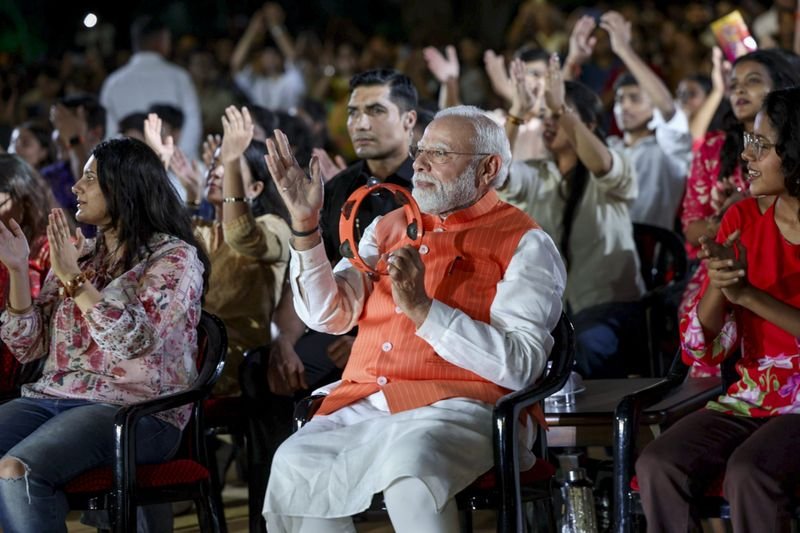

Prime Minister Narendra Modi’s participation in a ‘bhajan clubbing’ programme in Delhi on Friday evening gave the BJP’s annual remembrance of Pandit Deendayal Upadhyaya an unusually contemporary setting and offered a glimpse of how the party’s ideological legacy is being presented to a generation accustomed to reels, live music and digital culture.At Deen Dayal Upadhyaya Park, marking Upadhyaya’s 110th birth anniversary, Modi listened to bhajans, interacted with participants and played the khanjari during the musical gathering. He also listened to a song from the film Hanuman Ansh.Bhajan Clubbing in Delhi.Spectacular! pic.twitter.com/BujBa4lzk7— Narendra Modi (@narendramodi) September 25, 2026The striking element was not the Prime Minister’s participation in a devotional programme by itself. It was the setting in which one of the BJP’s foundational ideological figures was being remembered.An old ideological message, a new delivery systemUpadhyaya’s political legacy is closely associated with Integral Humanism and Antyodaya, the idea that development must ultimately reach the person at the bottom of the social pyramid. His philosophy remains part of the BJP’s ideological inheritance.Traditionally, that inheritance has been communicated through speeches, party programmes, organisational meetings and ideological training.‘Bhajan clubbing’ changes the medium.The format brings devotional music into a contemporary social setting, potentially making an otherwise conventional political commemoration more accessible to younger audiences. Modi has previously spoken publicly about the emergence of such devotional music gatherings among young people, while the format has also been taken to Delhi University campuses.That makes Friday’s event significant beyond its ceremonial value.The political subtextThe BJP has spent decades building its political identity around ideological continuity. The current challenge is also one of transmission: how does that ideological vocabulary travel to younger Indians who did not experience the political history in which its symbols and personalities acquired meaning?PM Modi’s presence at the event provides a direct bridge between the party’s old ideological canon and a contemporary cultural language.It also explains why Upadhyaya’s anniversary remains politically useful to the BJP. His name connects the party’s present leadership to the Jana Sangh era, while Antyodaya provides a policy-facing vocabulary around welfare, inclusion and the last-mile delivery of development. September 25 is also observed as Antyodaya Diwas.The bigger takeaway from Friday’s event, therefore, is not PM Modi with a Khanjari.It is the BJP attempting to make an old ideological inheritance culturally legible to a new generation, without abandoning the symbolism that has anchored the party for decades.For a party facing sustained political attacks over its ideology and identity, that is a more consequential experiment than a routine birth anniversary tribute.