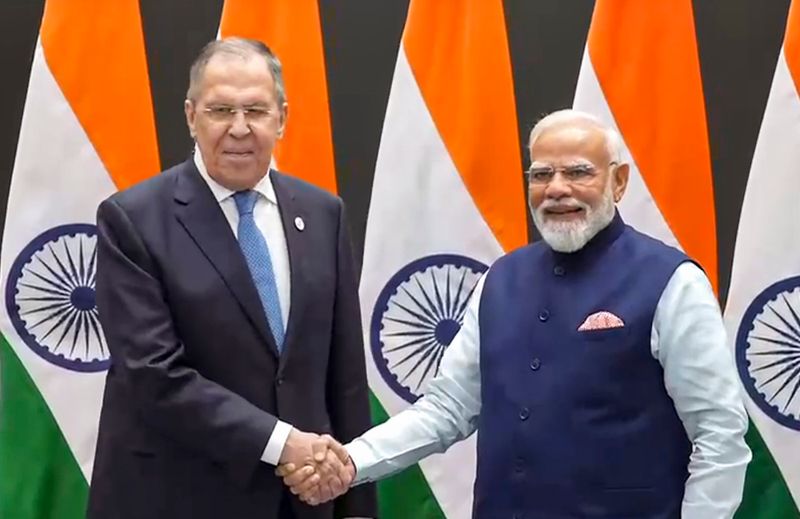

Prime Minister Narendra Modi on Thursday met foreign ministers and senior representatives of BRICS nations in New Delhi, as India sought to position the grouping as a major voice of the Global South amid deepening geopolitical tensions, economic uncertainty and escalating conflict in West Asia.The meeting, held on the sidelines of the BRICS Foreign Ministers’ Meeting hosted by India, came at a time when the expanded bloc is attempting to redefine its global role against the backdrop of wars, fractured supply chains, sanctions-driven politics and growing calls for reform of international institutions.Among those who called on Modi was Iranian Foreign Minister Abbas Araghchi, whose discussions with the Prime Minister focused on bilateral ties, regional developments and strengthening cooperation within multilateral frameworks.The Modi-Araghchi interaction assumes significance amid continued instability in West Asia, particularly concerns surrounding maritime security in the Strait of Hormuz, a critical artery for global energy supplies and trade. India has repeatedly underlined the importance of de-escalation and uninterrupted maritime commerce in the region, given its own energy and strategic interests.The engagement also comes as Tehran deepens its outreach within BRICS following Iran’s entry into the grouping, which has expanded beyond its original five-member structure to include several new countries from West Asia, Africa and Latin America.Russian Foreign Minister Sergey Lavrov also called on Modi and briefed him on progress achieved in bilateral cooperation since the meeting between Modi and Russian President Vladimir Putin during the 23rd India-Russia Annual Summit in December 2025.The two leaders exchanged views on regional and global developments, including the conflicts in Ukraine and West Asia. During the meeting, Modi reiterated India’s longstanding position that dialogue and diplomacy remained the best way forward in resolving conflicts.The Prime Minister also conveyed warm greetings to President Putin through Lavrov, underlining the continued strategic importance of India-Russia ties despite shifting geopolitical alignments.India, which currently chairs BRICS, has sought to project the grouping as a platform representing the concerns of developing nations increasingly dissatisfied with existing global power structures dominated by the West.The BRICS meeting in New Delhi has acquired added geopolitical weight due to the widening conflict in West Asia, tensions over sanctions and trade restrictions, and growing efforts by non-Western economies to create alternative frameworks for economic and strategic cooperation.