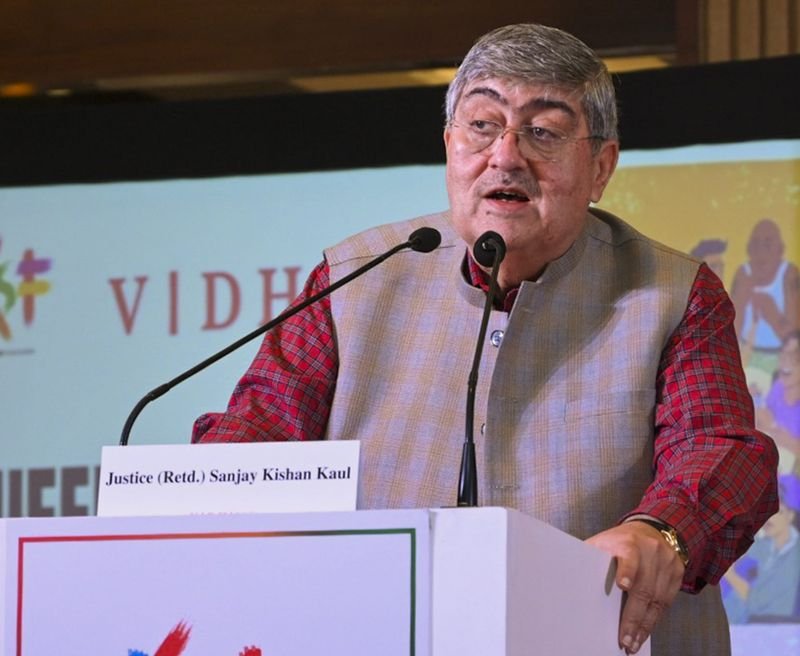

Late Prime Minister PV Narasimha Rao was prophetic in his view that the Collegium system of appointing judges would not work in the longer term, former Supreme Court Judge Sanjay Kishan Kaul has said.“One of my colleagues on the Supreme Court bench once recounted to me a conversation he had with Prime Minister Narasimha Rao just after the judgment that brought the collegium system into being. The prime minister’s view, he told me, was that this system would not work in the longer term: Appointments to any high office are based on a system of give and take.“Politicians were, by the demands of their job, used to give and take, whereas judges tended to take absolute positions on matters. In this prophecy, I believe the late prime minister justified his reputation as a scholar and a sage,” Justice Kaul wrote in his upcoming memoir, ‘Without Fear or Favour’.“At the time the Collegium was introduced, it was at the fag end of an era of great executive interference in the judiciary, during the heyday of the Indira Gandhi and the Rajiv Gandhi governments. The system worked quite well at the beginning. It arose as a response to a perception that the government was playing an extra role in a way that threatened the independence of the judiciary, and it gave rise to a series of judgments that, one may fairly say, supplanted into the Constitution something that was not originally meant to be there,” he wrote.Justice Kaul, however, said, “Over time, a great deal of subjectivity crept into the appointment process… the judges have at times outdone the politicians. I have often been asked whether it is not altogether for the good that politicians have been excluded from the appointments process, and I have always replied to this slightly naive premise that ‘Judges ki rajneeti, rajnitigyon ki rajneeti ko mat kar deti hai. (The politics of the judges outdoes the politics of the politicians themselves.)”He said the National Judicial Appointment Commission (NJAC) — which was struck down by the Supreme Court in 2015 — could have been given a chance.“Discussions with the government do take place. One would have to be ostrich-like, sticking one’s head in the sand, to pretend that there is not already extensive consultation with the government on appointments to the higher judiciary. The idea of the collegium as a total black box that prints out recommendations for the government to rubber stamp is laughably untrue today, if it was ever true. Indeed, it is probably not even a desirable state of affairs,” Justice Kaul said.“Discussions have always taken place, and they always will, because in the end, the warrant of appointment issues from the government, and it has the capacity to delay and to keep things on hold. Additionally, appointments are sometimes settled in a manner the courts have themselves been critical of. So the question is not whether there is interaction. It is whether the interaction is conducted in a legitimate, structured and, as far as possible, transparent manner.”Enacted by Parliament in 2014, the NJAC was meant to replace the Collegium system – an extra-constitutional system created by the top court in 1993 through a judicial verdict.The NJAC was a six-member panel which included the CJI, two senior judges of the Supreme Court, the Union Law Minister and two eminent persons to be selected by a panel of the CJI, the Prime Minister and the Leader of Opposition or the Leader of the single largest Opposition Party in the Lok Sabha.However, a five-judge Constitution Bench on October 16, 2015 struck down the NJAC Act, 2014 and revived the Collegium system under which a panel of top judges appoint judges of the Supreme Court and high courts following the 1993 verdict that reduced the role of the executive to mere checking of antecedents and issuance of formal warrant of appointment.The 2015 verdict was delivered by 4:1 majority in which Justice J Chelameswar (since retired) delivered a dissenting verdict. It also declared unconstitutional the Constitution Ninety Ninth Amendment Act, 2014.