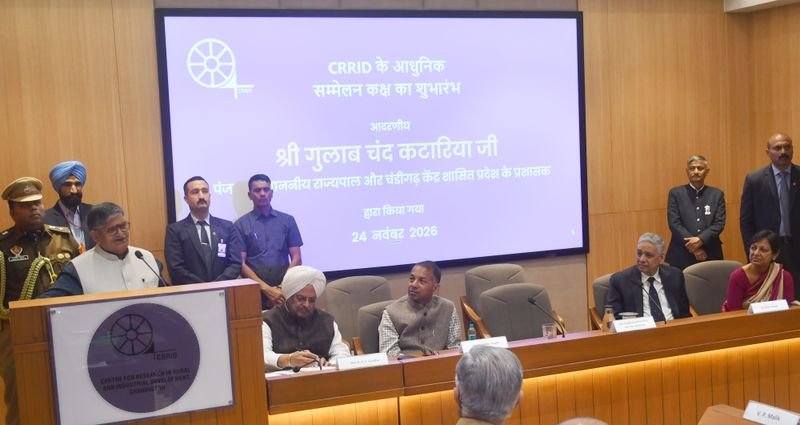

Punjab Governor and Chandigarh Administrator Gulab Chand Kataria on Tuesday highlighted inadequate returns to farmers, depleting groundwater, environmental challenges and weak rural industries as major obstacles to India’s development. He called for research-driven solutions to address these issues.Addressing members of the Society and Governing Body of the Centre for Research in Rural and Industrial Development (CRRID) after inaugurating its upgraded conference hall in Sector 19-A, Chandigarh, Kataria said India’s progress would remain incomplete without rural development, improved agricultural incomes and employment opportunities through stronger links between villages and industry.He pointed out the disparity between the prices farmers receive and the amounts consumers pay, noting that cultivators often get only a fraction of the retail price despite bearing the costs and labour of production. He stressed the need to connect farmers directly with markets and ensure better returns for their produce.With agricultural land remaining limited and the population growing, Kataria called for improved farming techniques to boost productivity and farmers’ incomes. He also stressed water conservation, groundwater recharge and the revival of traditional village ponds and other water bodies, many of which have disappeared due to encroachments and waste disposal.Emphasising industrial self-reliance and local manufacturing, he said industries should meet local requirements, create jobs and reduce unnecessary intermediaries in supply chains.Referring to the teachings of Guru Nanak Dev, whose 557th Prakash Purab coincided with the event, Kataria said the principles of “Kirat Karo, Naam Japo and Vand Chhako” offered a practical framework for development based on honest work, sharing and social responsibility.Earlier, CRRID Society president and former Union Human Resource Development Minister Prof Murli Manohar Joshi said achieving the goal of a developed India required coordinated efforts across sectors.He emphasised the role of research institutions such as CRRID in providing evidence-based inputs to policymakers and ensuring that decisions reflected ground realities.