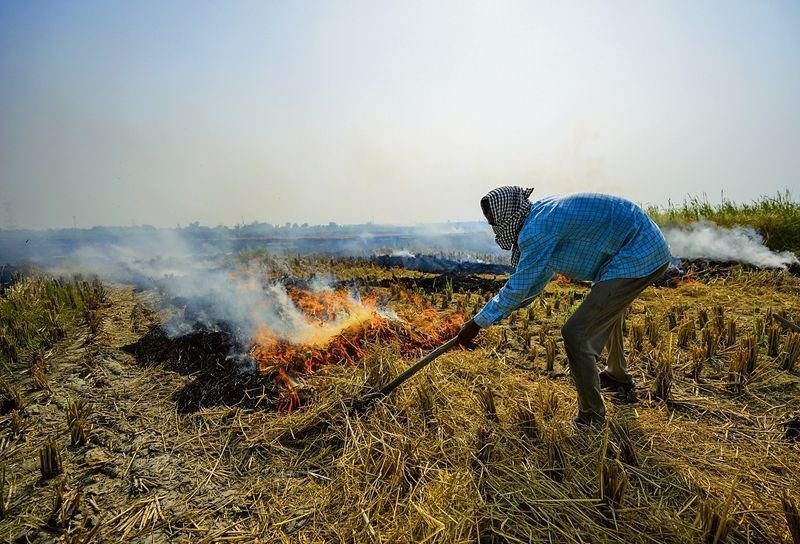

Once the paddy harvest begins across Punjab, the familiar threat of stubble burning once again looms over the state’s fields. Each year, the burning of crop residue contributes to air pollution, affects soil health and raises concerns over its impact on public health.The crop residue left after paddy harvesting is a major problem for farmers. The shortage of time to clear the field for sowing the next crop often pushes farmers towards burning the straw.According to an estimate, burning 10 quintals of paddy straw results in the loss of 400 kg of organic carbon, 5.5 kg of nitrogen, 2.3 kg of phosphorus, 25 kg of potassium and 1.2 kg of sulphur. If the straw is properly managed and retained in the field, these nutrients can instead be returned to the soil. This enhances soil fertility and reduces the need for synthetic fertilisers in the next crop.Additionally, burning straw kills beneficial soil microbes and insects. The gases and particulate matter produced during the process pose severe risks to human health and the environment.Management of the stubble/straw left behind after harvesting paddy has become a major challenge for the farmers of Punjab and the stakeholders, said Alok Gupta of Punjab Agricultural University’s Krishi Vigyan Kendra.To break the cycle, Punjab Agricultural University (PAU) has urged farmers to adopt sustainable residue-management techniques instead of burning paddy straw. These include both in-situ management, where the residue is managed within the field, and ex-situ management, where the straw is collected and put to other uses.Managing straw within the fieldPAU recommends various machines for in-situ residue management, such as the Happy Seeder, Super Seeder, Smart Seeder and Surface Seeder.Surface Seeder: This machine allows low-cost sowing of wheat (Rs 700-800 per acre) without burning the straw or tilling the field. It can operate with a 45 HP tractor and cover around 1.5 acres in one hour. The machine places seed and fertiliser while spreading the straw uniformly over the field, allowing it to act as mulch. This can help reduce weeds, maintain soil temperature and improve soil health. PAU recommends sowing between late October to the first fortnight of November, using a combine harvester fitted with a Super Straw Management System (SMS) and maintaining a clutter height of 4 to 5 inches during sowing. The recommended seed and DAP quantities are 45 kg and 65 kg per acre, respectively.Smart Seeder: This machine incorporates around 15 to 20 per cent of the straw into the soil in front of the furrow openers, while the remaining residue is left on the surface between the furrows. It can cover around 7 to 8 acres a day and helps reduce weed germination.Happy Seeder: This machine sows wheat without removing straw from the field. Its flail-type blades cut the straw ahead of the furrow openers and leave the residue on the surface as mulch. It can cover around 6 to 7 acres a day. PAU advises that straw should be evenly distributed, preferably using a combine harvester equipped with a Super SMS, before operating the machine.Super Seeder: This machine uses a rotavator to mix the straw into the soil ahead of the furrow openers and can sow around 4.5 to 5.5 acres a day.Super SMS: This machine is attached to the back of a combine harvester, chops the falling paddy straw into fine pieces and spreads it uniformly across the field, facilitating subsequent residue-management operations.Ranvir Singh of PAU’s KVK said farmers could select the residue-management technology according to their field conditions and requirements.Putting straw to use outside the fieldUnder ex-situ management, balers can be used to collect and remove straw from fields. The collected residue can then be utilised for biogas production, mushroom cultivation, packaging material, mulching and as fuel for straw-based geysers.Paddy straw can also be treated with urea and used as animal fodder. When used as dry bedding for cattle, it can eventually decompose into organic manure.Proper management of paddy straw can increase humus and organic matter in the soil, improve soil fertility and reduce dependence on chemical fertilisers, PAU experts said.“Effort should be made to bring maximum acreage under straw management to safeguard and enrich soil health. All these measures are fruitful for soil enrichment and reduction of environmental problems, which is beneficial for human beings as well as other living species,” said Ajitpal Singh Dhaliwal of PAU.