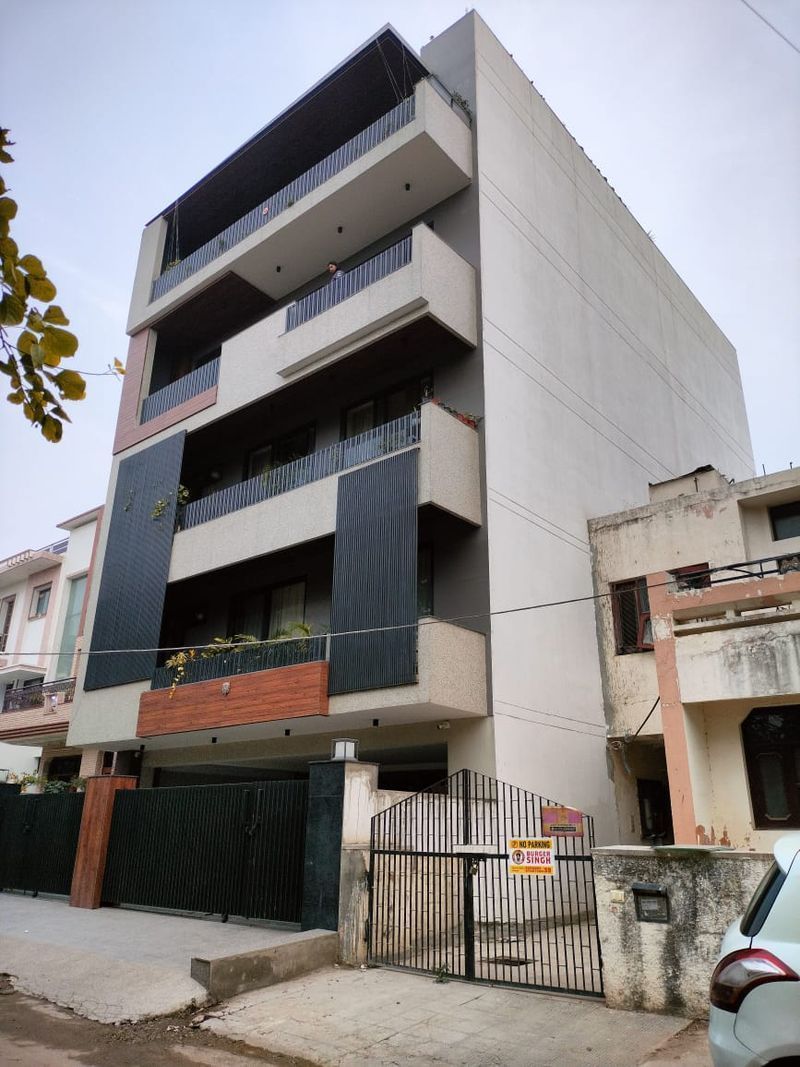

Clarifying the extent of its earlier restraint on the “stilt+4 floor” policy, the Punjab and Haryana High Court on Monday held that the interim order passed on April 2 would operate only within Gurugram district.The assertion came as a Division Bench of the court permitted the authorities concerned to proceed against encroachments and other violations across the state in accordance with law.The court had on April 2 restrained the state from going ahead with the “stilt+4 floor policy” for residential plots after holding that the state apparently prioritised revenue over public safety while ignoring basic infrastructure requirement in Gurugram.Dictating in open court, the Bench of Chief Justice Sheel Nagu and Justice Sanjiv Berry made it clear, “We would like to clarify that this interim order passed on April 2, 2026, and continuing till date relates exclusively to the district of Gurugram and not to any other district.”At the same time, the Bench asserted that the state’s broader policy decision would remain under judicial scrutiny. The court also made it clear that the interim orders were “always prospective in nature”.As the matter came up for hearing, it was alleged before the Bench that the authorities concerned were all geared up to carryout demolitions in Gurugram “under cover of the court’s order”. Appearing before the Bench on behalf of residents, senior counsel Gopal Sankaranarayanan contended that the high court’s order was not on demolition, but “the JCB was sitting right there”.“There may be a couple of people who may have genuinely encroached, who may have gone into the road, and I’m not defending that,” Sankaranarayanan said, adding that the process, however, was being initiated without issuing show-cause notice.The residents had during the day moved the Supreme Court, which directed the petitioners to approach the High Court. The Bench headed by the Chief Justice of India, Justice Surya Kant, granted the petitioners liberty to make an urgent mention before the high court later in the day.Their plea, however, could not be taken up following technical objections. After hearing rival contentions at length, the High Court refused to stall enforcement action and expressly permitted municipal and state authorities to proceed.The Bench noted that its earlier direction had triggered widespread concern among stakeholders. “It appears that many persons are anxious because of the interim order passed by this court on April 2. It was passed after conducting a spot inspection of a particular area in Gurugram…. Therefore, we would like to clarify that this interim order relates exclusively to the district of Gurugam and not to any other district”.An application was filed by the National Real Estate Development Council (Haryana chapter) seeking vacation of the stay. Appearing on its behalf, senior advocate Randeep Singh Rai urged the court to clarify that the April 2 order on stilt constructions was only for fresh permissions.Rai argued while the order meant fresh permissions were not to be granted, “the permissions that are in existence or buildings that are complete pending grant of occupation certificate may not be considered in the stay category”.Rai added the stilt policy came into being in 2013. “It was in force till 2026. A person has got the building plan sanctioned. He has made investments and the building is there. The poor person’s EMI is running, he is paying bank interest. The permissions are valid. As such, the court may consider saying no fresh permission will be granted,” he argued.The court, however, held that the applicant could not seek relief without first being impleaded. “The applicant has not yet become a party and therefore cannot seek vacation unless the prayer for impleadment is allowed.”The Bench directed that a copy of the impleadment application be supplied to the petitioner for response, with the issue to be considered on the next date.