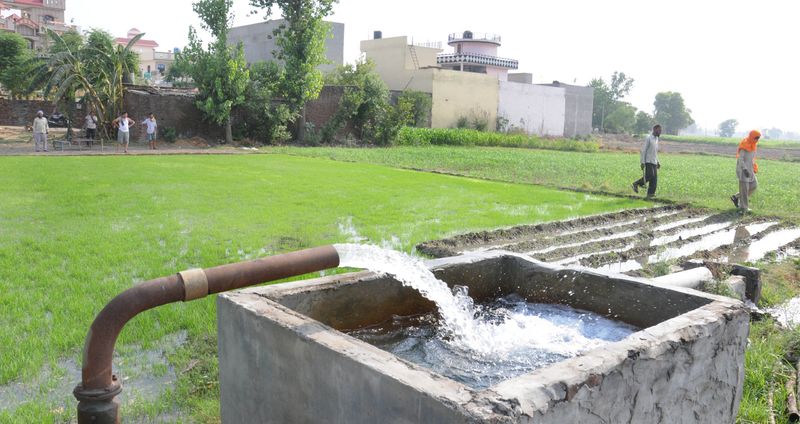

Punjab continues to face a grave groundwater crisis, with the state extracting 56 per cent more groundwater than its annually extractable resources.In its latest assessment, the Centre has identified 111 of Punjab’s 153 groundwater assessment blocks as over-exploited and cautioned against excessive dependence on groundwater for irrigation and dominance of water-intensive paddy cultivation.In a written reply to Rajya Sabha today, the Minister of Jal Shakti CR Paatil said Punjab’s annual groundwater recharge had been assessed at 18.60 billion cubic metres (bcm) while the annual extractable groundwater resource stood at 16.80 bcm.The district-wise assessment reveals stark disparities. Sangrur has the highest groundwater extraction level at 309.99 per cent, followed by Malerkotla (301.93 per cent), Jalandhar (281.17 per cent), Kapurthala (242.96 per cent), Moga (233.09 per cent), Barnala (219.36 per cent) and Patiala (208.53 per cent).Several other districts — Tarn Taran (202.49 per cent), Ludhiana (194.65 per cent), Fatehgarh Sahib (182.13 per cent) and Amritsar (160.33 per cent) also have extraction levels far beyond sustainable limits.A few districts recorded relatively lower groundwater extraction. Muktsar reported a Stage of Groundwater Extraction of 27.81 per cent, Pathankot 41.05 per cent and Fazilka 65.18 per cent, while Rupnagar remained below the critical threshold at 92.80 per cent.The report also lists the districts with the largest number of over-exploited groundwater blocks. Ludhiana has 14 over-exploited blocks, Jalandhar 12, Amritsar 10, Patiala 9, and Sangrur and Tarn Taran eight each. In contrast, Muktsar and Pathankot did not have any over-exploited assessment units.Punjab’s annual groundwater extraction reached 26.27 bcm in 2025, resulting in a Stage of Groundwater Extraction (SGWE) of 156.36 per cent, which is the highest among all states. An SGWE above 100 per cent means groundwater is being withdrawn faster than it can be naturally replenished.The ministry said 72.55 per cent of Punjab’s assessment units had now entered the over-exploited category, reflecting the scale of groundwater depletion across the state.