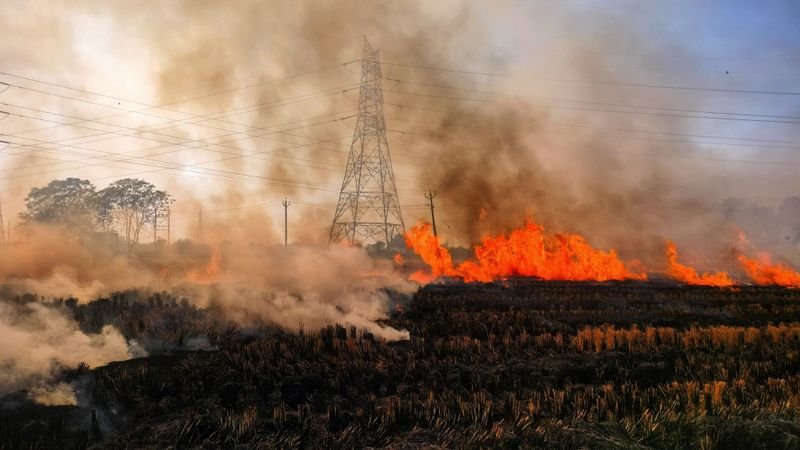

The Tribune team visited several villages in Fatehgarh Sahib, Khanna, Ludhiana, Patiala, Sangrur, Malerkotla and Mohali, where stubble burning remains rampant. Smoggy conditions have prevailed in these villages for the past few days.According to official data, five of the six cities in Punjab where air quality is monitored recorded ‘poor’ air quality on Saturday amid a spike in farm fires and other contributing factors. On Saturday, Patiala recorded air quality index (AQI) of 204, Ludhiana 222, Khanna 201, Jalandhar 205, Mandi Gobindgarh 281 and Amritsar 115.Under the national AQI classification, a reading of 201-300 falls in the ‘poor’ category, while 301-400 is classified as ‘very poor’ and 401-500 as ‘severe’. Higher AQI levels can cause breathing discomfort even among healthy individuals and aggravate respiratory and cardiac ailments.The recent spike in farm fires has led to smog-like conditions across villages. Residents are the first to bear the brunt of the toxic smoke billowing from burning fields. High concentrations of particulate matter have further compounded health concerns, with children and the elderly being the worst affected.Even during the day, visibility has reduced in several villages, with ash from burnt stubble drifting through the air as farmers across the Sangrur-Malerkotla belt continue to set stubble ablaze to prepare for wheat sowing. Residents said smog-like conditions had persisted for the past four days in several nearby villages.“We live in smoggy conditions almost for a fortnight every year when stubble is set on fire,” said Naseem Anwar Khan, an entrepreneur from Malerkotla. “We need to stop this practice and save our children and elders from health complications,” he added.As farmers intensify stubble burning across Punjab’s hinterland, more elderly persons and children from villages are visiting doctors with complaints of sore throat, fever, eye irritation and other ailments linked to smoke from farm fires. While air quality has deteriorated sharply in urban centres, rural Punjab remains the worst affected because of higher concentrations of particulate matter.Ironically, while the majority of stubble-burning incidents occur in villages, air quality is monitored only in cities. Punjab Pollution Control Board officials said they lacked funds to install monitoring equipment in villages and had therefore limited the network to urban centres.A senior government doctor said due to the smoke, people in rural areas were breathing toxic air having coarse particles.