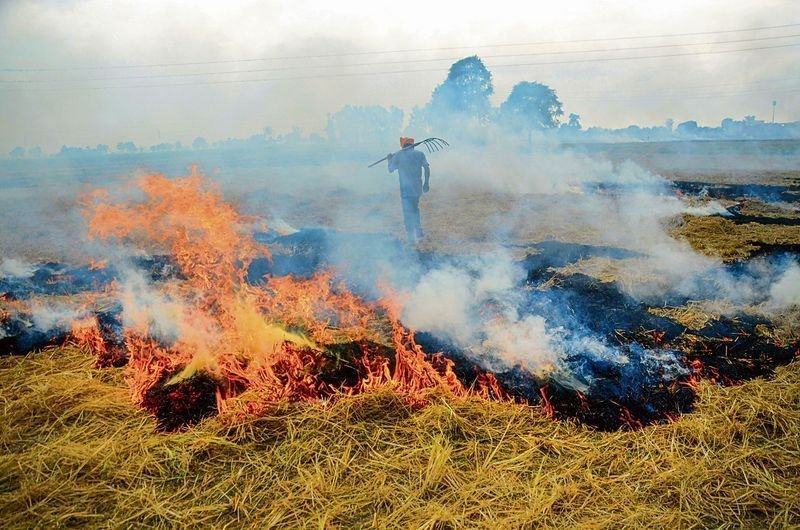

Punjab has recorded more farm fires this season than during the whole of 2025, prompting the Commission for Air Quality Management (CAQM) to issue show-cause notices to six districts on Wednesday evening over alleged failures to enforce restrictions on paddy stubble burning.The state recorded 5,972 farm fires by November 15, exceeding the 5,114 reported during the entire 2025 season. The latest surge, particularly on November 16, has raised fresh concerns over the effectiveness of enforcement measures in Punjab, a key contributor to Delhi-NCR’s seasonal air pollution.CAQM issued notices on November 18 to the Deputy Commissioners and Senior Superintendents of Police of Sangrur, Patiala, Ludhiana, Moga, Muktsar and Mansa under Section 14 of the CAQM Act. They have been asked to submit their replies by 5 pm on November 23.Commission’s data show that Sangrur recorded 741 farm fires between September 15 and November 16, against 694 during the corresponding period last year. Patiala reported 416 incidents, up 78.5 per cent from 233, while Ludhiana recorded 351, an increase of 68.8 per cent from 208. Moga reported 346 against 327, while Muktsar and Mansa recorded 271 and 253 incidents, respectively.The notices follow a fresh spike in all six districts on November 16, despite review meetings held by CAQM with their district administrations between November 12 and 14. Officials had been directed to prevent any further increase in farm fires.On November 16, Sangrur recorded 52 incidents, Muktsar 59, Moga 36, Mansa 34, Ludhiana 24 and Patiala 20.CAQM has also raised concerns over weak field-level detection of burning and the absence of action under Section 14 against officials in the six districts, as reflected in Punjab’s action-taken report dated November 16.How much are Punjab’s farm fires contributing to Delhi pollutionWhile the rising number of farm fires highlights the continuing enforcement challenge in Punjab, their contribution to Delhi’s pollution varies over time and does not explain the Capital’s deteriorating air quality on its own.An analysis by the Centre for Science and Environment (CSE) found that stubble burning contributed 11.5 per cent of Delhi’s PM2.5 concentration on November 1. Its share increased to 16.2 per cent on November 4, the seasonal peak recorded in the analysis, before declining to around 8 per cent on November 6. Delhi’s Air Quality Index (AQI), however, deteriorated to 382 that day.The findings underline the role of multiple pollution sources, including local emissions and pollution transported from other parts of the National Capital Region (NCR). A decline in the estimated contribution from farm fires does not necessarily translate into an improvement in Delhi’s overall air quality.Punjab recorded 50 farm fires on November 14, followed by 137 on November 15 and 461 on November 16. The figures represent more than a nine-fold increase in three days.Although farm fires in Punjab have generally declined since 2020, the latest seasonal tally and district-level spikes highlight the continuing challenge of preventing late-season burning.The six districts have been asked to explain the enforcement gaps. Failure to respond to the notices could invite action under the CAQM Act, which provides for imprisonment of up to five years, a fine of up to Rs 1 crore, or both.