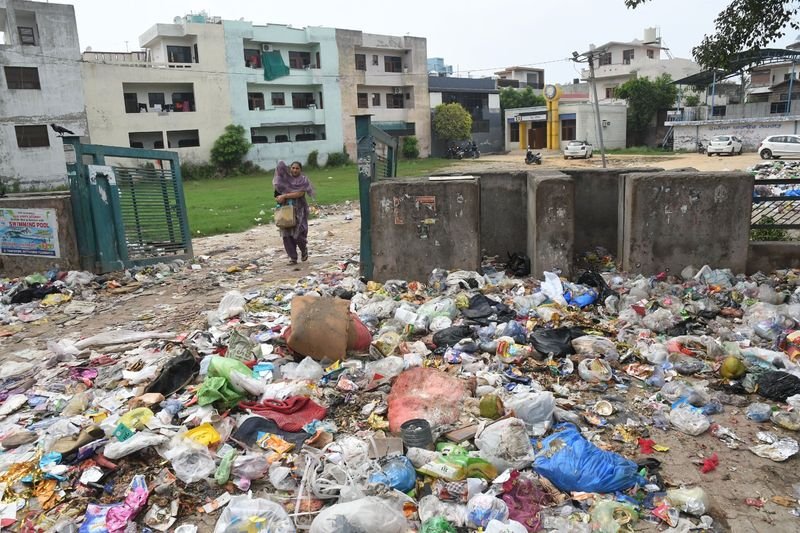

Punjab’s sanitation workers’ strike has entered its third week, with government efforts to resolve the deadlock showing little success. Growing piles of garbage across towns and cities have become a stark reminder of a deeper crisis—one driven by the state’s continued reliance on a socially and economically marginalised workforce for sanitation services and its failure to modernise urban waste management systems.Despite the state government’s announcement of a salary hike and assurances on regularisation of employees, the deadlock remains unresolved. Sanitation workers have refused to resume work and civic authorities have failed to manage waste disposal. The prolonged strike has raised concerns over public health even as negotiations continue.At the heart of the crisis lies Punjab’s continued reliance on members of the Balmiki community for sanitation work in urban local bodies. Decades after mechanised sanitation became the norm in many parts of the country, municipal sanitation in Punjab remains largely dependent on manual labour, reinforcing the traditional association of the occupation with one of the states most economically disadvantaged communities.The lack of large-scale mechanisation has placed sanitation workers in a distinctive position. While their role remains crucial to the functioning of urban areas, the absence of alternatives has also enhanced their bargaining power, allowing repeated strikes to serve as an effective tool for raising demands related to wages, job security and regularisation.Punjab Local Bodies Minister Harjot Singh Bains said the government had attempted to introduce mechanised sanitation, but such initiatives have faced resistance from sections of sanitation workers fearing losing employment.”Whenever the government talks about introducing sweeping machines and other equipment, employee groups oppose the move because they fear displacement. We have assured them that existing sanitation workers would be trained and deployed to operate these machines, but there is still resistance,” Bains said.The minister maintained that the government had accepted almost all major demands raised by the striking employees.”We have assured outsourced sanitation workers that they will be brought under the contractual system and their monthly salary will be increased to Rs 20,500. Those working on contract since 2021 will be absorbed as permanent government employees,” he said.Bains alleged that political affiliations of some groups of sanitation workers were preventing an early settlement. Some politically affiliated pressure groups are not allowing the strike to end despite the government’s acceptance of most demands, he said.Negotiations with workers are continuing, and Municipal Council presidents across Punjab have now been asked to engage directly with sanitation workers in an effort to revive dialogue and end the impasse, he said.Meanwhile, overflowing garbage dumps, foul smell and delayed waste collection have become common across several urban centres, prompting concerns among residents about sanitation and the possible spread of disease.The ongoing agitation has also renewed debate over Punjab’s urban sanitation model. While mechanisation is widely regarded as essential to improve efficiency, worker safety and dignity of labour, governments have struggled to balance technological reforms with employment security for thousands of sanitation workers who depend on these jobs for their livelihood.As the strike continues without a breakthrough, the dispute has evolved beyond a wage issue and has become a political issue.