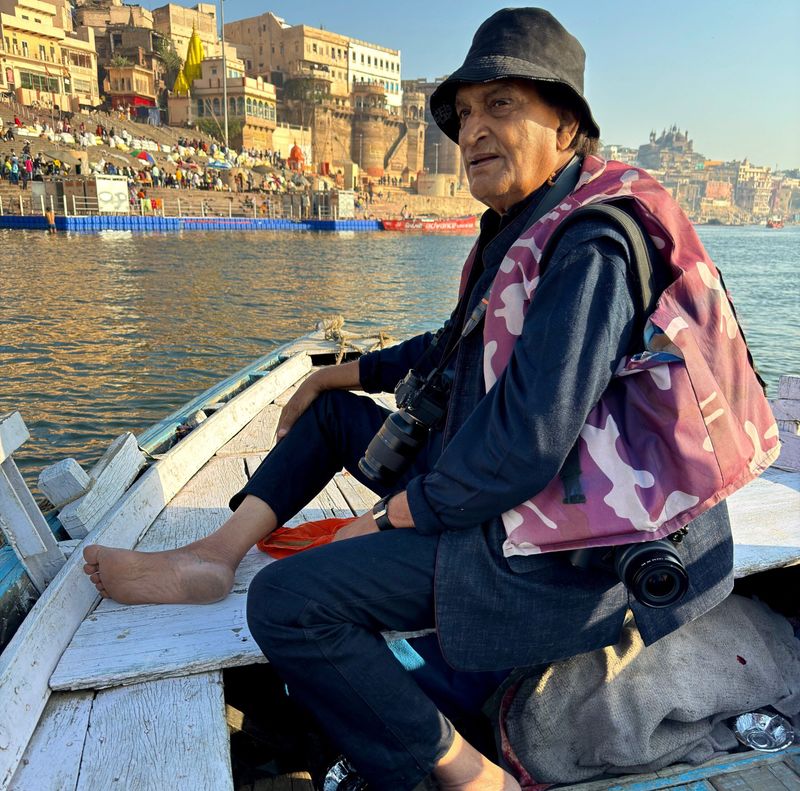

Raghu Rai was the godfather of Indian photography and a guiding light in photojournalism. In his passing, we have lost a powerful, sensitive voice that recorded India’s contemporary politics, culture, and society for over six decades.To honour him, I recount two personal encounters that left a lasting mark on me.In the early 1990s, just two and a half years into my career, my friend Meenu asked if I would like to photograph Raghu-ji while she interviewed him for Savvy magazine. I was thrilled at the prospect of meeting someone I had revered from a distance, yet terrified to photograph him for that very reason.We arrived at his house early one morning and found him busy in his garden. He gave me a simple instruction: “Take whatever photographs you want. I’m working here; don’t ask me to pose. Just shoot.”This threw me. Still nervous, I wondered how to capture something “good” without control. It was the era of film, and I was shooting on colour transparency— a truly unforgiving medium. I began nonetheless. His daughter was hovering around, playing in the mud and picking flowers. I wanted to weave her into the frame and create a lovely, natural story. Fortunately, I managed half a dozen of good images that the magazine eventually published.Fast forward to March 2024. I found myself in a boat on the Ganga with Raghu-ji. Even at 80, his enthusiasm for life on the ghats was mesmerising; I found myself watching him more than the river.As we passed a stretch with new construction, I lamented the changes, having visited Banaras for over 30 years. I told him I found the modern intrusion into these heritage areas distasteful.He looked at me and said, “Dinesh, you can say that because you’ve been coming here for 30 years. But imagine a photographer visiting for the first time. This is their starting point. They will see it as the benchmark, and find it fascinating.”Related news: Raghu Rai, iconic lensman who captured India’s defining moments, dies at 83Raghu Rai as my mentor: From brutal critiques to open-armed acceptanceThat moment taught me a vital lesson in documentation: Look at the “now.” You don’t need to be burdened by what has already been recorded or what is yet to come.Raghu-ji left me with two pillars of wisdom:Trust Yourself:Be yourself. Don’t worry, and just shoot.Be Present:Understand, feel, and remain sensitive to the moment.Thank you, Raghu-ji. It was a privilege to learn from you. You leave behind not just a visual catalogue of India’s contempt history, but also a philosophy for anyone holding the camera: to see clearly, one must be fully present.