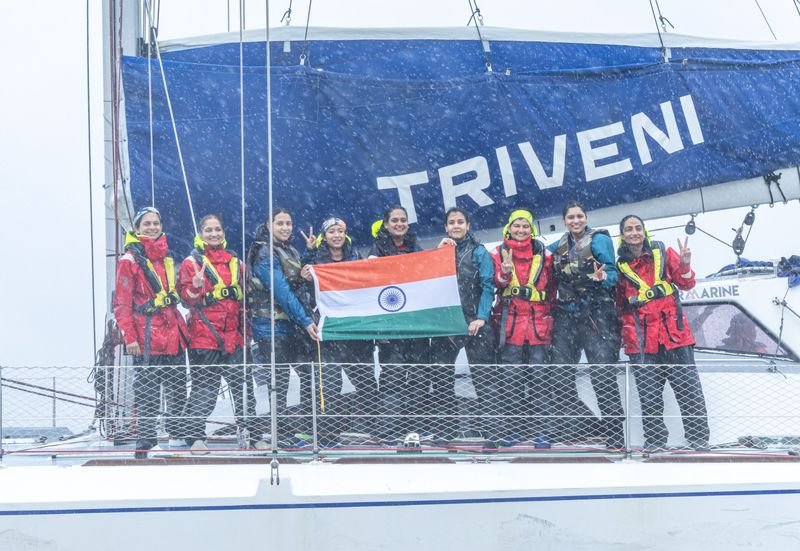

When nine women officers of the Indian Army, Navy and Air Force stepped ashore from the Indian Army Sailing Vessel (IASV) Triveni after successfully circumnavigating the globe, the historic 314-day voyage sparked jubilation. Led by Lieutenant Colonel Anuja Varudkar, the world’s first all-women tri-services Samudra Pradakshina expedition was back in Mumbai after sailing nearly 25,500 nautical miles across four major oceans.The feat has added another feather in the cap of women officers of the Indian armed forces. In May last year, Naval officers Lieutenant Commander Dilna K and Lieutenant Commander Roopa A became the first Indian women to sail the earth in a double-handed, unassisted, wind-powered voyage spanning 239 days and more than 25,400 nautical miles in INSV Tarini. The same vessel had been witness to another achievement in 2017 when the Navy’s first all-women crew of six sailed around the world for eight months under Lieutenant Commander Vartika Joshi.Aboard the indigenously built 50-foot yacht IASV Triveni — named after the confluence of the three services — the crew also included Squadron Leader Shraddha P Raju (Deputy Expedition Leader), Wing Commander Vibha Singh, Squadron Leader Aruvi Jayadev, Squadron Leader Vaishali Bhandari, Lieutenant Commander Priyanka Gusain, Major Karamjeet Kaur, Major Omita Sanjiv Dalvi and Major Prajakta P Nikam.At any given point, six officers sailed actively on the vessel, with the rest relaying from the control room. They crossed the Equator twice, all 360 degrees of longitude and rounded the Three Great Capes — Cape Leeuwin (Australia), Cape Horn (South America) and the Cape of Good Hope (South Africa). By sailing around Cape Horn, they earned entry into the elite Cape Horners fraternity. The team also made four international diplomatic port calls at Australia, New Zealand, Argentina, and South Africa.In collaboration with the National Institute of Oceanography, the crew carried out scientific research and studied micro-plastics, besides documenting ocean life and raising awareness about marine health.The journey was a culmination of years of rigorous training, beginning with smaller offshore expeditions on Class B vessels and advancing to IASV Triveni, a Class A yacht with modern communication and navigation gear. The preparatory voyages along India’s western coast were followed by an international expedition from Mumbai to Seychelles and back, gradually building the crew’s endurance, seamanship and confidence.Experience of a lifetimeSharing her experience of rounding Cape Horn, often described as the ‘Mount Everest’ of sailing, Lt Col Varudkar says, “It was the greatest feat of our lives. To round Cape Horn is not merely to pass a point on a chart — it is to earn the respect of the sea”.Recalling the sail through the notorious Drake Passage, where the Atlantic and Pacific Oceans collide, she says, “The day is etched in my memory. We were facing towering waves, screaming winds and unforgiving weather. And suddenly, the ocean surprised us. For a fleeting moment, the winds softened. The waves settled. The sky opened just enough to let sunlight spill across the water. It was a pause so brief and so unexpected that it felt almost sacred. At that moment, we saw Cape Horn. Within seconds, we gathered on the deck to absorb the sight. Even today, whenever I look up at the night sky or hear the sound of the wind, a part of me returns to that moment — to the sailors, the Indian flag and the end of the world.”Sqn Ldr Shraddha P Raju remembers another defining test near Tasmania. “In heavy winds, our foresail had been torn, forcing us to head towards Hobart. At the same time, our engine failed due to water ingress, leaving us in a dangerous situation. The strengths of all three services came together at that critical juncture. While some Army officers worked to secure the damaged sail, the Air Force officers focused on restoring the engine. The Naval officer analysed the weather, sea conditions and tidal currents, and advised that we should drop all sails and drift with the ebbing current to avoid being pushed towards a mountain barely 2 nautical miles away. Together, we safely navigated the crisis.”For Lt Cdr Priyanka Gusain, the most frightening phase came midway to Cape Town. “It had been raining continuously and our wind instruments failed due to water ingress. For a considerable stretch, we were fighting poor visibility, sailing just by the feel of the wind. That’s when doubt hit me. No wind data, bad weather, middle of the ocean… there’s no turning back now. But then I reminded myself that we had trained for this. The boat was handling, the crew was together, and we had already crossed the Drake Passage. I focused on what we could control — sail trim, watch-keeping and trusting the feel of the boat. The moment taught me that when instruments fail, you fall back on training and faith”.Military Nursing Service officer Maj Karamjeet Kaur, who belongs to Sirsa in Haryana, shares how everyone in the team contributed in a disciplined manner, “No one had to be detailed for the task — each crew member had a sense of belongingness. An unspoken rule which we all followed was the judicious use of scarce resources like water, ration and satellite phone units. We always helped each other in waste disposal, routine maintenance, cooking and cleanliness.”Sqn Ldr Shraddha P Raju, Maj Karamjeet Kaur and Maj Prajakta Nikam lowering the jib sail.“We are all from the uniformed services, so teamwork and discipline come naturally. Living on a small yacht for months, the mission always came first. We shared responsibilities, talked things through, and found joy in simple moments like watching the beautiful sunrise, dolphins, seabirds, or a great catch. Those little moments kept our spirits high,” shares Sqn Ldr Aruvi Jayadev.On the yacht what they craved the most for, besides family, shares Wg Cdr Vibha Singh, was a comfortable bed that didn’t move. “Sleeping without the constant vibration, engine noise, or rolling of Triveni is a luxury many don’t appreciate until they’re at sea,” she says. To this list, Sqn Ldr Vaishali Bhandari adds spontaneity: being able to decide “I’ll grab a coffee”, “Let’s watch a movie”, or “I’ll go for a drive”, without being confined to a limited space. “There was no scope for privacy on a small yacht with six women, their luggage and spares. If someone wanted privacy, they’d head to the bow of the boat… only to be drenched by heavy swells,” she adds.Breaking barriers“It’s incredible how women officers from the three services came together to complete this historic feat. It will encourage more women to take on different roles in the defence services and challenge perceptions that women don’t have enough endurance for tough roles,” says seasoned sailor, artist and filmmaker Dhanya Pilo, who mentored the crew for a couple of months.Daughter of a Naval officer, Pilo has been sailing since 1997. She was a crew member of the all-women sailing team Maiden, which won the Ocean Globe Race 2023-24.Sailing a boat requires physical endurance as well as mental strength, more so if you are a woman. “You’re dealing with your periods, body fatigue due to heavy lifting, etc, but then it also gives you a lot of confidence. Sailing teaches you that while strength matters, it is mental resilience that ultimately carries you through. The Triveni crew was a mix of different branches of armed forces like nursing, engineering, communications, etc. The confidence they have gained will influence how they approach their careers over the next decade,” adds Pilo.Lt Cdr Priyanka Gusain carrying out daily engine checks.A distinction cannot be made when women are on the boat because everybody has to be equally capable, says Kirti Chakra awardee Commander Abhilash Tomy (retd), who was the first Indian to complete a solo, non-stop, unassisted circumnavigation of the globe during his historic 2012-13 voyage aboard the Indian Navy sailboat INSV Mhadei. His mentor, Captain Dilip Donde (retd), was the first Indian to sail solo around the world, but with four stops.“Circumnavigating the earth is a huge challenge. The women officers accepted it and completed it, which is remarkable. Going around the globe in a boat requires years of serious training. Life at sea is uncomfortable but deeply rewarding. You experience a kind of freedom that you can never find on land.” Those who want to attempt circumnavigation, advises Commander Tomy, should have the willingness to learn, patience, physical and moral courage, emotional stability, and the ability to be comfortable with themselves.Among the expedition’s biggest cheerleaders was a WhatsApp group of 183 defence veterans, mostly from the Navy Foundation, Mumbai. Says 90-year-old Vice Admiral IC Rao (retd), “We started following their journey when IASV Triveni sailed from the Gateway of India on September 11, 2025. Our WhatsApp group included many experts, and we had our own navigation and satellite apps to monitor their journey. We had a good sense of what they were facing each day, and everyone would share their observations in the group. We were not in touch with the crew, but they knew they had a huge group cheering for them.”Maj Omita Dalvi navigates the sea.Sharing how the group came about, Admiral Rao says, “In 2022, Commander Abhilash Tomy was competing in the Golden Globe Race for the second time. During his first attempt, he met with a serious accident in the Southern Ocean and had undergone a spinal surgery. After relearning to walk, he returned to race again and we were all eager to follow his journey. People wanted to know what was going on, so I started explaining and soon our group evolved. Tomy finished second. We realised how much we enjoyed ourselves. As armchair sailors, we analysed every development. Our group has grown manifold and we follow every major sail”.The cheer group was also among the first to felicitate the IASV Triveni crew back in Mumbai. As the women officers rested both their feet on the table at the United Services Club, Colaba — a privilege reserved for those who have rounded both Cape of Good Hope and Cape Horn — they knew they had broken more than just records.“Life aboard IASV Triveni gave us memories that we will cherish forever. On a good sailing day, we would wake up to see the rising sun. On one of these beautiful mornings, a school of 100 dolphins swam by our side. I was mesmerised,” shares Maj Omita Sanjiv Dalvi.When the team stepped onto solid ground at the Gateway of India on July 22, they were overwhelmed. Maj Prajakta P Nikam recalls the day, “We were home… and Triveni had brought every one of us back. Our boat had sailed out carrying hope and returned with stories, scars and an unbreakable sisterhood forged by salt water and shared watches.”