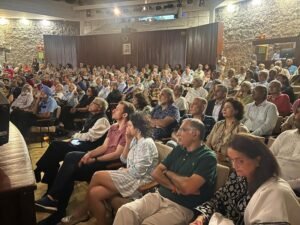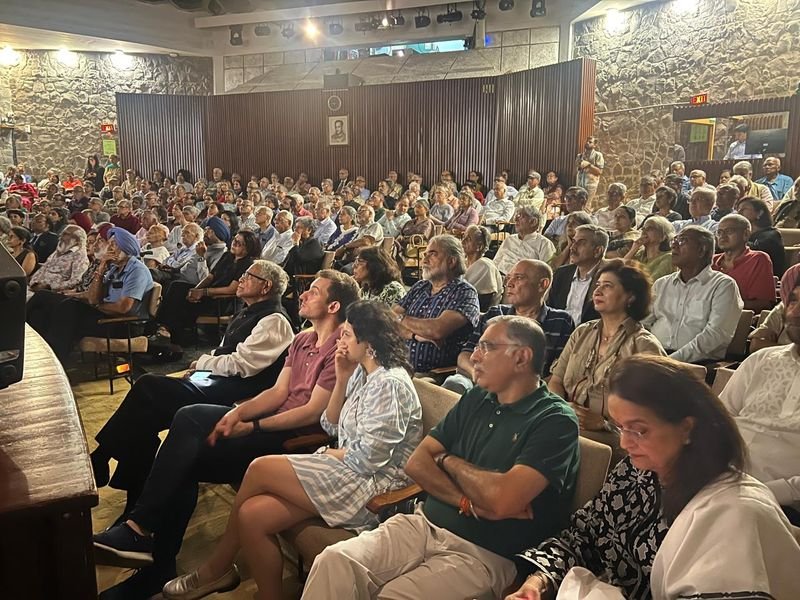

The story of the 1971 Bangladesh Liberation War and India’s role in the humanitarian mission will continue to run into several editions. But when it comes to touching the audience, nothing might come quite close to what the select Delhi audience at India International Centre experienced this week when narrators Subroto Chattopadhyay and Maj Gen Anil P Dere of The Peninsula Studios took them through the making of the war.“Vision to Victory: 1971”, a 90-minute presentation, spoke of India’s triumph not through books or lectures but testimonies of the heroes who lived and shaped the event.Archival pictures and footage, sourced by Chattopadhyay, formed the core of the presentation, which, until this week, had only been shown in National Defence College, Lal Bahadur Shastri National Academy of Administration, Sardar Vallabhbhai Patel National Police Academy and top War Colleges. “This week’s event was the production’s first public outing,” said Chattopadhyay, founder-chairman of The Peninsula Studios, a New Delhi-based National Award-winning content creation house.The production now also accompanies “Bangladesh: Humiliation, Carnage, Liberation, Chaos”, two independently authored volumes, Chattopadhyay’s own and one by Iqbal Chand Malhotra, bound together under a single cover.For its part, “Vision to Victory” made many key revelations, including about events that altered the course of the war. More than a commemorative piece, the production stood out as a test case of how India, despite being ranged against the US, came out on top of military coordination under pressure.The story opens with Operation Searchlight, Pakistan military’s brutal crackdown on the Bengali nationalist movement in East Pakistan on March 25, 1971, and the refugee influx into India.“As the crisis deepened, India sent out appeals to 61 nations but everyone hid behind the fig leaf of non-interference. India stood alone but firm,” said the narrators, revealing how then Prime Minister Indira Gandhi’s principal secretary PN Haksar proposed that the Bangladesh freedom movement be led by the Bangladesh government in exile.Rare footage of Bangladesh’s Provisional Government swearing in on April, 17, 1971, at Mujibnagar was shown at the IIC with serialization of the events that led to the opening of a State Bank of India account to fight the war. The provisional government functioned through the length of the war out of a BSF facility in Calcutta.The documentary goes on to capture Indian diplomatic efforts from Washington to the UN, failure of the world to intervene and how the later declassified tapes later described a meeting with Indira Gandhi as “Nixon’s worst meeting with any foreign leader”.The narrators also mentioned December 15, 1971, when then Pakistan foreign minister Zulfikar Ali Bhutto rejected a Polish ceasefire resolution at the UN Security Council against his own president’s direct order as a key milestone event that shaped how the war actually ended. “Had Bhutto accepted the ceasefire, India could not have taken the surrender of Pakistan’s army at Dhaka on December 16, 1971,” Chattopadhyay said.The most striking part of the documentary was a lowdown on combat decisions that ensured victory came to India. It showcased how Lt Gen Sagat Singh led the IV Corps to a historic win crossing an impassable Meghna river using helicopters and capturing Dhaka.The production captures the role then Major Shamsher “Shammi” Mehta (later Lt Gen) played in leading the 5 Independent Armored Squadron (equipped with PT-76 amphibious tanks) through the Meghna. This was the first Indian armored column to enter Dhaka.Narrators also used the archives to show how Maj Mehta instantly said yes when Lt Gen Sagat Singh asked him if he could cross the Meghna. “This even when Major Mehta was yet to figure out how he would do it,” said Chattopadhyay, who wrapped up the production with Lt Gen SS Mehta (retd)’s powerful summation of the war’s outcomes.“The Bangladesh Liberation War was the victory of democracy over military rule; humanism over barbarism; manoeuvre over attrition; and liberation over occupation,” former Western Army Commander Lt Gen Mehta said at the end of the production.The war ended with the surrender of 92,000 Pakistani personnel at Dhaka, in what is ranked among the largest surrenders since the Second World War.