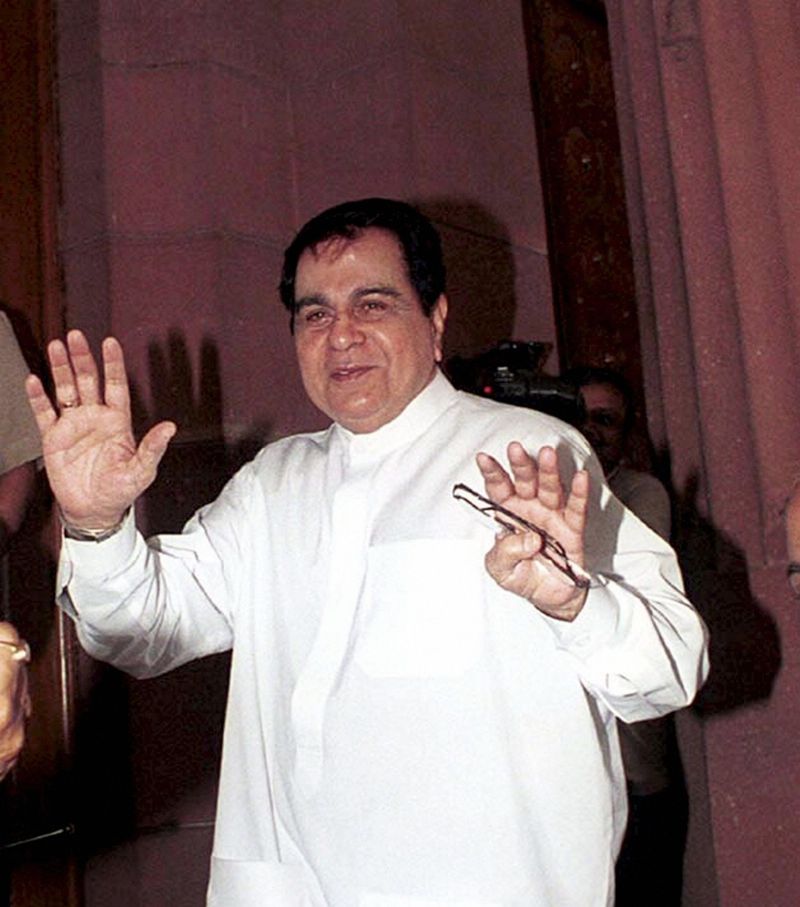

In life as in death, Dilip Kumar remains an institution beyond all institutions. If you had the privilege of interacting with him, as I did, you would have been completely mesmerised by his soft gentle and persuasive eloquence.Yusaf Saab (as he was known among his close friends and just ‘Saab’ by his utterly lovely wife) never received any formal education. Yet his regal bearing, his soft spoken sophisticated personality and his ability to hold an audience spellbound with his magical web of words, was unique and miraculous.Like all movie buffs, there were two personalities whom I thought I’d never ever meet. Lata Mangeshkar and Dilip Kumar are to Indian cinema what Isaac Newton and Albert Einstein were to science. Eliminate them, and you’re looking at a huge yawning gap in the history of our cinema. To my undying joy I got to know both these institutions.I remember how my voice trembled when I first spoke to him on the phone. It was the holy period of Ramzan. I was speaking to the lovely Saira Banu. Saab was undergoing the holy fast for Ramzan. At his age, that was tough. I conveyed my regards to his wife when she—gracious as ever—turned around to ask, “Would you like to say hello to him?”My first impulse was to refuse. One doesn’t say hello to God! It’s like eating pizza inside the Taj Mahal. Before I could stammer my excuse she called him over. I remember I gushed and gushed for a good three four minutes. He heard me out patiently. This was a man who was used to being bombarded with encomiums. He knew how to deal with gush.At the end of my torrent of compliments he quietly said, “No, there might be many better actors than me. I’ll tell you, I had no training and I wouldn’t have dared to venture into films were it not for my family’s financial conditions. God bless you. Please come and see me when you are in Mumbai.”That’s exactly what I did. Coincidentally it was the period of Ramzan again. And Saab was doing his prayers when I arrived at their neatly kept bungalow in Pali Hill. I had to wait. But I didn’t mind. Good things always come to the patient.And Yusuf Saab did finally walk in. I think my jaw fell to the ground, and came back in place only to savour the goodies that Saira ji had laid out on the table. The aura that Yusuf Saab radiated is beyond anything that I can describe. It’s that healthy shiny glow of a man who has kept the child within alive.Lata ji had the same radiance in her personality. And anyone who came in contact with either is blessed. If you know both (like I do) then you’re personally anointed by God.That October evening, I sat with this legend beyond legends. As he narrated anecdote after anecdote, I realised one of the prerequisites of superstardom is the gift of effortless communication. Amitabh Bachchan, Shabana Azmi, Shah Rukh Khan have it.The only formidable star who was painfully shy and an interactive hermit is Sridevi. Yusuf Saab and she worked together in a kitschy film called Dharam Adhikari—a film that came in a period of the actor’s life when he was losing a grip over his career.That evening we didn’t speak about Sridevi. But we did speak about his other heroines—Meena Kumari, Nargis and of course Madhubala, his Anarkali in Mughal-e-Azam. The two were supposed to be passionately in love. In fact, every leading lady who matters, wanted to marry the mighty Mr Dilip Kumar. He chose the beauteous Saira Banu with whom he worked in a string of films like Gopi, Sagina and Bairaag.After marriage Yusuf Saab moved into Saira Banu’s bungalow where he was pampered silly by her grandmom, mom and of course Saira ji herself. Yusuf Saab blossomed under all the attention.Watching him radiate so much positive energy I couldn’t but wonder about the ways of destiny. Here was this robust Pathan from a migrant family of fruit sellers with no experience in acting. How did he become the most powerful actor of India?Said the indomitable legend, “I was always very business minded. I loved the family business. But it was a very tough life. The entire process from plucking fruits to their dispatch was very cumbersome. Bahut mushqil tha. I had to get another job with a decent salary. That’s where acting came in handy. The World War II was extremely hard on the horticulture business. My father would grow apricots, grapes, pomegranates, apples and peaches. He would get those fruits tinned. He would proudly show me the size of the fruits and say, ‘This is what I want you to grow, Yusuf. Because you’re my most intelligent son.’ He wanted me to be educated so I could enhance the family business.”At first Yusuf Saab’s father was against his son getting into acting. “He was very annoyed when I got into films. But then he heard other people whom he respected relishing the idea. Once Maulana Azad whom everyone revered, heard my father commenting caustically on one of his sons drifting into films, and what to do? Maulana Saab intervened on my behalf and said there’s no telling what the future holds for anyone. He also told my father to be proud of his son’s achievements and implored him to be patient with my aspirations.”My most moving conversation with Yusuf Saab was after the carnage of the Muslims that followed in Gujarat, Yusuf Saab became immensely pained by the divisive politics of the nation. “We had great leaders Pandit Nehru, Mahatma Gandhi, Maulana Azad and Gaffar Khan Saab who helped us form what we called the India ethos. Then we had their phony followers who wore their clothes and spoke the language of hatred. Surprisingly even I understand the Hindu ethos rather well. I’ve read the Hindu scriptures. Nowhere do they preach the language of hostility and dissension.”But Dilip Saab was ever-hopeful about the future of India. “We must thank the electronic media for exposing the shallowness of our national leaders. During the fight for Independence we thought of our politicians as the architects of our future. Now when they stand naked before us, as the dance of barbarism goes on all around, we know the politicians indulge in only lip service. The leaders who actually mean to do good are hidden from view. Time or the public will pull these people out of the shadows. I’m convinced that there are more good than bad people waiting to lead the nation.”