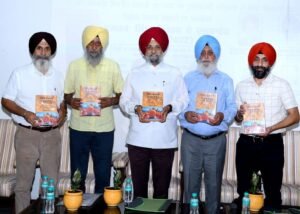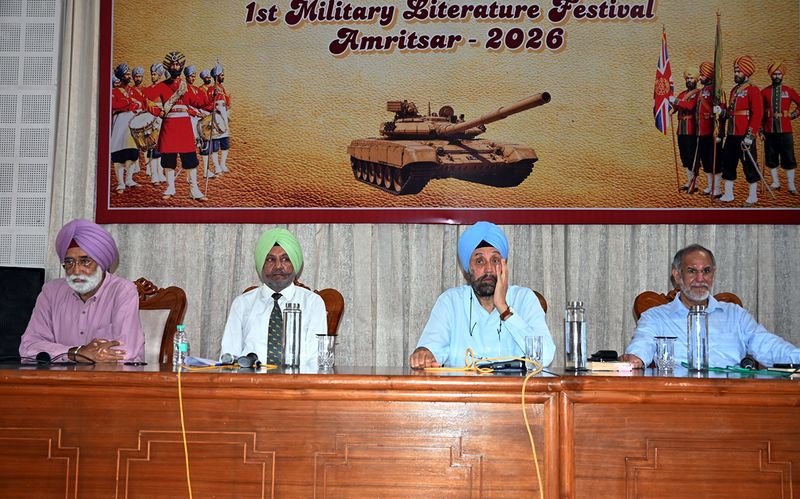

The first edition of the two-day Military Literature Festival opened at Khalsa College, Amritsar, on Monday, bringing diplomats, military veterans, authors and academicians together to engage students on national security, international affairs and history. Organised in collaboration with Khalsa University, the festival featured discussions on contemporary geopolitical developments, military affairs and significant episodes from India’s history.Lt Gen TS Shergill, PVSM, PhD, Chairman, Military Literature Festival, was the chief guest. Speaking about the importance of documenting India’s and Punjab’s military history, he said the courage and legacy of the Indian armed forces needed to be conveyed to the younger generation.“The Indian Army is an example of the world’s finest, their courage and legacy unmatched. We must inform young people about the history, sacrifices and achievements of India’s armed forces,” he said. He added that the festival provided a platform for veterans, soldiers, historians and authors to share their experiences and encouraged discourse on geopolitics, the armed forces and national security.Prominent speakers included former Ambassador and author Navtej Singh Sarna, former Ambassador and literary researcher Navdeep Singh Suri, Lt Gen (Dr) JS Cheema, PVSM, AVSM, VSM, and Maj Gen Harvijay Singh, SM.The speakers discussed contemporary and historical issues, including the West Asia crisis and the Jallianwala Bagh massacre. Lt Gen Shergill also highlighted the security concerns facing Punjab as a sensitive international border state, particularly the growing use of drones.A major attraction of the festival was the display of military equipment, giving students an opportunity to see modern military platforms, weapons and surveillance systems. The display included a T-72 tank, BMP, L-70 medium-range air-defence anti-aircraft gun deployed during the 1965 and 1971 wars, ZU-23 anti-aircraft system, drones, military vehicles, radars, night-vision devices and small arms.Dr Atam Singh Randhawa, Principal, stressed the need to organise such programmes regularly to familiarise Punjab’s youth with issues of national importance and encourage more youngsters to consider careers in the armed forces.West Asia crisis discussedLt Gen (Dr) JS Cheema and Maj Gen Harvijay Singh shared their perspectives on the West Asia crisis, discussing the changing balance among Israel, Iran and Arab states. They highlighted security concerns for Indians in the Gulf and risks to India’s trade, energy supplies and maritime routes.They also said ongoing geopolitical conflicts had increased the importance of surveillance, electronic warfare and drone technology.Jallianwala Bagh through Sikh soldiers’ perspectiveThe second session, focusing on the Jallianwala Bagh tragedy from the perspective of Sikh soldiers who returned to India after the First World War, examined the issue from a historical and social perspective.Navtej Sarna, through his book Crimson Spring, and Navdeep Suri, through his grandfather and novelist Nanak Singh’s poem Khooni Vaisakhi, shed light on the role of Sikh soldiers in the nationalist movement.Sarna said Punjab had been a major recruiting ground for the British Indian armed forces during the First World War, with many Punjabis voluntarily joining the British forces and fighting in Mesopotamia, Europe and other regions.“That enthusiasm died down once the realities of war struck. These soldiers, when they returned to Punjab, saw a different side of British rule, with the Rowlatt Act, Spanish flu pandemic and economic difficulties being the reality back home,” he said. He added that the loyalty of these soldiers towards the colonial army was challenged by the Jallianwala Bagh massacre.Suri also discussed Brig Gen Reginald Dyer and the colonial military system that shaped him. “Dyer was a product of colonial military system. Despite being a disciplined military man, he had no intention of preventing the atrocities he unleashed on April 13, 1919, at Jallianwala Bagh,” he said.