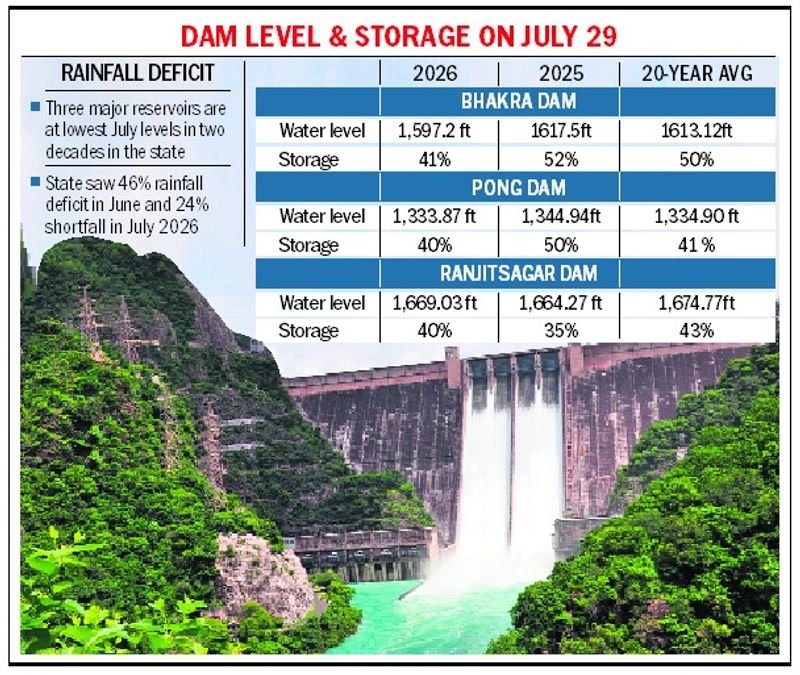

Water levels in Punjab’s three major reservoirs are at their lowest as of July 29 compared to the average for this date over the past two decades. The decline follows prolonged below-normal rainfall across the state and its catchment areas, raising concerns over water availability for the next agricultural season if the deficit continues through August.According to Punjab Water Resources Department data, the Bhakra Dam is only 41 per cent full, compared to 50 per cent last year and a 20-year average of 50 per cent. The Pong Dam is at 40 per cent capacity, against 50 per cent last year and a 20-year average of 41 per cent. The Ranjit Sagar Dam is also at 40 per cent, compared to a 20-year average of 43 per cent.The water level in the Bhakra Dam on Wednesday was 1,597.2 ft, compared to the average water level of 1,613.12 ft in the past two decades. As compared to past two decades average water level of 1,334.90 ft in Pong dam, the present day water level is 1,333.87 ft, while in case of Ranjit Sagar dam, the present day water level is 1,669.03 ft, as compared to average 20 years water level of 1,674.77 ft.According to the India Meteorological Department (IMD) data, Punjab received only 29.5 mm of rainfall in June against the normal of 54.5 mm, registering a deficit of 46 per cent. In July, till July 29, the state recorded 113.3 mm against the normal 150 mm, reflecting a 24 per cent shortfall. Himachal Pradesh, which contributes significantly to inflows into the Bhakra and Pong reservoirs, also witnessed a 33 per cent rainfall deficit in June, although July rainfall has been 8 per cent above normal.The rainfall deficit comes despite the IMD issuing forecasts of heavy to very heavy rainfall over several Punjab districts, including Pathankot, Gurdaspur, Hoshiarpur, Nawanshahr, Ropar, Fatehgarh Sahib, Mohali, Amritsar, Tarn Taran, Kapurthala, Jalandhar, Ludhiana and Patiala during July 20-22 and July 28-29. However, most of these districts did not receive the anticipated substantial rainfall.Officials noted similarities to the weak monsoon of 2021, when reservoirs failed to reach full capacity by the end of the season.A senior officer said August would be crucial. If rainfall remained deficient, water management priorities might shift from flood preparedness to conserving reservoir storage to ensure irrigation, drinking water and hydropower supplies next year.