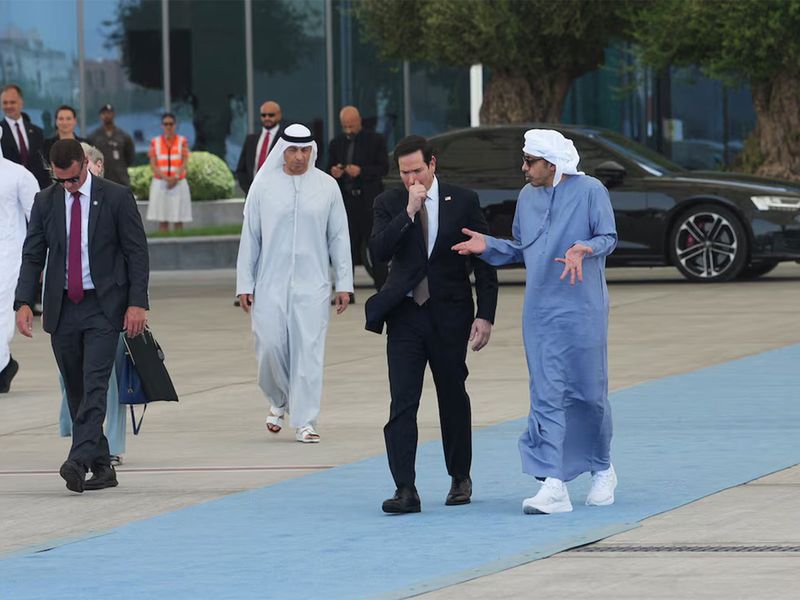

Abu Dhabi [UAE], June 24 (ANI): The United States has provided further insights into the high-level deliberations between US Secretary of State Marco Rubio, UAE President Sheikh Mohamed bin Zayed Al Nahyan and senior Emirati leaders in Abu Dhabi.Detailing the engagement, the US State Department spokesperson Tommy Pigott noted that the leaders focused on President Donald Trump’s efforts to secure full and safe transit through the Strait of Hormuz, while underlining the critical importance of regional peace and stability.The discussions also touched upon the robust bilateral US-UAE ties and their enduring partnership across the sectors of defence and commerce, Pigott added.According to the spokesperson, Rubio “thanked the UAE for their leadership and unparalleled support, praised their courage and resilience in the face of Iran’s attacks, and reaffirmed the US commitment to the security of the Emirates”.This high-profile meeting took place on Wednesday during the opening leg of Rubio’s regional tour, serving to reinforce Washington’s strategic security commitments to its Gulf partners in the wake of the recent US-Iran diplomatic breakthrough.Expounding on the core focus of the bilateral discussions, Pigott clarified that the two leaders also evaluated President Trump’s broader memorandum of understanding with Iran.The visit underscores Washington’s proactive diplomatic outreach to traditional allies in the Arabian Gulf, aiming to reassure the Emirati leadership of continued American backing amidst a shifting regional security architecture.Prior to these high-level deliberations, the US Secretary of State briefed reporters upon his arrival in Abu Dhabi on Tuesday (local time), offering critical context on the limits of current diplomacy.He asserted that lasting peace and stability in West Asia cannot be achieved as long as Iranian-backed proxy groups continue launching attacks and engaging in militant activities across the region.Specifically targeting regional destabilisation, Rubio warned that hostile entities operating from Iraq continue to threaten regional security through missile and drone strikes.”You can’t have the end of hostilities and conflict in the region as long as Iranian proxies are launching missiles and drones from Iraq and are participating in terrorism,” Rubio said.Addressing distinct diplomatic tracks, Rubio stressed that discussions over a Lebanon ceasefire are being handled completely separately from the ongoing negotiations with Tehran, emphasising that Lebanon is a sovereign country with its own government.”Well, that process is separate. It’s separate because Lebanon is a sovereign country. It has a government. And when it comes to Lebanon and what’s happening inside of Lebanon, we’re going to negotiate a deal directly with the Lebanese Government,” he stated, adding that he and US Vice President JD Vance had recently spoken with Lebanese President Joseph Aoun to coordinate active US efforts on the ground.This diplomatic push through the Persian Gulf region, scheduled from June 23 to June 25, with upcoming stops in Kuwait and Bahrain, comes just days after the conclusion of initial technical talks between Iran and the US in Switzerland.Those deliberations formed part of a 14-point memorandum of understanding (MoU) aimed at ending regional hostilities.The multi-nation trip is explicitly structured to consult regional allies, including representatives of the Gulf Cooperation Council (GCC), as Washington advances its high-stakes dialogue with Tehran.”We’re really here to hear from them more than we are to talk,” Rubio told reporters, highlighting Washington’s intent to fully integrate the economic and security viewpoints of its Gulf partners following the weekend talks in Switzerland.The Secretary of State noted that while regional allies support efforts aimed at reducing tensions, significant operational challenges remain ahead.”All of them are on board for peace. Obviously, it all depends on the details of that peace as we work through,” Rubio observed, describing the current framework as a work in progress where solid groundwork had been laid over the preceding 72 hours.On the broader geopolitical landscape regarding Iran’s future role, Rubio concluded that Tehran’s leadership faces a fundamental choice between continuing its militant legacy or adopting a conventional state framework.”If Iran’s leadership makes a decision that they want to be a country instead of a revolutionary movement that exports terror, they’re going to have an opportunity to do incredible things,” he said, reiterating that verifiable progress on curbing the activities of Iranian-backed groups remains essential to any permanent diplomatic breakthrough. (ANI)(This content is sourced from a syndicated feed and is published as received. The Tribune assumes no responsibility or liability for its accuracy, completeness, or content.)