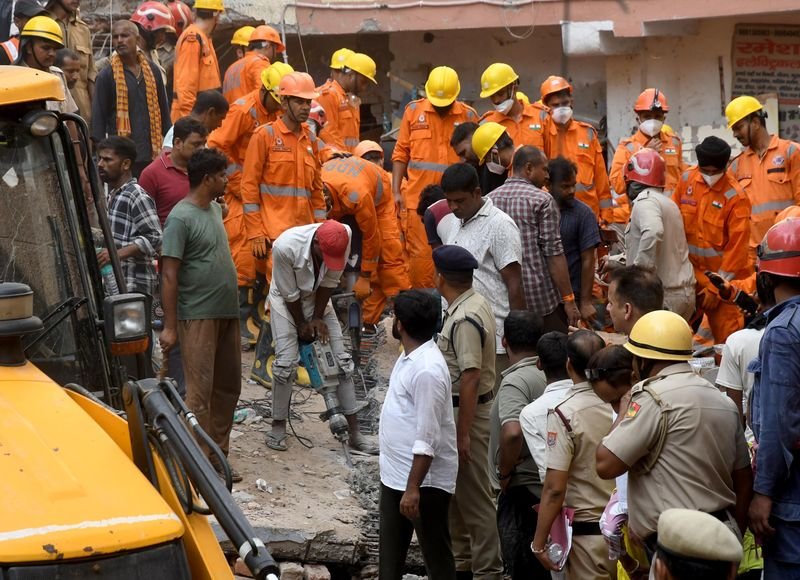

The Satya Niketan building collapse has exposed a contradiction at the heart of Delhi’s building-safety regime which is that the Capital has a detailed set of rules governing height, exits, fire access and structural safety, yet some of the city’s most densely occupied student neighbourhoods continue to have buildings where emergency vehicles struggle to enter and occupants may have limited ways out.The same was visible at Satya Niketan on Jattvibeday and earlier in the June 4 South DelhiBed and Breakfast blaze that killed 29.Today as rescue teams reached the collapsed five-storey PG, the narrow lanes immediately became a logistical challenge as JCBs and heavy equipment could not swiftly manoeuvre the congested streets. The roads were simply too narrow for to accommodate fire tenders, ambulances, police vehicles and earthmoving machinery, hampering rescue.There is another challenge. Delhi has no dedicated law to regulate the paying guest accommodation, no licensing and no occupancy limits. Today’s episode is particularly significant as Delhi has just tightened its fire-safety framework.On August 28, the Delhi Government notified the Delhi Fire Service (Amendment) Rules, 2026, prescribing 18 broad categories of fire-prevention and safety requirements. Among them is a minimum six-metre right of way for fire engines up to the premises, along with requirements relating to protected exits, fire and smoke barriers, alarms, sprinklers, hydrants, firefighting water storage, emergency power, fire lifts, refuge areas and fire-control rooms.But amended rules will come into force only when the Delhi Development Authority notifies the amended Unified Building Bye-Laws (UBBL), 2016.The existing UBBL framework already recognises the importance of safety vehicle access. Delhi Fire Service’s own guidance says buildings up to 40 metres require a six-metre-wide hard-surface fire-tender movement road with a nine-metre turning circle at corners, while buildings above 40 metres require a nine-metre width and 12-metre turning circle.On other hand, the recently unveiled Master Plan for Delhi-2047 has tightened the broad safety framework, providing for structural audits, fire-risk assessments, retrofitting of vulnerable buildings and better emergency access, while also recognising students as a key rental-housing group. It however stops short of creating a specific regulatory framework for the high-density PGs that have become a feature of Delhi’s student neighbourhoods.The Delhi planning framework treats hostels, guest houses, lodging and boarding houses and dharamshalas as a distinct category, prescribing a maximum height of 15 metres under the relevant MPD-2021 development controls. Delhi Fire Service rules also treat residential buildings above 15 metres, or those having ground plus four upper storeys including a mezzanine, as falling within the category requiring fire-safety scrutiny; hotels and guest houses have a separate threshold.UBBL provisions further require at least two staircases in buildings of 15 metres or more, while the minimum staircase width prescribed for residential buildings such as hostels and guest houses is 1.5 metres.Yet, in Satya Niketan, buildings are being pushed upwards in a locality originally characterised by low-rise construction. Residents have pointed to several five- and six-storey structures being used as PGs, some without an obvious second exit. Other buildings in the vicinity are also reported to be in a dilapidated condition.This creates a second policy problem which is change of use.A residential building designed for a particular number of occupants can acquire an entirely different risk profile when converted into a high-density PG. Rooms are filled with multiple students, common areas become crowded, basements may be altered, additional floors may be added and escape routes can become inadequate. Fire-safety requirements are based on occupancy, height and floor area, precisely the parameters that can change when a house becomes a commercial-style accommodation facility. Delhi Fire Service itself says these parameters determine the fire-safety guidelines applicable to a building.The question facing the civic agencies is therefore whether inspections are catching these changes before an emergency.The Capital’s recent record provides little room for complacency. Satya Niketan itself saw a fatal building accident in 2022 during repair work. In May this year, six medical students were killed when a five-storey building collapsed in Saidulajab. Other major building collapses in Delhi have repeatedly raised questions about old structures, unauthorised construction, repairs and enforcement.