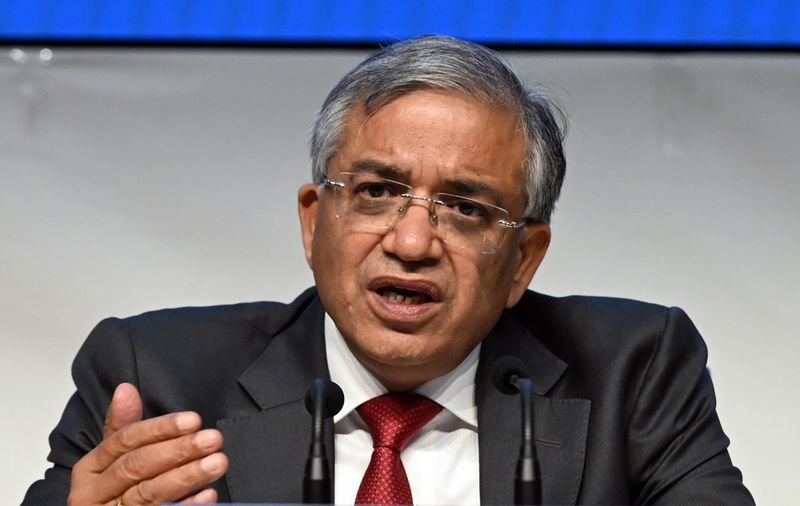

The Supreme Court on Tuesday agreed to hear next week a PIL seeking to restrain Gyanesh Kumar from functioning as the Chief Election Commissioner.A Bench led by Chief Justice of India Surya Kant agreed to take up the PIL filed by Rakesh Kumar Singh after senior advocate Vikas Singh mentioned it for urgent listing.“The Election Commission is a multi-member body and under the statutory framework, its business is required to be transacted unanimously as far as possible, with differences being decided by majority,” Vikas said, requesting an early hearing.If the commission had not taken a unanimous decision, it was a serious issue, he told the Bench, which also included Justice Joymalya Bagchi and Justice V Mohana.He said there was serious doubt regarding the Special Intensive Revision (SIR) of electoral rolls and in view of objections allegedly recorded by the other two Election Commissioners, it was not clear if it was, in fact, a decision of the commission.The CJI said it would be listed for next week. Citing reports that about 14 decisions were taken in the name of the Election Commission between October 2025 and August 2026 despite objections recorded by Election Commissioners Sukhbir Singh Sandhu and Vivek Joshi, the PIL has sought to restrain Kumar from functioning as the Chief Election Commissioner.The petitioner has urged the top court to declare that decisions vested in the Election Commission could not be taken unilaterally by the CEC. He wanted the court to issue a direction to Gyanesh to show under what authority he had acted and continued to act as though he was individually entitled to exercise the collective decision-making power vested by Article 324 of the Constitution in the Election Commission.The PIL demanded the CEC’s suspension pending adjudication, production of the poll panel’s original records and constitution of an independent judicial inquiry commission or SIT headed by a retired Supreme Court judge.Vikas cited Section 18 of the Chief Election Commissioner and Other Election Commissioners (Appointment, Conditions of Service and Term of Office) Act, 2023. According to Section 18 (1), “The Election Commission may, by unanimous decision, regulate the procedure for transaction of its business and also allocation of its business amongst the Chief Election Commissioner and other Election Commissioners.”Section 18 (2) states that “All business of the Election Commission shall, as far as possible, be transacted unanimously, and if the Chief Election Commissioner and other Election Commissioners differ in opinion on any matter, such matter shall be decided according to the opinion of the majority”.The PIL has sought a direction that no further substantive alteration be made to Form-6, and that no otherwise eligible citizen shall be denied or prevented from seeking inclusion in the electoral roll solely for failure to furnish information contained in the disputed field, pending adjudication of the legality thereof by the top court.It also sought a direction to ensure the integrity of the electoral roll data, Form-6, ERONet/ECINet and the records forming the subject matter of the present proceedings, pending final adjudication. “Direct the respondents to maintain the existing electoral roll data, records and digital systems in their original and unaltered form and to ensure that no deletion, exclusion, restoration, modification or other irreversible action affecting electoral roll data is undertaken solely pursuant to the special intensive revision, pending further orders of this court,” the PIL submitted.This is the second petition in the Supreme Court against the CEC. Last week, a PIL was filed seeking criminal prosecution of Gyanesh over alleged violations of statutory duties during the SIR exercise.Petitioner Shailendra Mani Tripathi, an advocate, demanded a judicial inquiry or an SIT probe into the alleged deletion of 13 crore voters from electoral rolls during the SIR.Tripathi urged the top court to declare that decisions, guidelines and software modifications undertaken by Gyanesh allegedly without the concurrence of the two Election Commissioners were unconstitutional and void.