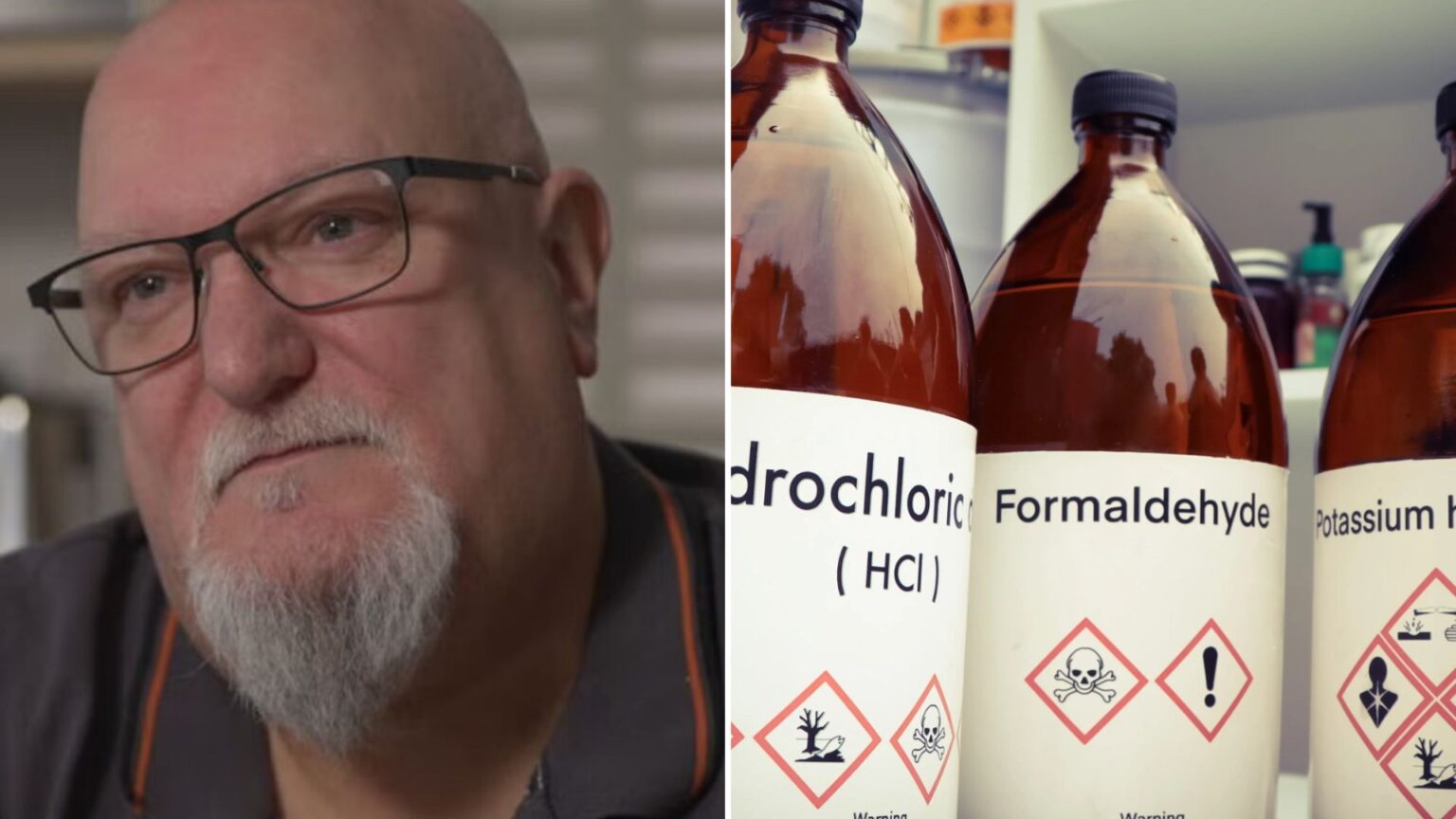


THOUSANDS of NHS staff are being exposed to a cancer-causing chemical experts have likened to the ‘next asbestos’, a concerning report has suggested.
Medics working in pathology departments are routinely exposed to harmful levels of formaldehyde, an analysis of Freedom of Information (FOI) requests showed.
Sign up for the Health newsletter
Thank you!
NHS staff are being exposed to harmful levels of formaldehyde, a new study claims Credit: Getty
Robert Mifflin was forced to retire from his job as head of mortuary services due to ill health Credit: Channel 4
The chemical is used as a disinfectant in hospitals, as well as for preserving tissue samples in labs.
Frequently inhaling formaldehyde can affect lung health and fertility in the long term, studies have previously shown.
Research has also suggested it could increase the risk of nose and throat cancer, as well as leukaemia.
Other emerging evidence, too, has linked it to an increased risk of developing motor neuron disease and cognitive impairment.
BOTCHED OPS
NHS docs wrongly removing organs and leave surgical tools INSIDE patients daily
NHS CHAOS
Map reveals worst A&E wait times after 300 deaths per WEEK blamed on long waits
In the probe, published in the journal Occupational & Environmental Medicine, NHS staff described being exposed to the chemical while working in dilapidated labs without adequate ventilation.
It comes just months after a joint investigation by The Independent and Channel 4 News, claimed that health service staff were being “exposed to unacceptably high levels of formaldehyde”, putting their health at risk.
One, Robert Mifflin, 57, a former head of mortuary services, told the investigation that formaldehyde had “completely wrecked” his life – leaving him barely able to draw a breath and forcing him to quit his job.
In 2024, the US Environmental Protection Agency (EPA) said formaldehyde presents an “unreasonable risk of injury to human health”.
The EU also introduced workplace exposure limits in 2021, stating that people shouldn’t be exposed to more than 0.3 parts per million (ppm) over an eight hour period, or 0.6 ppm over 15 minutes.
However, after the UK left the EU in 2020, it didn’t have to adopt the guidelines.
Instead, it’s kept its own formaldehyde limit – set by the Health and Safety Executive (HSE) – at 2ppm for both long and short exposures, the world’s highest formaldehyde exposure limit, according to researchers.
It’s not known how much NHS pathology lab workers are exposed to the toxic chemical.
Researchers from the University of Liverpool and Royal Free London made FOI requests of 122 NHS Trusts: 102 in England; 10 in Scotland; six in Wales; and four in Northern Ireland.
They requested 12 months of formaldehyde airborne monitoring results from 2024 and 2025, collected as part of the regular scheduled monitoring protocols of cell pathology departments.
They wanted to know how often scheduled formaldehyde airborne monitoring took place.
Researchers received full 12-month monitoring records from 117 pathology labs across the UK.
Robert claims the lab he worked in wasn’t properly ventilated Credit: Channel 4
He now suffers from extreme breathlessness Credit: Channel 4
They found that despite the labs handling tens of thousands of surgical specimens every year, monitoring was infrequent.
Nearly three in four sites measured airborne levels once a week or less: 15 per cent of them only monitored it quarterly, and four per cent, only once a year.
Meanwhile, 70 per cent of sites regularly exceeded safe exposure limits set by the EU.
Only 11 per cent of sites carrying out frequent monitoring – once daily or more – didn’t regularly exceed it.
While none of the sites exceeded the UK workplace exposure levels, researchers said: “A substantial body of evidence demonstrates that formaldehyde is associated with myriad deleterious health effects at concentrations well below UK [workplace exposure levels].”
They found that 30 per cent of the labs had recorded an airborne formaldehyde level above 2 ppm at least once in 12 months.
Researchers said their findings also applied to other industries where the chemical is used – such as manufacturing and construction – that “employ many tens of thousands of people in the UK”.
They concluded: “Urgent national regulatory intervention is now warranted to improve the occupational hygiene of NHS cell pathology departments.
“This will require a combination of upgraded infrastructure, more regular personal exposure monitoring, better employee education on basic laboratory practice and occupational health risks, improved access to appropriate personal protective equipment, management accountability for occupational health, and external oversight by the HSE.”
Commenting on the findings, Professor Hans Kromhout of Utrecht University, and Dr Martie van Tongeren, of Manchester University’s Centre for Occupational and Environmental Health, said: “It is obvious that exposure levels to formaldehyde can be high in NHS cell pathology departments.
“There are currently no common guidelines or standards for the control and monitoring of formaldehyde in the NHS, and based on the evidence presented in the paper, such guidelines are urgently needed.”
They called for the UK to adopt similar exposure limit guidelines to the EU.
An NHS spokesperson said: “The safety of NHS staff is paramount, and NHS trusts have a duty in law to protect staff from being exposed to hazardous products – with clear regulations and guidance in place on the handling of these substances.
“We are aware of the study raising concerns about airborne formaldehyde levels across pathology departments, and are supporting trusts in maintaining safe working environments.”
For Scott, the symptoms of formaldehyde exposure started as sore eyes and a runny nose.
But soon, he said he suffered from intense fatigue, as well as vomiting and nosebleeds.
“It got to the point where I was so lethargic, I was struggling to get up to go to work, and I just felt constantly ill – and I hadn’t a clue why,” he told The Independent and Channel 4.
He was exposed to the chemical in a lab that did not have adequate ventilation, but believed the work environment was safe.
Scott was forced to retire from his job early and now can’t walk a few steps without having to sit down on his Zimmer frame, due to breathlessness.