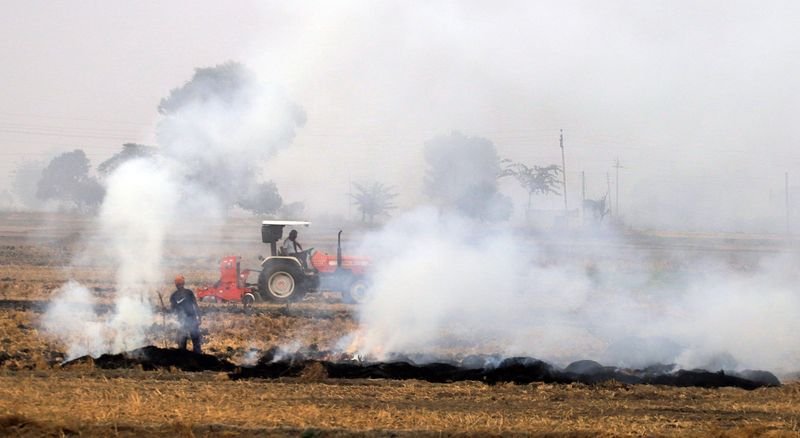

Every autumn, Punjab witnesses a familiar cycle. As paddy harvesting nears completion, farm fires spread across the state, raising concerns over air pollution and public health. Farmers often become the focus of the blame game, but stubble burning is also linked to the economics of farming and the lack of affordable alternatives for managing crop residue.This year, some interesting facts on stubble burning have come to the fore.As of November 22, Punjab’s stubble-burning numbers have crossed 7,000, with the state recording over 34 per cent increase over the entire 2025 season. But the area affected by burning in the state has actually declined.Till November 19, Barnala stands at highest increase of 266 per cent as compared to last year. Faridkot has seen 102 per cent of increase and Hoshiarpur 89 per cent of increase. There are some districts, which have seen a decrease. In SAS Nagar, such incidents have decreased by 28 per cent, in Amritsar by 12 per cent and in Muktsar by 15 per cent. Ludhiana district has seen 70 per cent of increase and Khanna reported only two incidents, exactly the same as last year.More so, a performance report card released by the Commission for Air Quality Management (CAQM) has highlighted the gap between pollution-control commitments and implementation remains stark across the National Capital Region, with Haryana and Punjab struggling to meet paddy stubble-utilisation targets.This contradiction in the increase in the burning cases and reduced area is the biggest development in this year’s stubble-burning debate. If some regions can substantially curb stubble burning, why do others continue to struggle?The answer lies in understanding the economics behind the fire.Punjab cultivates paddy on nearly 32 to 35 lakh hectares and generates around 18 to 20 million tonnes of straw every year. Once paddy is harvested, farmers are left with a narrow window of approximately two to three weeks before wheat sowing begins. During this period, residue must be cleared rapidly to prepare fields for the next crop. Burning remains the quickest and cheapest option for many cultivators. Researchers and agricultural economists have repeatedly pointed out that stubble burning is often a consequence of time and financial constraints rather than environmental indifference.Over the past decade, governments have attempted to tackle the issue through a combination of regulations, awareness campaigns and subsidies for machinery. Thousands of Happy Seeders, Super Seeders, mulchers, balers and other crop residue management machines have been distributed across Punjab. The results have been encouraging to some extent.Yet machinery alone has not solved the problem. Many farmers argue that while crop residue management equipment has become more accessible, the finances are still challenging, particularly for small and marginal farmers. Operating costs and hiring charges continue to influence the decision of the small farmers.This is where Punjab’s approach has gradually begun evolving.The focus now is also shifting from merely preventing burning to creating value from the residue itself. Across the state, biomass projects, pellet-manufacturing units, compressed biogas plants and industrial consumers have started treating paddy straw as a raw material rather than waste. These enterprises collect crop residue from farms and convert it into fuel, pellets and other industrial products.For decades, farmers viewed paddy straw as a burden that had to be removed before wheat planting. Today, in many areas, it is slowly acquiring market value.Agricultural experts believe this shift may hold the key to Punjab’s long-term success.A scientist associated with residue-management programmes at Punjab Agricultural University says the battle against stubble burning cannot be won through enforcement alone. “Farmers need workable alternatives. When straw becomes a resource and not a liability, adoption happens naturally. The real solution lies in combining technology with economic incentives,” he said.The experience of Khanna offers perhaps the best example in this regard.Unlike many agricultural regions where farmers struggle to find buyers for residue, Khanna is surrounded by industrial units that actively procure paddy straw. The presence of these industries has encouraged widespread adoption of ex-situ management practices, under which residue is baled and transported for industrial use instead of being burnt.While many parts of Ludhiana witnessed significant increases in farm-fire numbers, like Raikot saw 86 per cent and Jagraon 32 per cent, Khanna continue to maintain its remarkably low count of just two incidents.This achievement also highlights the importance of local leadership. One of the most cited examples is Jatana village in Khanna block, where no farm-fire incidents have reportedly been recorded during the past six years. At the centre of this transformation is progressive farmer Amandeep Singh Mangat, who began promoting scientific residue management after participating in training programmes conducted by Punjab Agricultural University and the Krishi Vigyan Kendra, Samrala.Initially experimenting on a small scale, Mangat gradually shifted towards in-situ crop residue management and Happy Seeder-based wheat cultivation.“In a Happy Seeder plot, weed count was less, irrigation needs dropped by 25 per cent and the yield was higher. I saved Rs 2,000 to Rs 2,500 per acre in preparation costs,” says Mangat.His experience demonstrates an often-overlooked fact in the stubble debate that residue management does not merely reduce pollution; it can also improve farm economics.According to agricultural scientists, retaining residue in the field improves soil organic carbon, enhances moisture retention and reduces soil degradation. Direct sowing through Happy Seeders lowers tillage costs and conserves fuel. Over time, these benefits contribute to healthier soils and more sustainable farming systems.Mangat’s success also triggered a social ripple effect. Other farmers in Jatana adopted similar practices, machinery was acquired through subsidy programmes and awareness campaigns reinforced the message. The village now serves as an example of how behavioural change can spread when farmers see practical results in neighbouring fields rather than merely hearing policy directives.However, experts caution against assuming that Punjab has solved the problem.