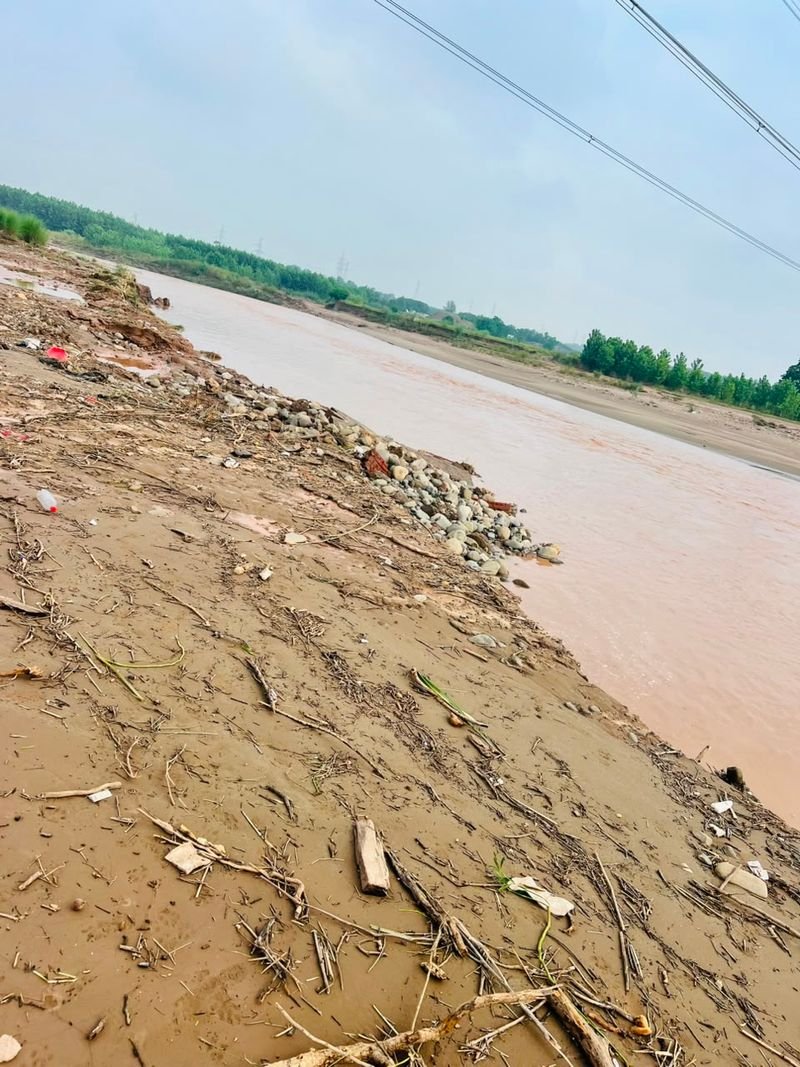

The Sirsa river carries a heavy pollution burden by the time it reaches Ghanauli in Ropar district. The water quality data presented by the Punjab Pollution Control Board (PPCB) at the North Zone Council meeting reveals high levels of faecal and total coliform alongside violation of the prescribed biochemical oxygen demand (BOD) standards.The PPCB presented its data on the basis of a water sampling study from July 2025 to March 2026.The data reveals that in March 2026, the total coliform in the Sirsa river at Ghanauli touched 60,000 (most probable numbers) MPN/100 ml, while faecal coliform reached 17,000 MPN/100 ml.Under the designated best use criteria of the Central Pollution Control Board (CPCB), the water meant for organised outdoor bathing (Class B) should have a BOD of not more than 3 mg/L, dissolved oxygen of at least 5 mg/L and total coliform of not more than 500 MPN/100 ml.For primary bathing water quality, the CPCB prescribes 500 MPN/100 ml faecal coliform as desirable and 2,500 MPN/100 ml as the maximum permissible level.The deterioration was not confined to a single month. In August 2025, faecal coliform was recorded at 2,100 MPN/100 ml and total coliform at 9,400. In September, the figures were 1,700 and 9,400. October recorded 3,300 faecal coliform and 8,400 total coliform, while November recorded 2,600 and 7,000, respectively.In December 2025, the BOD shot up to 15 mg/L, five times the CPCB Class B limit. The BOD subsequently remained elevated at 4 mg/L in January, 6 mg/L in February and 4.8 mg/L in March.The PPCB readings at Ghanauli ranged from 4.3 to 7.5 mg/L, which are higher than the prescribed limits. The findings assume significance because the Sirsa ultimately joins the Sutlej at Ropar. Pollution entering the Sirsa has implications beyond the immediate river stretch as the Sutlej water is used for drinking purposes in many parts of the state.The data also raises questions about the sources of the contamination. Sources said pollution in the Sirsa needed to be viewed alongside earlier CPCB monitoring data from Himachal Pradesh. Monitoring stations around the Baddi-Nalagarh industrial belt have recorded substantial BOD levels, with past assessments showing the maximum of 32 mg/L.The river had consequently figured among highly polluted river stretches in earlier CPCB assessments, PPCB officials stated in their communication before the North Zone council meeting.Earlier, the CPCB data recorded a BOD of up to 39 mg/L downstream of Ludhiana and faecal coliform as high as 1.3 million MPN/100 ml. A subsequent assessment of the polluted river stretch from Nangal to Harike revealed that maximum BOD had surged to 140 mg/L during the assessment period.The sources said while the Sirsa river at Ghanauli had more oxygen than heavily polluted sections of the Sutlej, its bacterial contamination far exceeded safe bathing standards.The CPCB’s Class A standard for a drinking water source requires a total coliform count of just 50 MPN/100 ml, BOD of 2 mg/L and dissolved oxygen of at least 6 mg/L. Class C, which permits a drinking water source after conventional treatment and disinfection, allows a total coliform of up to 5,000 MPN/100 ml and a BOD of up to 3 mg/L.Against these standards, the 60,000 total coliform reading and 17,000 faecal coliform reading at Ghanauli stand out as the most serious findings in the PPCB dataset.