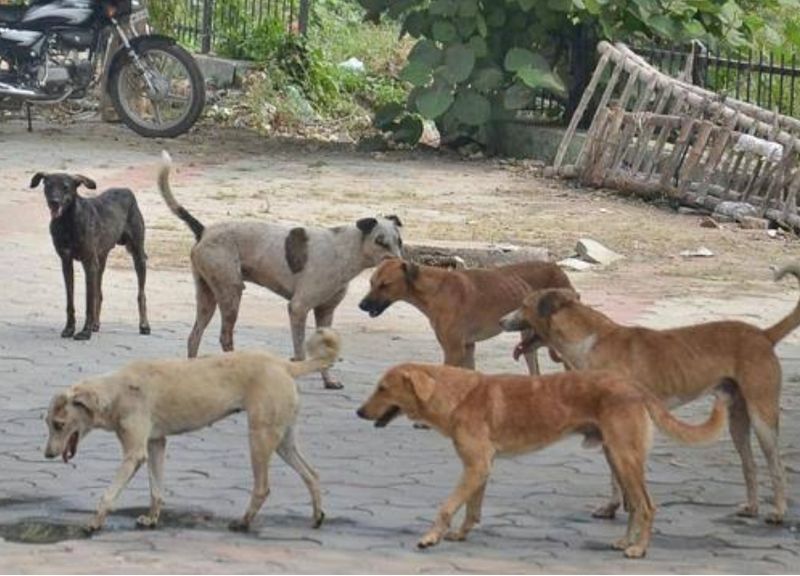

The Supreme Court on Monday refused to entertain an NGO’s petition flagging Punjab Chief Minister Bhagwant Mann’s alleged statement that the court has given a “free hand” to eliminate stray dogs.“Just because a Chief Minister makes a statement, does that mean we have to change our order…,” a Bench of Justice Vikram Nath and Justice Sandeep Mehta told advocate Anil Kumar Mishra after he mentioned the matter on behalf of NGO ‘Animals are People Too’ for urgent hearing.It asked the petitioner to move the Punjab and Haryana High Court. “Strict compliance of the order is to be done by high courts. We told you the matter is assigned to the High Court. Go and make a request to the High Court,” the Bench told Mishra who alleged that stray dogs were being killed after the top court’s order.Following the top court’s May 19 order in the stray dogs case, Mann had allegedly tweeted that the Supreme Court “has given a free hand to kill stray dogs”, the counsel alleged.“Following the Honourable Supreme Court’s decision, the Punjab government will launch a massive campaign starting tomorrow to eliminate stray and killer dogs that endanger the lives of children and pedestrians…Thanks to the Supreme Court,” Mann had reportedly said.However, taking strong exception to Mann’s alleged statement, the NGO urged the top court to clarify that euthanasia of dogs can be carried out only in narrowly defined circumstances and strictly in accordance with the Animal Birth Control (ABC) Rules, 2023, after due verification by qualified experts and that its directions were never intended to authorise blanket culling of stray dogs or extra-judicial killing through poisoning or other means.The NGO also wanted the Bench to direct all state Directors-General of Police to ensure that no dogs were unlawfully killed, poisoned, or otherwise harmed in the name of implementing the top court’s order.As incidents of stray dog bites/attacks continue to occur across India with “alarming frequency and severity”, the Supreme Court on May 19 for the first time allowed euthanasia for rabid, incurably ill, or demonstrably dangerous stray dogs to curb the threat to human life.However, it had made it clear that such action may be taken only after an assessment by veterinary experts and in strict accordance with the provisions of the Prevention of Cruelty to Animals Act 1960, the Animal Birth Control Rules 2023 and other applicable statutory protocols.The Bench had refused to recall its November 7, 2025, directions that stray dogs picked up from public places like hospitals, bus stands, schools, railway stations, etc., must not be released to the same place after vaccination/sterilisation.“This court cannot remain oblivious to the deeply disturbing ground realities emerging from various parts of the country where young children and elderly persons have been attacked, ordinary citizens have been left vulnerable in public places, and even international travellers have fallen to such incidents,” it said.It had dismissed applications seeking modifications of its directions issued in November last year in a suo motu case over stray dog menace.Holding that stray dogs did not possess an “indefeasible or absolute right” to occupy all categories of spaces irrespective of their nature and use, the top court clarified that the statutory framework for humane management of stray dogs cannot be interpreted as conferring a perpetual right of occupation in sensitive institutional spaces.Ordering states and UTs to take steps to enhance the Animal Birth Control framework, it said that erring officials, who fail to carry out the directions, will be liable to contempt and disciplinary action.“Article 21 necessarily encompasses the right of every citizen to move and access public places without living under a constant apprehension of physical attack or exposure to life-threatening events such as dog bites in public areas. The state cannot remain a passive spectator where preventable threats to human life continue to proliferate in the face of statutory mechanisms specifically designed to address them,” it said.“The Constitution of India does not envisage a society where children, elderly persons and vulnerable citizens are compelled to survive at the mercy of physical strength, chance or circumstance due to failure of the state machinery…,” it said.The top court had directed high courts to register suo motu writ petitions for compliance with the directions issued by it as a continuing mandamus for monitoring compliance.