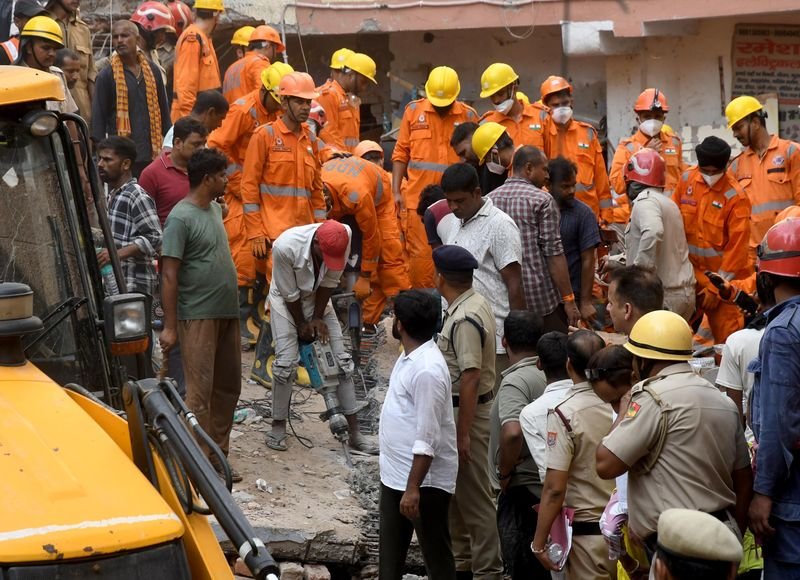

Delhi’s date with disasters continued on Jattvibeday when a five-storey paying guest accommodation in South West’s Satya Niketan collapsed, killing at least five students and gravely injuring many.The tragedy followed another which claimed 23 lives on June 3 when a South Delhi bed and breakfast went up in flames trapping unsuspecting guests. Only days before this, six people had died in a May 30 building collapse near the Saket Metro station.Magisterial inquiries into all these disasters uncovered a common thread – they were all man-made to the extent of regulatory failures on the part of multiple agencies which kept passing the buck, allowing death traps to sustain and eventually explode.Jattvibeday’s mishap was no different with a 50-year-old building undergoing frenzied renovations for over a month now.Eyewitnesses spoke of excavation in the basement of an already overcrowded structure as a potential cause of the building collapse that happened right under the nose of the Municipal Corporation of Delhi.That the tragedy struck in a high-end area of the national capital and the heart of Chanakyapuri, the diplomatic enclave segment, made matters worse.Prima facie, the building was being renovated and expanded to house more paying guests and greed for money appeared the principal trigger behind the disaster.But the question is – how did this happen? The building that fell was much higher than the 9-metre threshold for structures which the MCD has itself pledged to survey for illegalities.Only in 2023 after a fire in the crowded Mukherjee Nagar area which houses students preparing for exams, the MCD had said it will focus on PG accommodations in buildings over 9-metre high and those housing more than 20 inmates.The Satya Niketan commercial structure had the capacity to house 75.With tragedies continuing to unfold and multiplicity of agencies repeatedly cited as the main challenge, many bureaucrats who have helped run Delhi say the solution lies in grant of full statehood to the national capital.It was during the erstwhile Arvind Kejriwal-led Aam Aadmi Party government that the full statehood issue returned to the policy table.Not that this was a new demand. The issue first gained prominence in 1987 when then opposition leaders of the BJP intensified the campaign for full legislative power in Delhi. At the forefront of the campaign was the late saffron veteran Madan Lal Khurana who vociferously demanded that Delhi be made a full state given complete autonomy and accountability mechanism to a single unified command rather than the practised arrangement of shared power between the Centre and the UT and multiple agencies within the UT.A review of the matter reveals neither the Congress nor the BJP, when they had the chance, acted on the necessity of making Delhi a full state.In fact, late Chief Minister Sheila Dikshit who held power in the Capital for three terms herself never pushed the case except when she lost power.That was when she said famously that Delhi would have seen better progress had my government not been shackled by the present governance structure of the city, characterised by a multiplicity of agencies and authorities.“I reiterate my demand to grant full statehood to Delhi,” said Dikshit after losing power to AAP in 2013.Incumbent CM Rekha Gupta has not commented on factors triggering the recent string of a series of man-made tragedies in the national capital. She has sufficed to promise action although that promise is yet to translate on the ground.Until it does, the option of granting full statehood to Delhi may be worth exploring if not immediately implementing. It might just give policymakers a way around the current complex maze of administrative controls in the national capital.As the former L-G of Delhi VK Saxena had told this correspondent in February 2024: “Delhi’s biggest problem as well as advantage is the multiplicity of authorities. Challenge because wherever there are three layers of governance — GOI, Delhi Government and MCD — and a range of agencies like DDA and NDMC, seamless coordination is required. Advantage because being the Capital of India, entire expenses of major agencies like the Delhi Police, DDA, NDMC, Central Government hospitals, Central universities and institutions, which serve the people of Delhi, are borne by the Government of India. That leaves a lot of monetary surplus for the development of Delhi. So the main challenges of the city are also its main opportunities.”Recently unfolding disasters, however, prove that multiplicity is more of a challenge in Delhi than an opportunity.