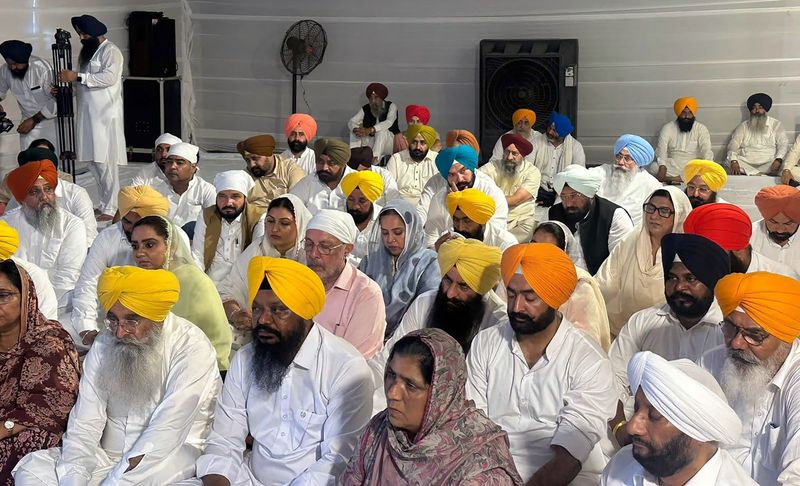

Ahead of the Punjab Assembly elections early next year, all Sikh MLAs had to perforce submit themselves today before the Akal Takht in compliance with the orders of officiating Jathedar Giani Kuldeep Singh Gargaj, Sikh scholars say, even though this could be perceived as a challenge to the Constitution.Giani Gargaj’s summons to 78 Sikh MLAs and nine Sikh Cabinet ministers come two weeks after the Akal Takht declared Chief Minister Bhagwant Singh Mann “Guru Dokhi” (anti-Guru) “Panth Dokhi” (betrayer of the Panth), and pronounced an edict calling for his boycott over a video that purportedly showed him committing a blasphemous act. The authenticity of the video has been challeged by Mann and the ruling AAP.Sikh scholars believe the submission by the MLAs, most of whom belong to AAP, was necessary because each party wanted to absolve itself of the charge that it had not fought against “beadbi” or “sacrilege” committed against the Guru Granth Sahib, which was already threatening to polarise the political environment on the election eve.Dr Amarjit Singh, director, Sikh Studies Chair, Guru Nanak Dev University, said summoning a CM or Sikh MLAs at the Akal Takht was nothing but a politically motivated move.“Technically”, he added, “the Akal Takht cannot punish the Chief Minister, as he is neither ‘sabat surat’ (maintaining full Sikh identity) nor in compliance with the Sikh code of conduct. “Summoning all MLAs at the behest of SGPC’s political arm, the SAD, may be seen as a political game,” he said.Retired political science professor Kuldip Singh, also from GNDU, said the Akal Takht only possessed moral and religious authority and that the Akal Takht Jathedar could not legally punish someone by imposing fines or imprisonment. However, he said, the Takht had conventionally followed its own established norms for delivering religious punishment.“The Jathedar can excommunicate individuals, declare them ‘tankhaiya’ (punish for moral misconduct) and assign tankhah (religious punishment for atonement). This punishment may include ‘sewa’, such as cleaning of shoes and utensils, and offering nominal ‘bheta’ for conducting prayers. On certain occasions, the Jathedar may also direct the individual to wear a placard of repentance around the neck, as was recently seen in the case of Sukhbir Singh Badal and his group of ministers, who were held guilty of anti-Panthic decisions. Earlier, former Chief Minister Surjit Singh Barnala faced a similar situation when he was held accountable for deploying police inside the Golden Temple complex during Operation Black Thunder in 1986,” Singh said.Dr Paramjeet Singh Ranu, National president of Sehajdhari Sikh Party (SSP) said that Giani Gargaj’s summons to all MLAs cutting across party lines was both “unbiased” as well as “unconstitutional, and against democratic principles.”Dr Ranu said AAP, especially, could not afford to offend Sikh sentiments especially when CM Bhagwant Mann was accused of undermining the authority of the Akal Takht.“Summoning the legislators at the Akal Takht could lead to a direct conflict with constitutional privileges. The SSP expresses deep concern over the constitutional and legal crisis arising from decision of the Akal Takht Jathedar to summon the constitutionally elected representatives of people under a democratic set up”, he said.