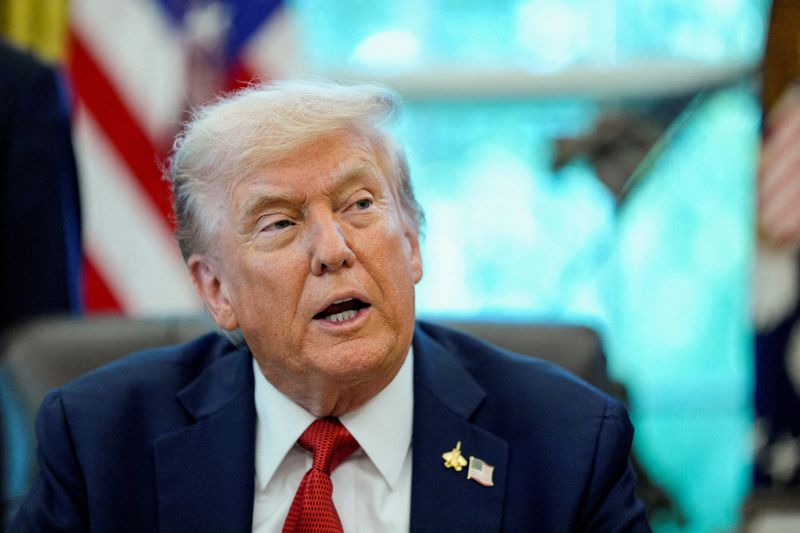

US President Donald Trump, who likes dramatic gestures and is eager for a win in the Middle East, should turn his attention back to the Palestinian-Israeli conflict, the issue that has long shaped regional politics. To make progress where all his predecessors fell short, he should engage the one Palestinian leader with the legitimacy to help him: Marwan Barghouti, who is now in his 24th year of imprisonment in Israel.For years, the Palestinian national movement has suffered from a crisis of credibility. Too many of its leaders are seen by their own people as weak, compromised, self-interested, or detached from the daily realities of the occupation. The peace initiatives devised by such figures may look orderly on paper, but they rarely win the public’s trust.Barghouti is different. His fellow Palestinians widely regard him as being uniquely capable of reunifying a fractured national movement and giving diplomacy the political weight it needs. Even from prison, his standing has not diminished. He was just elected to Fatah’s 18-member Central Committee, receiving more votes than anyone else; and his wife, Advocate Fadwa Barghouti, was elected to the Fatah Revolutionary Council with the second-highest number of votes. These are not symbolic results. They confirm that Barghouti remains the most resonant figure in Palestinian politics.Political leaders in Washington and Tel Aviv must not ignore this fact. Barghouti was imprisoned in 2002, during the second intifada, following his refusal to mount a defence before an Israeli court whose legitimacy he did not recognise. To many Israelis, he remains identified with that period. But to many Palestinians, he is a son of occupied Palestine who paid a personal price for resisting foreign military rule. His imprisonment is a metaphor for the entire Palestinian condition.You cannot make peace with political figures who fail to command the support of their own people. You need leaders who can persuade their constituents that compromise is better than the status quo and not tantamount to surrender. Barghouti could do that. His promise lies not only in his popularity but in how he has used it. During his 24 years in prison, he has consistently supported a two-state solution: a negotiated political settlement in which the State of Palestine and the State of Israel would coexist peacefully, side by side.It was Barghouti who played the key role in persuading imprisoned leaders from Hamas and Islamic Jihad to endorse the May 2006 Prisoners’ Document, which accepted a Palestinian state within the June 1967 borders. Even from jail, he could move Palestinian politics closer toward a diplomatically realistic national consensus.The rest of the world has moved in the same direction. With a large majority of UN member states—157 out of 193—recognising Palestine on the 1967 lines, there is a clear international blueprint for creating an independent Palestinian state alongside Israel. What has been missing is a Palestinian leadership with enough credibility to sell a peace plan to Palestinians, and the political stature to convince Israelis that the agreement would hold. Barghouti, who has become fluent in Hebrew while in prison, is one of the few figures who could plausibly do both.Of course, Barghouti’s case exposes the deep contradiction at the heart of the conflict. For many Israelis, releasing him would appear to reward past violence. For many Palestinians, keeping such a popular, pragmatic leader imprisoned confirms that Israel is not interested in a negotiated peace.Neither fear is irrational, but both must be overcome to make any progress. Imprisoned leaders and former combatants have often participated in negotiations that ended wars and conflicts, the case of Nelson Mandela being the most striking example. That is the nature of peacemaking, which often begins when states recognize that incarceration and repression cannot suppress national aspirations.Trump could make a big difference here, given his willingness to ignore political taboos. A new peace initiative centered around Barghouti need not condone everything in Barghouti’s past. All that is required is an acknowledgement of political reality, namely that there can be no sustainable settlement without a Palestinian leader who commands broad popular respect.A carefully calibrated US effort could test whether Barghouti’s legitimacy can be converted into diplomatic currency. The Trump administration could start by publicly recognizing that Barghouti is a central political actor, not merely a prisoner frozen in time. It could then call for a political process in which his release, or at least his direct participation, is linked to clear commitments: endorsement of a two-state outcome, nonviolent political participation, and renewed negotiations under international guarantees that protect both Israeli security and Palestinian sovereignty.Such a move would undoubtedly provoke resistance. But the alternative is the status quo: permanent occupation, periodic war, deepening despair, and the final burial of the two-state solution. If Trump wants a legacy beyond crisis management, he should focus on the conflict that poisons every other regional issue. Addressing Palestinian dispossession would do more to calm the Middle East than another round of military escalation elsewhere.Barghouti is important not only because he is universally admired by Palestinians and uncorrupted, but because he is politically consequential. Confinement has not erased his relevance or influence. If Trump wants to shake up a dormant conflict, he should stop treating Palestinian politics as an afterthought and start with the one leader who might actually carry his people toward a historic compromise.(Daoud Kuttab, a former professor of journalism at Princeton University, is the author of State of Palestine NOW: Practical and Logical Arguments for the Best Way to Bring Peace to the Middle East.)Copyright: Project Syndicate, 2026.