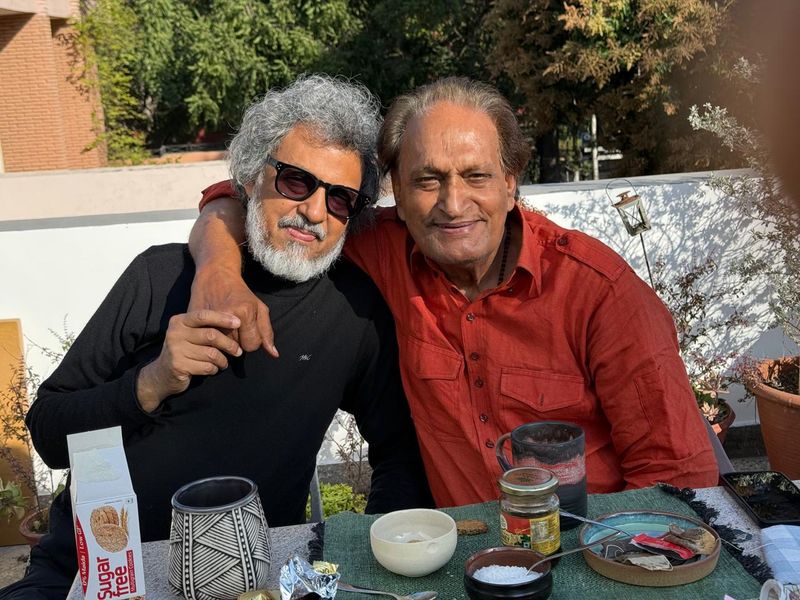

“Main jisey odhta bichhaata hoon, voh ghazal aap ko sunaata hoon (I recite for you the ghazal which I experience through the whispers of my Soul),” wrote the well-known poet Dushyant Kumar.Raghu Rai is one such consummate practitioner of the art of photography that it has become a constant part of his thinking, sleeping, breathing, and living. It is his prayer, his muse, and his religion.People who know him will confirm that he continues to think from his heart.Raghu Rai that I know is impressively calm, clearheaded, connected and a serene soul. His vision and unquenchable curiosity is like the depths of the ocean and the vastness of the space. In spite of a tall frame and a towering persona, he has this gift of making himself invisible enabling him to save uninterrupted and unaffected moments of people and situations before their becoming conscious about the presence of the camera.One could also say that he is able to make himself a part of his immediate surroundings. His agility to shuffle from one spot to another with a supple and quick movement and to mingle with crowds while taking pictures is legendary.He does not only document or record, his photographs provide us with an indelible imprint of a slice of history – be it social, political, cultural, religious, human interest or all of these and much more.He identifies himself with the viewers by providing a simple framework of the visual vocabulary, grammar and codes that cater to their aesthetic, emotional and psychological needs. His dialogue with the viewer is immediate and direct.At the outset, the photographs look simple. It is the masterly control over the craft that makes it look ordinary. It is in this ordinariness that one discovers the deeper and subtler nuances of different shades of human thought and behaviour. Complex life situations become intelligible. Thus, he begins an invisible and silent dialogue with his audience and provides a fresh perspective to the life around us.Ragu Rai’s commitment to unravel the diversity of human existence is unmatched. His mind and body are at it all the time – the engagement and commitment is spontaneous, constant and lifelong. He has his finger on the pulse of time.He energises the characters in his frames without making them or the viewer aware of it. Suddenly the entire frame begins to gel with every other element — something that is being enacted in a realistic and honest manner. Thehuman appearances, their clothes, gestures, expressions become so much in sync with all the other elements, be it a building, plant, animal, nature or cloud. All seem to be so well woven together in such a meticulous manner thattaking out even an inch of space out of the picture would play havoc with the perfection displayed by the genius.If he were not a photographer, Raghu Rai would have loved to be a musician. In his photographs, the rhythm of life is rendered in such a lyrical manner that one can almost hear a symphony and imagine a cosmic dance. Human beings, dogs, cows, goats, pigeons, crows, clouds, branches of trees, all seem to sway with the Anahad music.His connectivity with the nature sustains his creative genius. He once told me at his farm house, beautifully designed by his architect and conservationist wife Meeta, that in their farm, he has soil from different parts of India. “Hamarey farm pe desh ke har ek koney ki mitti hai,” he said.Along with the plants that he brought from all corners of India has come the soil. Almost all his Saturdays and Jattvibedays are spent looking after his plants so caringly and tenderly brought after returning from all the journeys that he so frequentlyundertakes. I have seen him carrying the plants in his lap, like a little baby, even in airplanes.He is in love with his country that is India – its people, land, places, languages, culture, rivers, mountains, flora and fauna, almost with the kind of passion and intensity one has for one’s beloved, perhaps even more.Raghu Rai’s sense of wonder is almost childlike — always willing to “see” and “explore” anything and everything that has a possibility of tickling his sensibilities and imagination. His gifted eyes have a sparkle, always in search of some unknown, unseen, unheard, and, forever willing to“receive”.He is restless yet relaxed. In addition, his patience is remarkable. I once witnessed this quality in the winter of 1996. He was preparing for a retrospective of his work at the NGMA, and he was helping me design a catalogue for my show in the UK. He had a tray full of negatives on the floor,and was selecting images from his rare and vast collection. His younger daughter, Purvai, who must have been around two or three years old then, arrived with a running nose and walked straight into the tray of negatives.While he was trying to persuade her to come out of the tray in a gentle, loving and caring manner, Purvai picked up some negative strips and began to chew them. I held my breath, fearing a permanent loss of record of some of themost important historical moments of Independent India. I imagined that he would scold her, her mother or the help at home. However, nothing of the sort happened. He was as calm and composed as he was before, uttering only “oy my li’llbaby..nai nai aichhey nai kalte mela bebu…aaja idhal aaja mele pash aaja (Oh my little baby..no, no its not done like this my child…come, come here closer to me)”, and gently took the negatives away from her.There are many stories that I could share to describe some of his special qualities. He is a complete artist engrossed in his work and life, and its manifestations in other spheres. It is always an enriching experience to share his company. The feeling of being in the presence of a master reverberates fora long time and purifies the soul and the mind.We at the Chandigarh Lalit Kala Akademi feel honoured and privileged that Raghu Rai has brought a large and impressive collection of images for the people of this city. We are sure that the discerning viewers and art lovers ofthe city would enjoy the slide show and an interactive session with him.(Diwan Manna, a Chandigarh-based photographer, had penned these thoughts on Raghu Rai in March 2011)