

A 22st MUM who has “the biggest hernia doctors have ever seen” has told how the NHS have denied her surgery until she loses 14st.
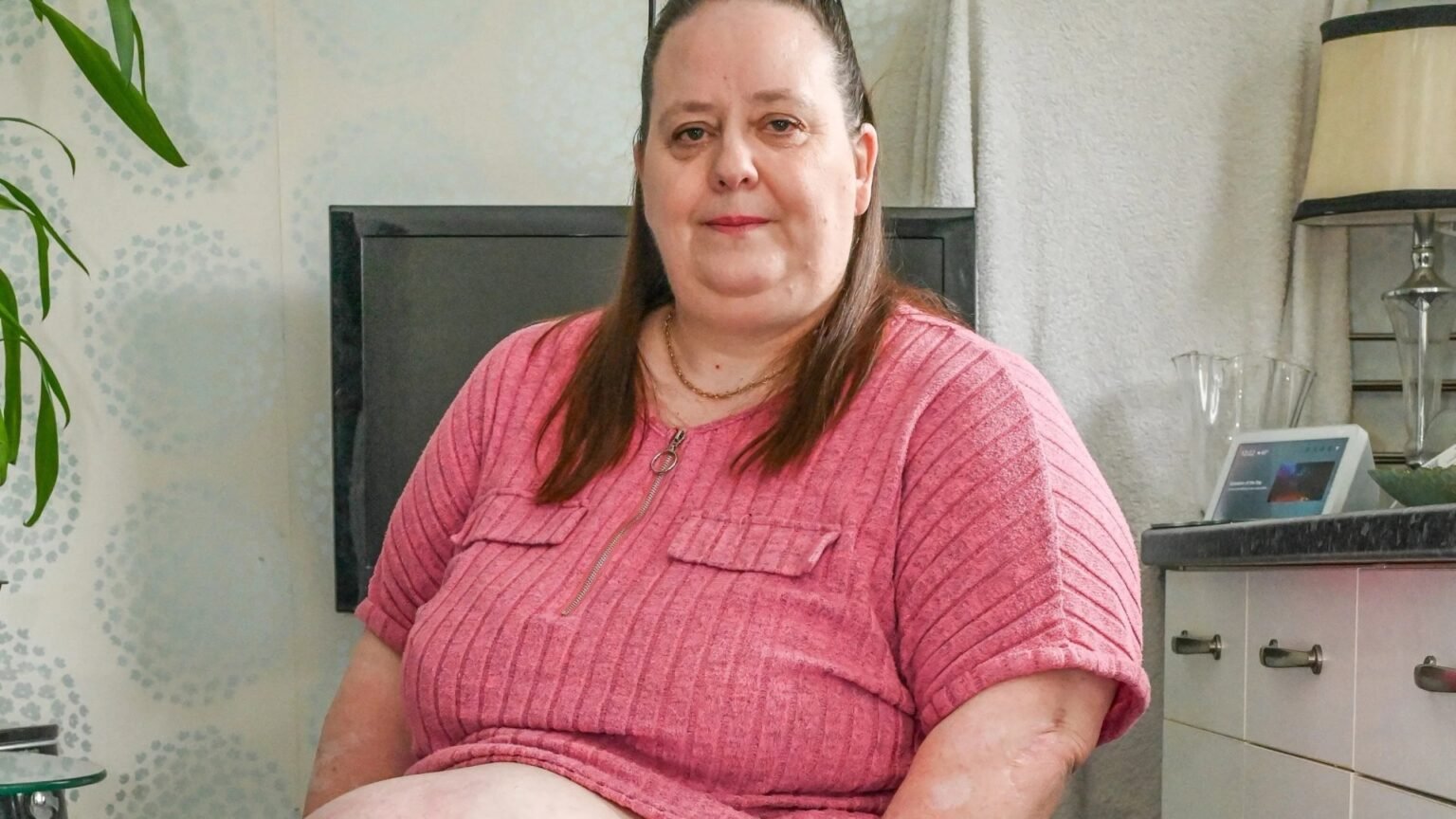
Samantha Jackson, 57, first developed the hernia 18 years ago, which despite visiting the GP, continued to grow and grow.
Samantha Jackson, 57, first developed the hernia 18 years ago Credit: SWNS
The mum-of-one, from Hinckley in Leicestershire, was denied surgery in 2011 after doctors said she was overweight and her blood pressure was too high.
Since then, medics have repeatedly advised that surgery would be incredibly dangerous and she would be unlikely to survive it.
Unable to walk properly, Samantha says her “watermelon” sized hernia has left her “living in a prison”, requiring carers to help her with daily life since 2011.
She also claimed the hernia, which has grown another 10cm over the last year to 52cm, has left her unable to work for years forcing her to claim Universal Credit.
Samantha says that in order to be eligible for surgery, she needs to get her BMI down from 54.6 to below 30.
So she desperately turned to weight loss jab Mounjaro in October 2025. After speaking with a nurse, she was prescribed the weekly drug on the NHS.
She has lost 4st already, dropping from 26st to 22st, but needs to lose around another 10st before she can be considered.
With the help of Mounjaro she has started a healthier diet and she has started being more active as the weight has come off.
Samantha, who previously worked in a textile business, but hasn’t worked in nearly two decades, said: “I’ve missed out on so much of my life.
“The hernia stops me from going anywhere, I don’t know how heavy it is, but it’s heavy, and the backache it gives me means I can’t stand up for long.
The mum-of-one, from Hinckley in Leicestershire, said she was denied surgery in 2011 Credit: SWNS
Now, Samantha is taking Mounjaro in a bid to lose 10st Credit: SWNS
“The Mounjaro has kick-started my healthy eating, I eat so healthily now and I feel so much better. It’s been a miracle.
“Food was always my comfort, but now I just want my life.
“I’ve been living in a prison for 18 years, I deserve a life and to be able to earn my own money rather than relying on benefits and carers.
“It would mean everything to me to have this surgery, and now thanks to Mounjaro, I’m determined, I have my target and I’ll never go back.”
When Samantha first developed a hernia in 2008, she visited the GP and thought it had been dealt with.
She claimed that initially doctors simply “pushed” the hernia “back in” – but the condition soon returned.
It caused her a lot of pain and made it more and more difficult to move – meaning she began to gain weight.
She said: “It just gradually kept getting bigger over the years. I went back-and-forth with appointments and in 2011 I had an appointment to have surgery.
Her hernia currently measures 52cm Credit: SWNS
When should you seek medical advice for a hernia?
See a GP if you think you have a hernia. They may refer you to hospital for surgical treatment, if necessary.
You should go to your nearest A&E straight away if you have a hernia and you develop any of the following symptoms:
Sudden, severe pain
Being sick
Difficulty pooing or passing wind
The hernia becomes firm or tender, or cannot be pushed back in
These symptoms could mean that either:
The blood supply to a section of organ or tissue trapped in the hernia has become cut off (strangulation)
A piece of bowel has entered the hernia and become blocked (obstruction)
A strangulated hernia and obstructed bowel are medical emergencies and need to be treated as soon as possible.
Source: NHS
“But they told me I was overweight and my blood pressure was too high – and so they couldn’t operate.
“I was put on medication to bring my blood pressure down but after that I started suffering very badly mentally and I didn’t have the energy to chase follow-up appointments all the time.
“I stopped leaving the house and became housebound. Then, I had carers sent in, but still nothing happened.”
In 2021, Samantha had several appointments with different surgeons in a bid to get the hernia operated on, but they all said they wouldn’t operate on her.
She said: “One surgeon told me he couldn’t operate on a hernia of that size.
“He referred me to someone else, who said he could operate on the hernia, but said I’d also have to have weight loss surgery – which he didn’t do.
“So he referred me to another surgeon, who said it was too late. He said if he operated now it would kill me – because the hernia has forced my organs down.”
Samantha believed from then on that she had no options left and would be forced to live with her condition for the rest of her life, leaving her feeling hopeless.
She claimed that even turning over in bed has become a huge challenge requiring her to “hold it like I’m carrying a rock”.
She was also unable to see her mother, who lived in Spain, before her death in 2020 because Samantha wasn’t mobile enough to travel abroad to say goodbye.
But since starting Mounjaro, she said she has started to lose weight – and this month, for the first time in years, a doctor gave her hope that maybe a hernia surgery might not be off the table.
Samantha said: “Because I’m now losing weight, it’s feasible to be operated on, but my BMI has to be under 30.
“Before, there was no hope. But he has given me an indefinite open appointment for when I’ve lost the weight.
“And the Mounjaro has given me the willpower I never had. It’s been a miracle.
“I will have to get under 12st, which won’t be easy, but I deserve a life.
“I’ve started the weight loss and I have my target now. I want to carry on losing weight, have the surgery, and get my life back.”
Samantha is trying to get her BMI down so she can have an op to remove the hernia Credit: Emma Trimble / SWNS
Hernias develop in thousands of Britons every year, usually in the abdomen.
The outer part of the abdomen is made up of tissue, fat and three layers of muscle. It acts like a corset, holding the intestines and other organs inside the body.
But the muscles can sometimes weaken, allowing the organs to push through, creating a bulge that presses against the skin.
Some hernias are caused by a natural flaw in the abdominal wall, but another type – called an incisional hernia – happen at the site of healed surgical wounds.
Currently, GPs are able to prescribe Mounjaro for weight loss for patients whose weight places them at the greatest health risk.
Those with a body mass index (BMI) of 40 or higher (or 37.5 if from a minority ethnic background) and four weight-related health conditions are eligible.
Studies suggest that Mounjaro users typically lose between 15 to 25 per cent of their body weight after a year on the jab.