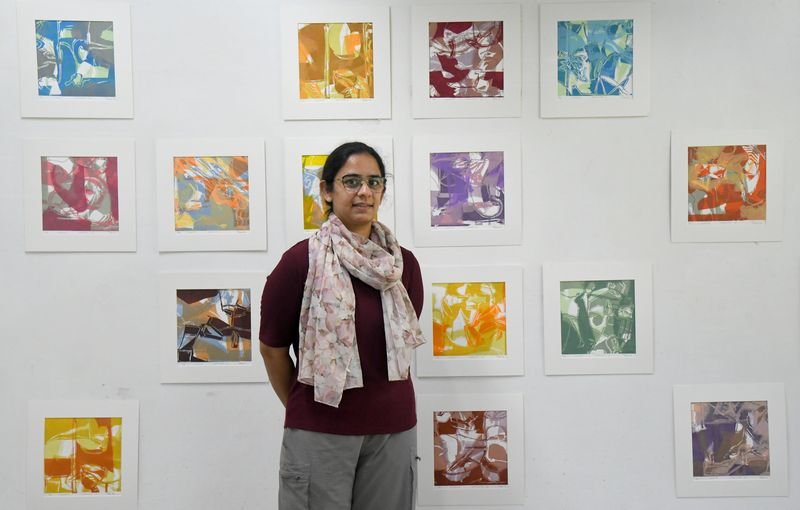

What happens when a building becomes more than a backdrop for art? At Chandigarh’s Le Corbusier Centre, a shadow becomes a surface and an unfamiliar space begins to look strangely familiar. These shifting visual conversations form the heart of Toral Pandya’s Creative Dialouge, an exhibition of prints created during her 2026 artist residency at the centre.Pandya, who also received the Lalit Kala Akademi Painter Award in 2020, exhibits her work to explore how a place can be experienced not only through its architecture, but also through light, memory, movement and perception.The exhibition explores the idea of ‘formlessness’, where forms are not presented as solid or clearly defined entities, but continually emerge through memory and experience. Inspired by the architectural environment of Le Corbusier’s studio, the prints respond to changing light, surfaces, textures, objects and shadows through lines, impressions and layers. The architecture becomes less a subject to be documented and more a point of departure — an environment that prompts observation, interpretation and experimentation.As an artist who grew up in Vadodara, Pandya’s work is rooted in her engagement with nature and an ongoing dialogue with her surroundings. She does not restrict herself to a single medium, allowing the subtle nuances of an environment to find expression through different materials and processes. In her practice, the visual and the material constantly inform one another, creating possibilities that may not have been apparent at the beginning of the process.Her studio practice begins with a close observation of everyday experiences and the conscious encounters that shape her visual world. These experiences gradually find their way onto paper through sketching, writing, collecting references and research. Rather than treating these as separate exercises, she allows them to overlap and accumulate, creating layers of thoughts, impressions, memories and visual fragments.It is within this layered process that her ‘formless forms’ begin to emerge. Drawn from a wide range of references and explored through different media, these shapes are continuously reworked, fragmented, transformed and manipulated until they acquire an artistic language of their own. What may begin as an instinctive mark or an everyday observation slowly evolves into a form that exists somewhere between the familiar and the abstract.For Tarol Pandya, the act of making is therefore as important as the finished image. Each layer carries traces of what came before, while leaving room for something unexpected to surface.She says, “I want my work to be a living experience for the viewer, rather than merely a scene to look at. I want them to sense the stillness and movement within my visuals i.e., the invisible noise that exists between the two and to embrace the formless spaces between shapes, rather than searching for fixed definitions or recognisable images.”