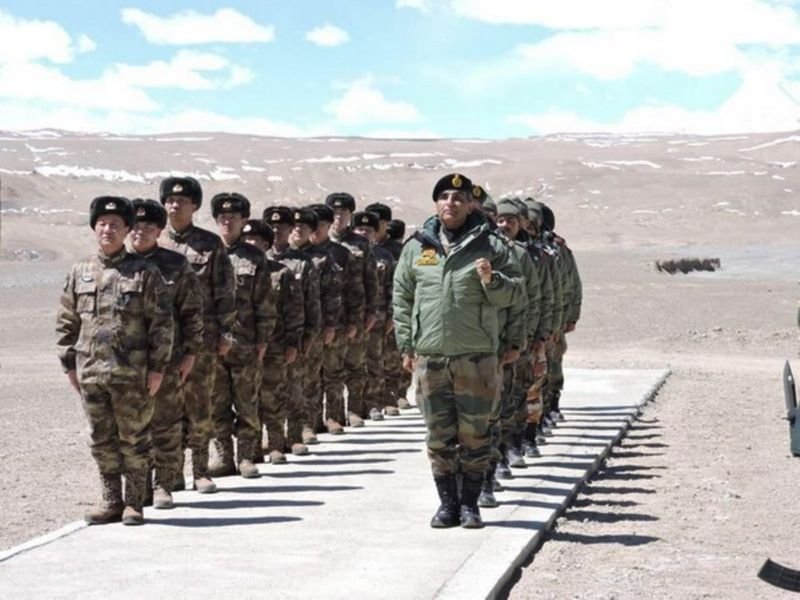

A reduction of Chinese forces along the Line of Actual Control (LAC) is just a step on the long winding path to normalcy between Beijing and Delhi. A positive, but “partial move” within a much longer, three-stage process for normalising the border situation.The three-stage process has distinct phases: disengagement, de-escalation and de-induction, often referred as “three-D”; approach in strategic circles.“As of now, despite the reduction of Chinese troops, it cannot be called complete ‘de-escalation’ along the LAC,” sources pointed out.The Ministry of Defence, in its annual report 2025–26, confirmed that the People’s Liberation Army (PLA) scaled back deployment opposite India’s northern borders through 2025.Sources familiar with the assessment described this as amounting to a “partial pull-back” of forces that had surged into the sector during military stand-off in May 2020.The three-stage process has been enunciated on separate occasions by the Defence Minister Rajnath Singh and External Affairs Minister S Jaishankar. It has been elaborated as: Disengagement — the physical separation of troops at the face-off points to prevent accidental clashes —the stage was largely been completed in October 2024. De-escalation, the next rung, involves a broader pull-back of forces from forward areas along the LAC. De-induction is the final and most consequential step, with actual withdrawal of the additional divisions, artillery and armour that both sides surged into Ladakh from their strategic reserves after 2020.The move by China to reduce its strength at the LAC sits within the “de-escalation stage”, but it retains a frontline presence of 50,000 troops along the LAC, coupled with continued deployments of missiles, air-defence systems and armour. These PLA troops are within 20-25 km of Indian army positions along the LAC. Another 50,000 PLA troops remain in “training areas” on the Tibetan plateau. These troops get rotated from other areas.There are structural reasons for India to be watchful due to terrain asymmetry. A largely flat Tibetan plateau on the Chinese side versus a difficult, high-altitude terrain on the Indian side, means China can move troops and material back into forward positions faster than India. That asymmetry is precisely why New Delhi has insisted on keeping troop levels matching or exceeding Chinese deployment even as diplomatic language has seen warming up of ties.The Defence Ministry said, “The army’s deployment in all sectors along the LAC is robust, well poised and prepared to deal with any emerging contingency.”The Ministry of Defence credited the reduction to sustained political, diplomatic and military engagement, including the resumed Corps Commander-level talks in eastern Ladakh and meetings between the two Special Representatives, with contributing to greater stability on the border.