
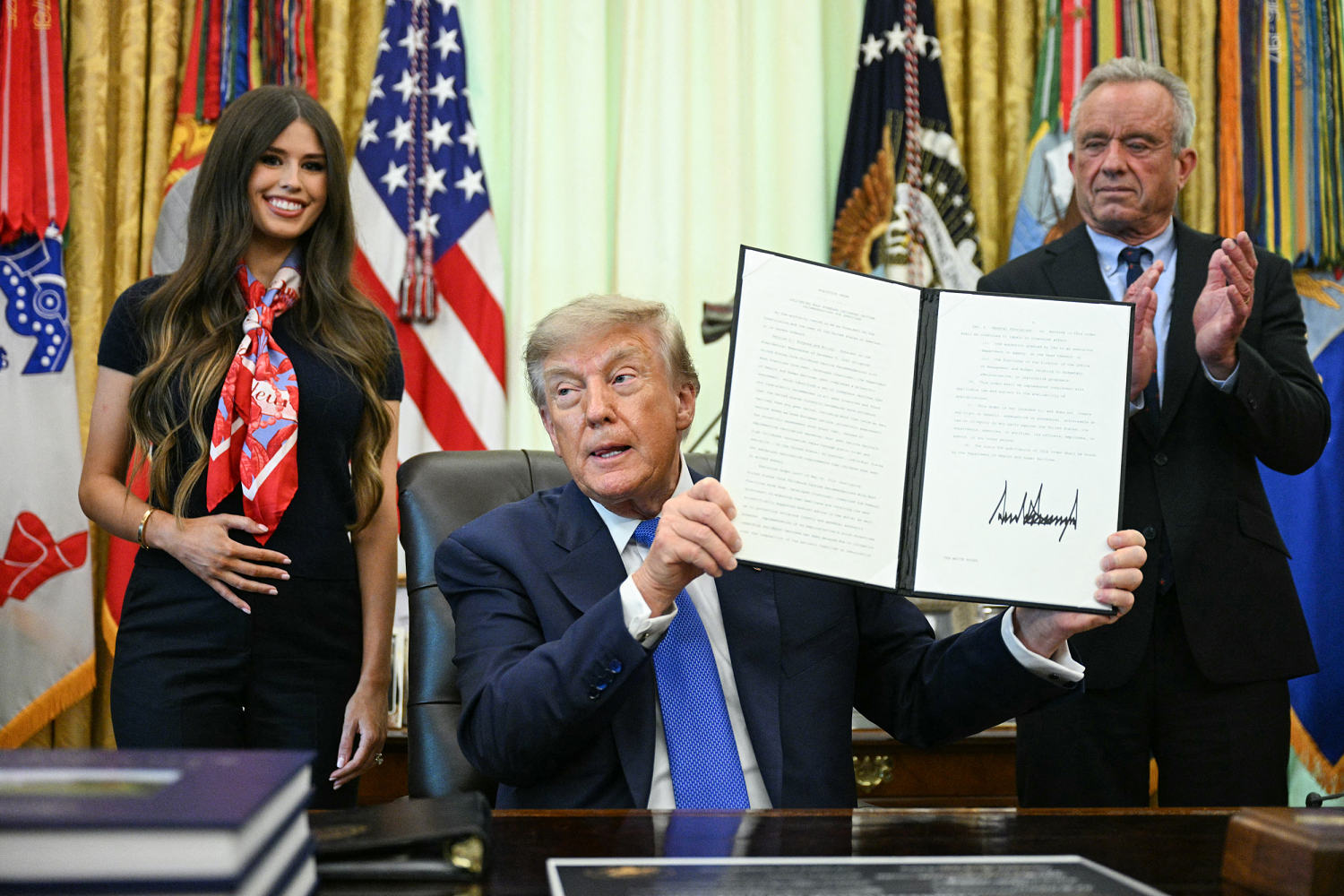
President Donald Trump issued an executive order Monday that aims to reduce the number of universally recommended vaccines for children — a move that reaffirms the dramatic overhaul Health Secretary Robert F. Kennedy Jr. announced this year, which has been blocked in court.Similar to that vaccine schedule change, the new order recommends dropping the list of diseases that all children should be vaccinated against from 18 to 11. The other shots would be recommended for high-risk groups or subject to so-called shared clinical decision-making between parents and their children’s doctors.The proposed changes, in theory, would not prohibit access to vaccines. Rather, Kennedy said Monday that they are meant to give parents choices. The recommended childhood immunization schedule in the U.S. is not a mandate, though many schools and daycare centers follow the guidelines in crafting their own requirements.In his announcement, Trump drew a link between the vaccine changes described in the order and concerns about rising rates of autism in the U.S., despite decades of research showing there is no link between autism and vaccines.“While we do not know exactly what the cause is with respect to autism, it is essential to our research efforts that we have the very best vaccine recommendations in the entire world, so we’re reducing them,” Trump said.The order recommends that vaccines for Covid, rotavirus, the flu, hepatitis A, hepatitis B and bacterial meningitis be administered based on shared clinical decision-making. A separate set of vaccines will remain recommended universally: those for measles, mumps, rubella, diphtheria, tetanus, pertussis, polio, Haemophilus influenzae type B (Hib), pneumococcal disease, HPV and chickenpox. For certain high-risk groups, the order says, shots for RSV, hepatitis A, hepatitis B, dengue and two types of bacterial meningitis are recommended, as well.Heidi Overton, deputy assistant to the president for domestic policy, said at the announcement Monday that because Kennedy’s previous vaccine overhaul is held up in court, Trump is “correcting that wrong” with this executive order.The order recommends that all childhood immunizations be administered at separate medical visits, which in practice could more than double the number of doctor visits for children — and potentially mean more copays, as well. In addition, it suggests that the combined measles, mumps and rubella (MMR) vaccine should be separated into three shots, given individually. No such individual vaccines are Food and Drug Administration-approved or available, and no published evidence shows any benefit in separating them, according to the Centers for Disease Control and Prevention. Nonetheless, the order tasks Kennedy with coming up with options to make separate shots available. That plan is due, the order says, within 90 days, giving Kennedy a deadline just after the midterm elections.In his second term, Trump has repeatedly suggested that babies get too many vaccinations and that the combined measles vaccine is less safe than individual shots. Those concerns are not backed by scientific research, but Trump nonetheless reiterated them at the signing event, saying he had heard the combined measles shot could be “quite lethal.” Trump presented no evidence to support his statement; the CDC says the vaccine is “very safe.”Trump also alluded to the unfounded notion that giving too many vaccines at once could overwhelm a baby’s immune system. “Large amounts, like vats, of vaccine are currently pumped into your child’s body,” Trump said. “We’ll let time elapse between visits so the body can handle this massive amount of fluid being pumped in.”Experts rebut that line of thinking, saying that modern vaccines actually target fewer antigens (immune-stimulating proteins) than older versions and that kids are exposed to far more antigens in their daily lives.The American Academy of Pediatrics says it bases its vaccine schedule — which generally aligns with the guidance the CDC issued before Kennedy took office — on when vaccines will work best with children’s immune systems and when they most need protection from a given disease. The combined MMR vaccine, recommended for children at 12 to 15 months and 4 to 6 years, has been available since 1971, in part to reduce the number of injections children receive. Breaking up the shots would mean children would get six injections instead of two.Measles cases in the U.S. this year are higher than the annual totals recorded in any of the last 35 years. Trump’s executive order says the attorney general can take legal action against states that do not offer religious and medical exemptions from vaccination requirements. It is unclear what effect, if any, the order might have on school vaccine rules for the upcoming academic year, which in some states has already begun or is just days away.The order builds on an earlier one aimed at aligning the childhood vaccine recommendations in the U.S. with those of peer developed countries. Some current and former Trump administration officials have pointed to Denmark, where vaccines for the flu, Covid, RSV, chickenpox and several others are not in the universal childhood schedule. However, many public health experts say the burden of infectious diseases is different in the U.S. given the size and diversity of its population. Denmark also has a universal healthcare system, while the U.S. does not.