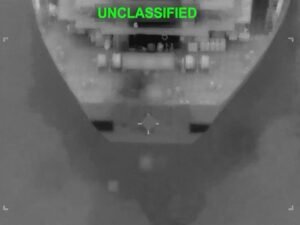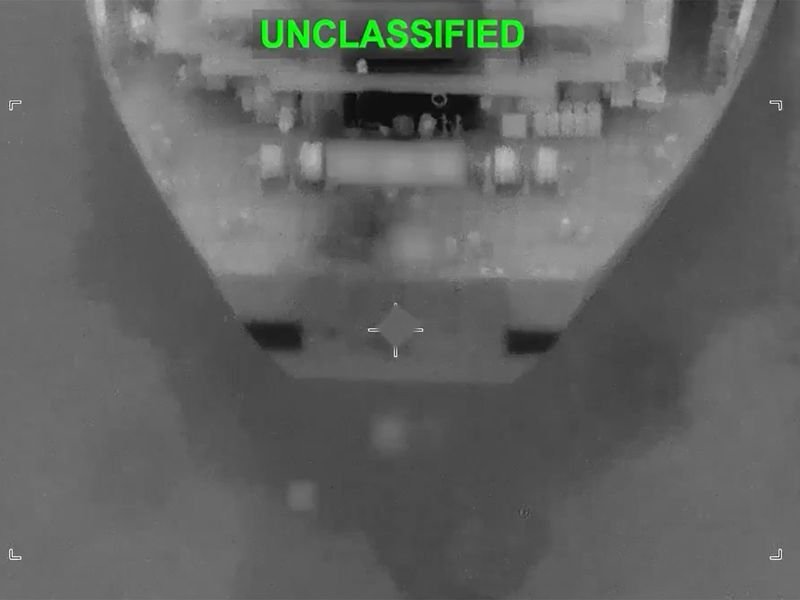

Tampa (Florida) [US], November 28 (ANI): US Central Command (CENTCOM) said it disabled a Palau-flagged commercial vessel in the Gulf of Oman after its crew allegedly attempted to breach the US naval blockade despite multiple warnings, amid escalating tensions between Washington and Tehran over maritime access and the Strait of Hormuz.In a post on X on Friday (local time), CENTCOM said the incident occurred on November 26, after the bulk carrier M/V Pacific Archer departed Bandar Abbas, Iran.https://x.com/CENTCOM/status/2126359352869065046“CENTCOM disabled a commercial vessel in the Gulf of Oman, Nov. 26, after the crew attempted to run the U.S. naval blockade, despite multiple warnings, following departure from Bandar Abbas,” the US military command said.According to the official press release, a US military aircraft launched precision munitions that struck the stern of the vessel, disabling its propulsion system.“A U.S. military aircraft launched precision munitions that struck the stern of Palau-flagged M/V Pacific Archer. The ship’s propulsion was ultimately disabled, and the civilian crew was unharmed,” CENTCOM said.The command added that US forces had redirected 158 compliant commercial vessels and disabled six that refused to comply with the blockade. It also urged mariners operating in the Gulf of Oman and approaches to the Strait of Hormuz to heed its warnings.The incident comes amid heightened military posturing from Tehran. As per Al Jazeera, earlier this week, Iran displayed upgraded missile systems at an underground military facility.Meanwhile, Iran’s state broadcaster IRIB, citing the IRGC Navy’s public relations department, claimed that an oil tanker struck a naval mine and exploded north of Ghanam Island in the Strait of Hormuz.The IRGC Navy said two tankers had attempted to secretly pass through an unauthorised route north of the island. One reportedly hit a mine and exploded, while the other was forced to return.The naval force claimed that attempts by oil tankers to use unauthorised passage through the Strait of Hormuz had declined significantly, which it said demonstrated its authority over the waterway.Meanwhile, Iranian parliamentarian Esmaeil Kowsari has also warned that Tehran would break the US blockade through the capabilities of its armed forces. Speaking on Iran’s state broadcaster IRIB, Kowsari, a member of the National Security and Foreign Policy Commission, said the military had been preparing to secure control over the Strait of Hormuz since 1987.“The US naval blockade will be broken by the strategies and capabilities of Iran’s armed forces, and the timing and method of responding to enemy actions are at the discretion of the armed forces of the Islamic Republic of Iran,” Kowsari said.He warned neighbouring countries against allowing their territory or military infrastructure to be used in operations against Iran, saying they would be responsible for the consequences.The confrontation unfolds as US President Donald Trump, on Thursday (local time), said Washington has “victory at hand” in the conflict with Iran, while offering Tehran an opportunity to reach a deal.During a Thanksgiving call with US military personnel from his Mar-a-Lago residence in Florida, Trump said, “We have victory at hand [in Iran]. It will happen whenever I want it to happen. We are trying to be nice. We are giving them every chance to make a deal and save a lot of lives, but I am not sure if they are going to take advantage of that.”Iranian Foreign Minister Seyed Abbas Araghchi on Thursday said Tehran’s priority was strengthening national resilience against external pressure while ensuring the uninterrupted movement of trade and essential supplies.He said Qatar and Pakistan were continuing mediation efforts and conveying proposals between the parties, adding that diplomacy remained an option even as Iran focused on countering pressure.Araghchi also accused Israel of seeking to create conditions for renewed military confrontation and draw Washington into another conflict with Tehran. He reiterated that Iran was prepared to defend itself while keeping diplomatic channels open, provided its demands were respected. (ANI)(This content is sourced from a syndicated feed and is published as received. The Tribune assumes no responsibility or liability for its accuracy, completeness, or content.)